Those who are breastfeeding and children under 3 years in NHS Greater Glasgow and Clyde can get free vitamin D supplements.
Why is Vitamin D important?
Vitamin D is needed to support bone and muscle health. Our main source of vitamin D is sunlight. In Scotland, we only get right kind of sunlight for our bodies to make vitamin D from April to September. Our bodies may find it difficult to make vitamin D, for reasons such as, covering up, using sunscreen, how long we spend outside and cloud cover.
From October to March, we are unable to make vitamin D from sunlight and need to find another way to get vitamin D. Food options naturally containing vitamin D is limited which is why we recommend everyone should take a vitamin D supplement, especially during the winter. Vitamin D supplements are available to buy from your local pharmacy and supermarket.
National Recommendations
All those who are pregnant and breastfeeding should take a daily supplement containing 10 micrograms of vitamin D.
Breastfed babies from birth – 1 year of age should be given a daily supplement containing 8.5 – 10 micrograms of vitamin D.
Formula-fed babies should not be given a vitamin D supplement until they are having less than 500ml (about 1 pint) of infant formula a day. This is because infant formula contains added vitamin D.
All children aged 1 to 4 years old should be given a daily supplement containing 10 micrograms of vitamin D.
Vitamin D supplements can be collected at your local pharmacy by asking at the counter.
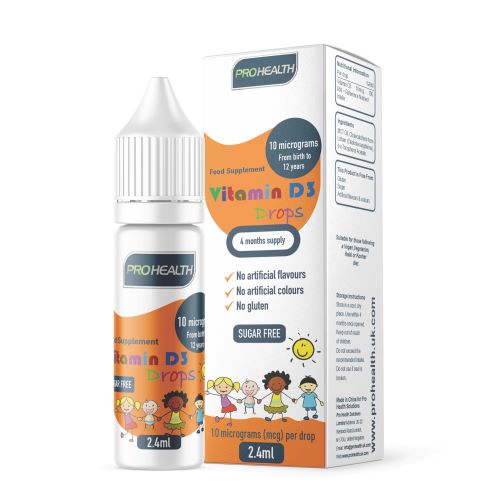
Children vitamin D drops
1 drop a day is all your baby/infant needs.
Directions for use:
1. Shake bottle before use.
2. Squeeze 1 drop onto a clean spoon or to food or drink and offer to infant or toddler.
Vitamin D tablets for those who are breastfeeding
1 bottle contains 120 tablets
Directions for use:
Take 1 tablet per day, with a meal, or as directed by a healthcare practitioner. Swallow with water or a cold drink.
How to access Vitamin D supplements
Pregnant women are provided Healthy Start vitamins containing vitamin C, vitamin D and folic acid at antenatal clinics.
Breastfeeders and breastfed babies will get vitamin D tablets (for breastfeeders) and drops (for baby) on the maternity ward before going home. This provides a 4-month supply. More can be collected for free from your local community pharmacy.
Vitamin D drops for all children under three years old are available for free your local pharmacy. Formula fed babies should not be given vitamin D supplement until they are having less than 500ml (about 1 pint) of infant formula every day. This is because infant formula contains added vitamin D.
For more information, speak to your Midwife, Health Visitor or Pharmacist.
If you are looking for more information Vitamin D and You leaflet covers the benefits of Vitamin D as part of a healthy diet.
Fun First Foods This booklet gives information on the different stages of weaning with tips, advice and recipes.
Starting Solids – this page provides lots of useful information and support on introducing solids (weaning) to your baby.
You might be entitled to Best Start Foods and Best Start Grant. Best Start food is prepaid card that you can use to buy healthy foods for children under 3 years. Best Start Grant are three cash payment; pregnancy and baby, early learning and school aged payments. Visit: www.mygov.scot/best-start-grant-best-start-foods
Equality Impact Assessments are a means of showing how NHSGGC shows ‘due regard’ to the Equality Act 2010 when writing new policies, creating new services or making changes to existing services.
This means that we work in a way that removes discrimination, promotes equality of opportunity and fosters good relations between people who have a protected characteristic and people who don’t.
Conducting EQIAs is a legal duty for NHSGGC and helps us provide services that are sensitive to inequalities and meet the needs of our diverse community.
EQIAs can make a positive difference to the experiences of people who use our services. This short film by the Scottish Government explains why.
If you’ve been asked to undertake an EQIA in your service area you need to book onto a Lead Reviewers training session before starting. Click on the button below for more information and dates.
Please note: NHSGGC’s commitment to equality impact assess services and policies pre-dates The 2010 (Specific Duties) (Scotland) Regulations 2012. As a result, some terminology used within earlier assessments may not match current legislative terminology.
Laws are now in place which are designed to protect people from unfair discrimination due to their personal characteristics. Referred to as ‘protected characteristics’, these include age, disability, gender reassignment, marriage & civil partnership, pregnancy & maternity, sex, race, religion & belief and sexual orientation.
‘A Fairer NHS Greater Glasgow & Clyde’ explains how the organisation will uphold the law by addressing inequalities. This means, for example, making sure that services are working well for everyone and that people are getting information in a way they can understand. The document also covers people’s right not to be discriminated against in the workplace. It includes the organisation’s:
A Fairer NHSGGC 2025-29 is available in other formats such as easy read, large print, British Sign Language DVD and alternative languages. Please contact us with your request.
EQIA is a vital part of NHSGGC’s overall approach to dealing with inequalities and discrimination. It means that services, policies and projects are thought about carefully in terms of their likely impact on different groups of people and on the various aspects of inequality.
The links listed on this page are NOT controlled by NHS Greater Glasgow and Clyde. We take no responsibility for the contents, reliability or availability of the websites and we may not agree with views expressed within them.
Additional classes will now be running at Stobhill Hospital.
The 6-week courses will be commencing on 22nd June. Classes offer an insight into how Deaf people communicate and cover the alphabet, how to introduce yourself, colours, numbers and role playing.
Places are limited and will be allocated on a first come, first served basis. Please speak to your line manager before applying.
It is important to commit to the 6 weeks. Please be aware that if you do not attend the first class, your place will be offered to someone else.
This short session gives participants an understanding of what hate crime is and how to report if witnessed in the workplace. It is an important safeguarding learning opportunity for all members of staff working in frontline roles. For further information on hate crime and the NHSGGC response, visit our Hate Crime page.
The following dates are available for 2026 and will take place on MS Teams. To book, simply follow the Webropol link.
Equality Impact Assessments assess all organisational activity – including policy, plans, projects, service delivery and practice – in order to identify actions to address discrimination and promote equality.
Conducting EQIAs is a legal duty for NHSGGC and helps us provide services that are sensitive to inequalities and meet the needs of our diverse community.
Our interpreting service provides a range of services and resources for patients whose first language is not English and who may need communication support in a health setting. Support is also available for patients who are Deaf, hard of hearing, blind or deafblind.
It is the responsibility of NHSGGC staff to arrange interpreting support for patients using any of our healthcare services. It is therefore vital that staff know how to access the support available.
Training includes information on: how to use telephone interpreting; accessing BSL Online interpreting; booking face to face interpreters, requesting translations and direct patient access to telephone interpreting.
Sessions are run on Microsoft Teams. To book a place, please click on the link for the relevant date and time.
New on Turas Learn – the ‘Equality and Diversity Zone’
NHS Education for Scotland is pleased to announce the launch of the Equality and Diversity Zone on Turas Learn, NHS Education for Scotland’s platform for learning and support resources.
The Equality and Diversity Zone provides information and resources to support people at all levels to develop knowledge and skills in equality, diversity and human rights.
The resources you find here will help you to make your practice, services and workplace more accessible and inclusive, supporting better experience and outcomes.
We host and curate content from NHS Education for Scotland, NHS Boards, and other key partners on a Once for Scotland basis to make these resources as accessible as possible.
In the zone you will find:
information on equality duties, human rights and related tools and topics
a range of educational resources, including eLearning modules, guides and frameworks.
Anyone who works or volunteers in or with the public sector in Scotland (including third/voluntary sector or if you work in care homes, care at home or day care) can sign up for a Turas account. Log in with your Turas account to access eLearning modules and record the eLearning on your personal learning record.
Whether you are a student, support worker, clinician, administrator, project manager or Board member, there will be something for everyone.
Log into the Zone and you will find learning and practice support for:
Augmentative and alternative communication
Making communication even better
Corporate Parenting
Dementia and equality
Deaf awareness
Equal Partners in Care: Carer Aware, Caring Together
Equality, diversity and human rights
Equality impact assessment and planning for equality
Supreme Court Ruling Update – Thursday 17th April 2025
We are currently reviewing our policies in light of the Supreme Court’s ruling on 16 April 2025 that ‘sex’ in the Equality Act 2010 refers to biological sex.
NHSGGC Transitioning in the Workplace – Guidance for Managers Nov 24 (under review)
This is a placeholder tab content. It is important to have the necessary information in the block, but at this stage, it is just a placeholder to help you visualise how the content is displayed. Feel free to edit this with your actual content.
Accordion title 2
This is a placeholder tab content. It is important to have the necessary information in the block, but at this stage, it is just a placeholder to help you visualise how the content is displayed. Feel free to edit this with your actual content.
Was this helpful?
Yes
No
Thanks for your feedback!
Was this helpful?
Thanks for your feedback!
More information will become available on this section as we move across information from our old website. Please check back soon for more additions to this page.
We use cookies to analyse traffic to our site and to enable certain functions such as forms and embedded videos. These do not collect personal information. By clicking "Accept All", you consent to our use of cookies, or you can customise the options.
This website uses cookies
Websites store cookies to enhance functionality and personalise your experience. You can manage your preferences, but blocking some cookies may impact site performance and services.
Essential cookies enable basic functions and are necessary for the proper function of the website.
Name
Description
Duration
Cookie Preferences
This cookie is used to store the user's cookie consent preferences.
30 days
CloudFlare provides web performance and security solutions, enhancing site speed and protecting against threats.
Sequence rules uses cookies to track the order of requests a user has made and the time between requests and makes them available via Cloudflare Rules. This allows you to write rules that match valid or invalid sequences. The specific cookies used to validate sequences are called sequence cookies.
session
cf_ob_info
The cf_ob_info cookie provides information on: The HTTP Status Code returned by the origin web server. The Ray ID of the original failed request. The data center serving the traffic
session
cf_chl_rc_m
These cookies are for internal use which allows Cloudflare to identify production issues on clients.
session
__cfruid
Used by the content network, Cloudflare, to identify trusted web traffic.
session
__cf_bm
Cloudflare's bot products identify and mitigate automated traffic to protect your site from bad bots. Cloudflare places the __cf_bm cookie on End User devices that access Customer sites that are protected by Bot Management or Bot Fight Mode. The __cf_bm cookie is necessary for the proper functioning of these bot solutions.
session
__cflb
When enabling session affinity with Cloudflare Load Balancer, Cloudflare sets a __cflb cookie with a unique value on the first response to the requesting client. Cloudflare routes future requests to the same origin, optimizing network resource usage. In the event of a failover, Cloudflare sets a new __cflb cookie to direct future requests to the failover pool.
session
_cfuvid
The _cfuvid cookie is only set when a site uses this option in a Rate Limiting Rule, and is only used to allow the Cloudflare WAF to distinguish individual users who share the same IP address.
session
cf_clearance
Whether a CAPTCHA or Javascript challenge has been solved.
session
cf_use_ob
The cf_use_ob cookie informs Cloudflare to fetch the requested resource from the Always Online cache on the designated port. Applicable values are: 0, 80, and 443. The cf_ob_info and cf_use_ob cookies are persistent cookies that expire after 30 seconds.
session
__cfwaitingroom
The __cfwaitingroom cookie is only used to track visitors that access a waiting room enabled host and path combination for a zone. Visitors using a browser that does not accept cookies cannot visit the host and path combination while the waiting room is active.
session
cf_chl_rc_i
These cookies are for internal use which allows Cloudflare to identify production issues on clients.
session
cf_chl_rc_ni
These cookies are for internal use which allows Cloudflare to identify production issues on clients.
session
Statistics cookies collect information anonymously. This information helps us understand how visitors use our website.
We use Microsoft Clarity to understand how users interact with our website, including information such as clicks, scrolling and navigation behaviour, to help improve our services.
Microsoft Clarity uses cookies and similar technologies. These are only set if you accept analytics cookies.
If you choose not to accept analytics cookies, Clarity will operate in a limited mode using non-cookie-based data, which does not track users across pages or visits.
The data collected is behavioural and technical in nature and does not directly identify individuals. Sensitive information such as names, email addresses and form inputs is automatically hidden and not recorded or viewed.
Some information, such as device and approximate location data will still be collected and is treated as personal data in accordance with data protection legislation.
This will not be used for any purpose other than analytics and will not be used to identify you.
We use Microsoft Clarity to understand how users interact with our website, including information such as clicks, scrolling and navigation behaviour, to help improve our services.
Microsoft Clarity uses cookies and similar technologies. These are only set if you accept analytics cookies.
If you choose not to accept analytics cookies, Clarity will operate in a limited mode using non-cookie-based data, which does not track users across pages or visits.
The data collected is behavioural and technical in nature and does not directly identify individuals. Sensitive information such as names, email addresses and form inputs is automatically hidden and not recorded or viewed.
Some information, such as device and approximate location data will still be collected and is treated as personal data in accordance with data protection legislation.
This will not be used for any purpose other than analytics and will not be used to identify you.