The WestMARC Wheelchair and Seating Service provides wheelchairs (manual and powered) and children’s buggies, with postural supports if required, to people requiring wheeled mobility that are living in the West of Scotland. Services provided include:
Clinical assessments
Provision of equipment (wheelchairs, buggies, seating systems) tailored to patient’s needs
Equipment repairs
Our team consists of administrative staff, technical staff, occupational therapists, physiotherapists, clinical scientists (bioengineers), nursing/medical staff and clinical psychology staff.
Making A Referral
New Service Users
Important Information
For anyone who has not used our service before, a referral form needs to be submitted by a healthcare professional or social worker registered with one of the following bodies:
Nursing and Midwifery Council
Health and Care Professions Council
General Medical Council
Scottish Social Work Council.
Wheelchair eligibility criteria
Please refer to the following information before making a referral.
Anyone who has used the wheelchair service before can self-refer if their conditions and/or requirements change by contacting the service directly for reassessment or advice.
Alternatively a healthcare professional can refer on their behalf by submitting a reporting form.
Please note, previously paediatrics and adults required separate reporting forms. We now have one reporting form which can be used for all service usersand devices e.g. wheelchairs, buggies and seating.
When the service receives a new referral it will be assessed by a clinician. The clinician will review the information and decide whether you require an assessment, or whether a chair can be issued from the information that has been provided. If an assessment is required, you will be added to the waiting list for a clinic appointment.
The New Paediatric Referral Form
The WestMARC Clinical Team have redeveloped the paediatric referral, please ensure you have read the guidance above before completing the new referral form. Thanks
Clinics are conducted within the centre and at many satellite locations across the West of Scotland. Your appointment letter will specify the location of your appointment.
West of Scotland Mobility and Rehabilitation Centre
Queen Elizabeth University Hospital 1345 Govan Road Glasgow G51 4TF
There is also a depot where the service’s equipment store, repair facility and technicians are located.
Drop in repairs available Monday to Friday 9.00am to 3.45pm.
The Motherwell hub is a smaller unit and we are unable to hold all parts, so please call 0300 790 0129 in advance to confirm parts are in stock to complete the repair.
WestMARC Yoker Depot
Unit 20 Halley Street New Albion Industrial Estate Yoker Glasgow G13 4DJ
WestMARC Motherwell
Unit 33 Fern Street Motherwell ML1 2AJ
Satellite clinic locations
Douglas Grant Rehabilitation Centre
Ayrshire Central Hospital Kilwinning Road Irvine KA12 8SS
Community Rehabilitation Unit 1st Floor – North Entrance Mountainhall Treatment Centre Bankend Road Dumfries DG1 4AP
Repairs
If your chair is in need of repair you should contact the service immediately. You might find Standard Wheelchair Parts helpful for explaining what part of the chair requires a repair.
Equipment is repaired free of charge by the service. Our mobile engineer repair service will usually visit and repair equipment at service users home or other suitable setting.
If a complex repair is needed than it may be necessary to bring the equipment into our workshop to carry out the work.
WestMARC Yoker depot and the WestMARC Motherwell Hub are open for drop in repairs Monday to Friday 9.00am to 3.45pm. Please see ‘Clinic Locations’ above for address details. Note, Motherwell hub is a smaller unit and we are unable to hold all parts, please call 0300 790 0129 in advance to confirm parts are in stock to complete the repair.
Equipment is loaned by the service and it is the service user’s responsibility to keep equipment in good condition.
Any accident or adverse incident that occurs with equipment provided from the service should be reported so that the service can record and followed up if necessary. This helps us to improve safety for all service users.
Please see video resources created by SMART Centre, Edinburgh on wheelchair demonstration/operation. Adult Manual Wheelchair video demonstrates transporting manual wheelchair into a vehicle.
The Motability Scheme helps you get mobile by exchanging your higher rate mobility allowance to lease a new affordable car, wheelchair accessible vehicle, scooter or powered wheelchair.
Power Chair Charging
Please see following advice on charging your electric powered wheelchair:
Please see Self Management – NHSGGC toolkit developed by NRU which educates and provides references for conditions, physical activity, getting out and about, psychological wellbeing and other helpful resources.
Hundreds of people in Scotland need the help of egg or sperm donors to give them the chance to become parents and the gift of starting a family.
The Scottish Government and NHS Scotland have launched the first national campaign of its kind to encourage people to become egg and sperm donors, with the four NHS tertiary Fertility Centres in Scotland (Aberdeen, Dundee, Edinburgh and Glasgow).
Donating your eggs or sperm is something that requires careful consideration, but if it’s right for you then you have the potential to give the joy of starting a family to those people in Scotland, who need the help of donors to become parents.
NHS inform provides information for the public about sickle cell and thalassaemia disorders. Scroll down the each programme pages for access to translated information, Easy Read, and explanatory videos.
NHS inform provides information for the public about screening programmes in Scotland. Scroll down the each programme pages for access to translated information, Easy Read, and explanatory videos.
NHS inform provides information for the public about screening programmes in Scotland. Scroll down the each programme pages for access to translated information, Easy Read, and explanatory video
NHSGGC is improving access to life-saving cancer screening: Cheryl Pollock shares her experience of cervical screening in order to help people with learning disabilities to decide. Watch the video below:
An online catalogue of materials to order or download including cancer resources, screening information and posters. When the breast screening mobile unit is in your areas, you can order posters listing the location.
Resources for national campaigns to promote screening. These can be downloaded for use in social media, newsletters, etc.
Was this helpful?
Yes
No
Thanks for your feedback!
These self-management resources are designed to help you make well-informed health decisions by providing clear, trustworthy advice and useful tools that focus on what’s important to you. They aim to boost your confidence and understanding, while giving you the knowledge and skills to manage common symptoms and conditions. This information can also support good conversations with your healthcare providers, helping you set realistic goals and ensuring your care matches your own preferences and situation.
My Health – Living Well with Long-Term Conditions Service
What we do
‘My Health – Living Well with Long-Term Conditions Service’ helps you to manage your health and symptoms. Support will be offered in different ways, depending on what you need. We are an Allied Health Professional (AHP) led service, consisting of Occupational Therapists, Physiotherapists and Healthcare Support Workers.
If you have a diagnosis of COPD and would like more support, please contact and discuss with your GP/Doctor about onward referral to specialist respiratory care.
Quit Your Way
Are you looking to stop smoking? Have you ever thought of stopping or tried to stop before?
Would it be helpful to understand how you can help yourself to stay active and involved in the things that are important to you?
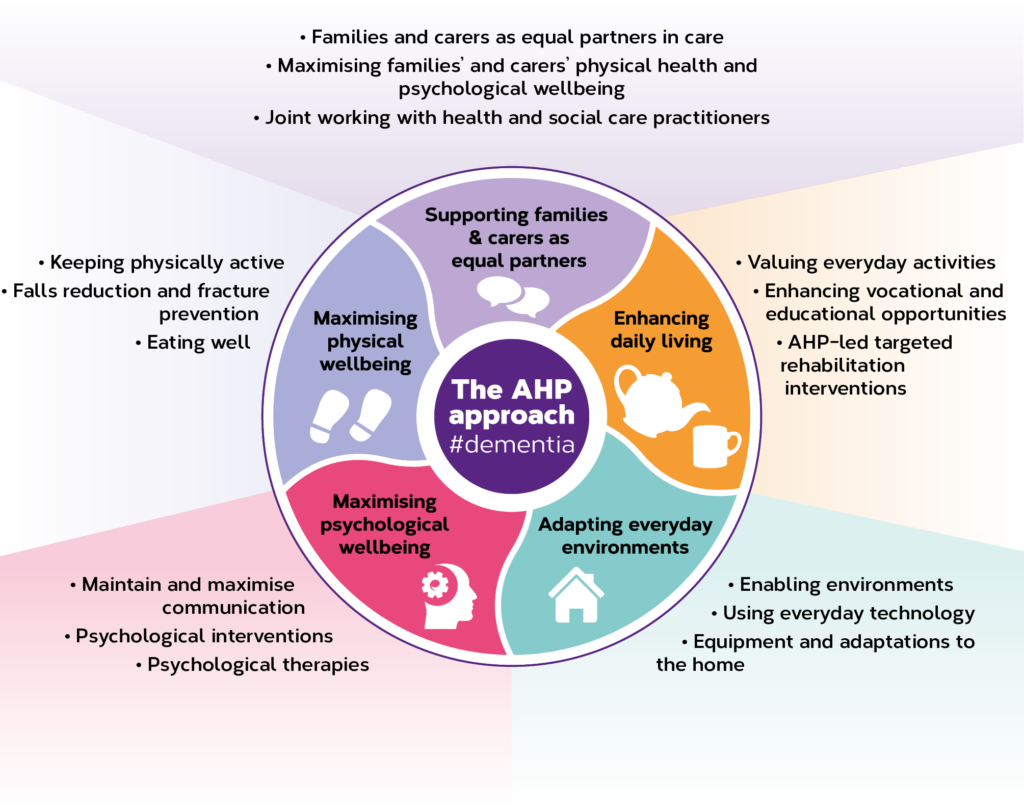
Allied Health professionals (AHPs) are experts in prevention and rehabilitation and will hep you focus on your abilities and strengths so you can stay connected to your community and live in your own home for as long as possible. There are five key areas where AHPs can make a positive difference to people living with dementia. The diagram below describes this:
There are several online tools that can provide you with a personalised report to tell you about things that you might find useful in your daily life. By answering a few questions about your needs, they can give you specific advice and allow you to create an action plan.
Many underlying causes of falls can be treated or corrected. There’s a lot you can do yourself, or with your family or carer, to reduce your risk of falls.
Always speak to your GP, physiotherapist or occupational therapist, if you have had two or more falls in the last year – even if you are unhurt. If you have had two or more falls you may be at risk of falling again if you don’t take steps to reduce your risk of falls.
If you do feel dizzy or lightheaded for whatever reason, if you have ever experienced a blackout or lost consciousness or if you had palpitations before your fall, it is important that you speak to your GP. It may be something simple which can easily be addressed.
Speak to your GP, physiotherapist or occupational therapist who can support you with the right next steps.
Joint injury, muscle weakness or pain – musculoskeletal (MSK) conditions
MSK physiotherapy information
Would it be helpful to understand how you can help yourself with a pain or weakness from an injury or general joint, muscle, spinal pain?
We know that many musculoskeletal (MSK) conditions benefit from good self-care and self-management. The best way of managing to look after your physical body is a combination of movement, exercise and self-care guidance.
Already diagnosed with Prediabetes or Type 2 Diabetes? Learn how you can help yourself to manage your symptoms
Changes to your lifestyle, including managing your weight, stopping smoking or getting more active could significantly reduce the chances of developing type 2 diabetes or worsening of the condition if you’ve already got type 2 diabetes.
Watch the following videos to find out more about prediabetes and what type 2 diabetes is.
Control It Plus Programme
If you already have type 2 diabetes, we want to support you to self-manage your condition as best you can. Our main service to help you do this is our diabetes lifestyle programme, Control IT Plus.
The programme is delivered by a team of Diabetes Nurses, Dietitians and Podiatrists. See the information leaflet below on what our programme covers.
For further information on making lifestyle changes, accessing available support, or registering for Control It Plus, please visit our Type 2 Diabetes Hub:
Would it be helpful to understand what changes you could make that may help you live well despite the pain that you experience?
We know that chronic pain is a condition that may not be cured or fixed and affects over one third of adults in the UK. It can affect what you are able to do and how you feel.
Understanding long-term management strategies is key. These strategies could include:
Understanding more about pain and why it has stayed
Managing your activities
Understanding more about chronic pain and your mental health
If you would like to access the NHSGGC Chronic Pain Service for more support, please ask:
Your GP/Doctor to refer you if you live in Greater Glasgow and Clyde Health Board area
You can be referred by another NHS Service
Helping you live well with pain Information video
Long COVID
Advice to manage your symptoms
Would it be helpful to understand how you can help yourself with fatigue, sleep issues, breathlessness and your mental wellbeing?
We know that some Long COVID symptoms can benefit from good self-care and self-management.
A good way of self-managing some of your Long COVID symptoms can be looking at ways to make your body systems work more efficiently, balancing energy and activity and taking a holistic approach.
Looking after your Long COVID can start with:
Improving your sleep
Balancing your energy through rest and adapted activity (please see fatigue section) and your nutritional intake
Consider your mood and emotional well-being
Improving the efficiency of your breathing
More information about self-care and self-management for Long COVID
How to access the NHS Greater Glasgow and Clyde Long COVID Service:
GP – you can ask your GP or Doctor to refer you if you live in Greater Glasgow and Clyde Health Board area.
Hospital or Clinic – You may be referred by another NHS Service (Including Allied Health Professionals – Occupational Therapists, Physiotherapists, Speech and Language Therapists etc.)
Fatigue
More than tiredness
Are you looking for help managing your fatigue?
Fatigue is more than tiredness – it’s persistent and not relieved by rest. With a fatigue condition, you may also experience Post-Exertional Malaise (PEM) – a worsening of symptoms after even minor activity, stress, or infection. Symptoms can be delayed, and recovery may take days or longer.
Key strategies to manage these issues
Understand your fatigue and its impact.
Balance activity with rest
Identify and avoid PEM triggers.
Avoid boom and bust cycles- periods of increased energy (booms) followed by periods of fatigue (busts)
Improve your sleep
Reduce your stress levels
Try gentle movement
To improve your understanding and management of fatigue please explore:
Complete an activity diary to assess for triggers (post exertional malaise), unhelpful energy patterns (boom and bust) and your routines – Energy and symptom diary – NHSGGC
Consider your mood and how this affects your sleep patterns.
Would it be helpful to know how to improve any incontinence issues?
Learning how to use your pelvic floor muscles properly can help with your incontinence problems. Making appropriate changes to your lifestyle can help improve your quality of life. This may include:
Decreasing bladder and bowel leakage
Improving discomfort caused by pelvic floor prolapse
Giving you more control over your bladder and bowel
Would it be helpful to learn how to move and eat well during your pregnancy?
Aches and pains are quite common during pregnancy, especially in the lower back, pelvis, and hips. Keeping active, maintaining good posture, and exercising can make you feel more comfortable.
Eating nutritious foods and getting the right nutrients both during pregnancy and after childbirth supports the health of both you and your baby.
How to manage your exercise, movement and your diet during pregnancy videos
Moving well during and after pregnancy
It is recommended that all pregnant women do up to 150 minutes of moderate exercise a week. Doing the exercises in the following videos are a great way to stay active and help manage pregnancy related discomfort.
Having strong pelvic floors muscles is important during pregnancy, and are demonstrated in the video below
Here are some more resources to help you during your pregnancy
Found some advice but not sure where to start, or how to stick to it?
Whether you’re getting ready for appointments or managing your condition on your own just now, making some changes that help us manage our condition and feel our best can be important.
You may have read something in these pages which you would like to try.
Setting a small, realistic goal (even a tiny one!) and making a simple plan for how you’ll do it can make it easier to get started and stay motivated.
It can also help to think about what might get in the way and come up with a few ideas for how you could deal with those challenges.
These services are shared care with neurology consultants and neuro-ophthalmology consultants
Royal College for Sick Children Hospital
Paediatric clinics – New patients Orthoptic and Optometrist joint clinic
North Glasgow Hospitals
Stobhill Hospital
Adult services
General orthoptics
Adult motility
Orthoptic stroke assessments
Acute Referral clinic (eye casualty)
Paediatric services
Paediatric ophthalmology
General orthoptics
Visual stress screening
Shared care orthoptic/optometry
Pre-school vision screening
Glasgow Royal infirmary
Adult services
General Orthoptics
Orthoptic Stroke assessments
Paediatric services
General Orthoptics
Visual stress screening
Shared care orthoptic/optometry
Clyde Hospitals
Royal Alexandra Hospital
Adult services
General Orthoptics
Adult motility
Orthoptic stroke assessments
Acute Referral Centre (eye casualty)
Paediatric services
Paediatric ophthalmology
General Orthoptics
Visual stress screening
Shared care orthoptic/optometry clinic
Pre-school vision screening
Inverclyde Royal Hospital
Adult Services
General Orthoptics
Orthoptic Stroke Clinic
Acute Referral Centre (eye casualty)
Paediatric service
General Orthoptics
Visual stress screening
Shared care orthoptic/optometry
Pre-school vision screening
Vale of Leven
General Orthoptics Adult & Paediatric clinics
Royal College for Sick Children Hospital
Royal College for Sick Children Hospital
Paediatric Orthoptics
Paediatric Ophthalmology
Shared care orthoptic/optometry clinic
Imaging services
Pre-school Visual screening
See4School is a national screening program that tests for visual defects in children during their pre-school year. Pre-school vision screening | NHS inform is carried out by a qualified Orthoptists or support workers specifically trained by orthoptists to detect reduced vision or binocular vision problems.
This is usually carried out at the child’s nursey. If your child has been referred for further assessment they will be seen by an orthoptist and optometrist.
Was this helpful?
Yes
No
Thanks for your feedback!
Cookie Consent
We use cookies to analyse traffic to our site and to enable certain functions such as forms and embedded videos. These do not collect personal information. By clicking "Accept All", you consent to our use of cookies, or you can customise the options.
This website uses cookies
Websites store cookies to enhance functionality and personalise your experience. You can manage your preferences, but blocking some cookies may impact site performance and services.
Essential cookies enable basic functions and are necessary for the proper function of the website.
Name
Description
Duration
Cookie Preferences
This cookie is used to store the user's cookie consent preferences.
30 days
CloudFlare provides web performance and security solutions, enhancing site speed and protecting against threats.
Sequence rules uses cookies to track the order of requests a user has made and the time between requests and makes them available via Cloudflare Rules. This allows you to write rules that match valid or invalid sequences. The specific cookies used to validate sequences are called sequence cookies.
session
cf_ob_info
The cf_ob_info cookie provides information on: The HTTP Status Code returned by the origin web server. The Ray ID of the original failed request. The data center serving the traffic
session
cf_chl_rc_m
These cookies are for internal use which allows Cloudflare to identify production issues on clients.
session
__cfruid
Used by the content network, Cloudflare, to identify trusted web traffic.
session
__cf_bm
Cloudflare's bot products identify and mitigate automated traffic to protect your site from bad bots. Cloudflare places the __cf_bm cookie on End User devices that access Customer sites that are protected by Bot Management or Bot Fight Mode. The __cf_bm cookie is necessary for the proper functioning of these bot solutions.
session
__cflb
When enabling session affinity with Cloudflare Load Balancer, Cloudflare sets a __cflb cookie with a unique value on the first response to the requesting client. Cloudflare routes future requests to the same origin, optimizing network resource usage. In the event of a failover, Cloudflare sets a new __cflb cookie to direct future requests to the failover pool.
session
_cfuvid
The _cfuvid cookie is only set when a site uses this option in a Rate Limiting Rule, and is only used to allow the Cloudflare WAF to distinguish individual users who share the same IP address.
session
cf_clearance
Whether a CAPTCHA or Javascript challenge has been solved.
session
cf_use_ob
The cf_use_ob cookie informs Cloudflare to fetch the requested resource from the Always Online cache on the designated port. Applicable values are: 0, 80, and 443. The cf_ob_info and cf_use_ob cookies are persistent cookies that expire after 30 seconds.
session
__cfwaitingroom
The __cfwaitingroom cookie is only used to track visitors that access a waiting room enabled host and path combination for a zone. Visitors using a browser that does not accept cookies cannot visit the host and path combination while the waiting room is active.
session
cf_chl_rc_i
These cookies are for internal use which allows Cloudflare to identify production issues on clients.
session
cf_chl_rc_ni
These cookies are for internal use which allows Cloudflare to identify production issues on clients.
session
Statistics cookies collect information anonymously. This information helps us understand how visitors use our website.
We use Microsoft Clarity to understand how users interact with our website, including information such as clicks, scrolling and navigation behaviour, to help improve our services.
Microsoft Clarity uses cookies and similar technologies. These are only set if you accept analytics cookies.
If you choose not to accept analytics cookies, Clarity will operate in a limited mode using non-cookie-based data, which does not track users across pages or visits.
The data collected is behavioural and technical in nature and does not directly identify individuals. Sensitive information such as names, email addresses and form inputs is automatically hidden and not recorded or viewed.
Some information, such as device and approximate location data will still be collected and is treated as personal data in accordance with data protection legislation.
This will not be used for any purpose other than analytics and will not be used to identify you.