
These self-management resources are designed to help you make well-informed health decisions by providing clear, trustworthy advice and useful tools that focus on what’s important to you. They aim to boost your confidence and understanding, while giving you the knowledge and skills to manage common symptoms and conditions. This information can also support good conversations with your healthcare providers, helping you set realistic goals and ensuring your care matches your own preferences and situation.
Self-Management Resources
COPD and difficulty with your breathing
Live better with Chronic Obstructive Pulmonary Disease (COPD)
Using self-management strategies when you have COPD can help you with your quality of life. These can include:
- Help with your understanding of COPD
- Improving your breathlessness
- Reducing your anxiety
- Improving your ability to move and exercise
- Provide tips to help with activities of daily living
Some useful resources to support you
Watch the following videos to learn more about COPD
Further reading
Local Support and Contact Details
- Glasgow Asthma + Lung UK Singing for Lung Health
- Singing for Lung Health Glasgow (Platform Singers)
- Movement Matters – Chest, Heart and Stroke Scotland
If you need additional support
If you have a diagnosis of COPD and would like more support, please contact and discuss with your GP/Doctor about onward referral to specialist respiratory care.
Quit Your Way
Are you looking to stop smoking? Have you ever thought of stopping or tried to stop before?
To find out more about what our services can offer call Quit Your Way on 0800 916 8858 or find a Stop Smoking Service in your area via Scotland’s Service Directory on NHS Inform.
Dementia
Staying active and involved
Would it be helpful to understand how you can help yourself to stay active and involved in the things that are important to you?
Allied Health professionals (AHPs) are experts in prevention and rehabilitation and will hep you focus on your abilities and strengths so you can stay connected to your community and live in your own home for as long as possible. There are five key areas where AHPs can make a positive difference to people living with dementia. The diagram below describes this:
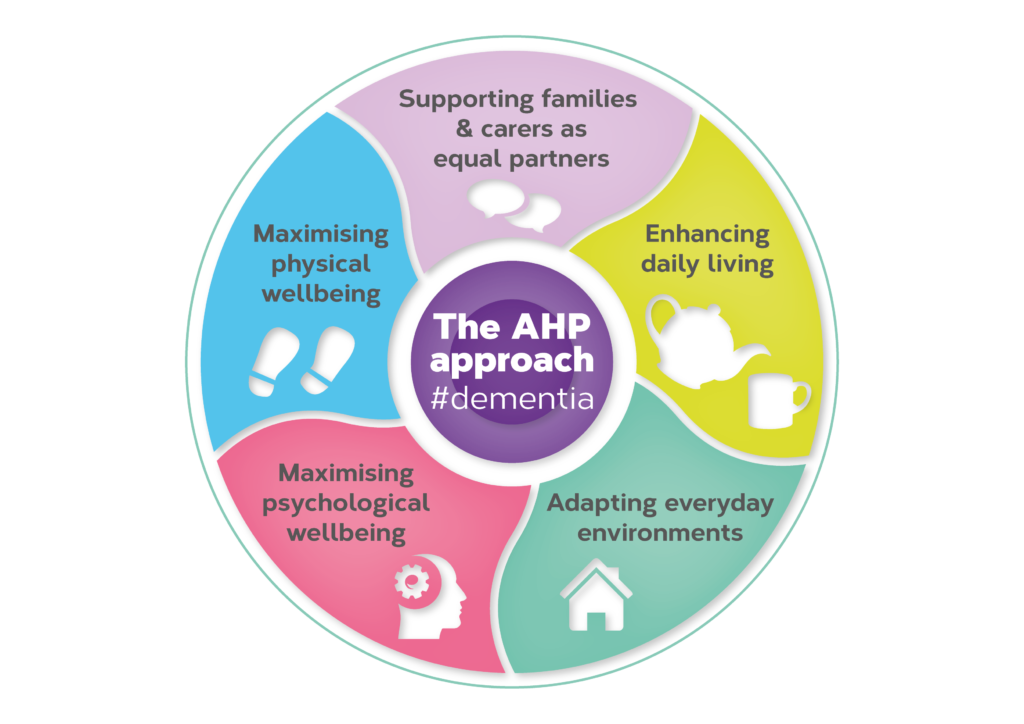
The AHP Approach
- Maximising physical activity
- Supporting families and carers as equal partners
- Enhancing daily living
- Adapting everyday environments
- Maximising psychological wellbeing
Further information
Activities and exercise advice
What’s next?
If you need additional support, there are several ways you can access the NHS Greater Glasgow and Clyde AHP Services
- GP – you can ask your GP or Doctor to refer you if you live in Greater Glasgow and Clyde Health Board area.
- Hospital or Clinic – You may be referred by another NHS Service
Osteoarthritis
Managing Osteoarthritis (OA)
We know that OA is a common joint condition which can be managed well with self-care and self-management
Would it be helpful to understand how you can help yourself if you are experiencing pain, stiffness, joint swelling, bony changes or muscle weakness?
The best way of managing to look after your physical body is a combination of movement, exercise and self-care guidance
Looking after your physical health can:
- Improve your overall movement and strength
- Improve your day-to-day function and activities
- Improve your mood and emotional well-being
- Improve aches and pains
Further Information
Please take a look at the following clip which tells you a bit more about osteoarthritis and what to expect:
Things you can do to help yourself
What’s next?
For more advice and support visit What is MSK Physiotherapy? – NHSGGC
To access NHSGGC Musculoskeletal Physiotherapy services please find more information here on How to access the Physiotherapy Service.
Falls and Balance
Helping with falls and balance
Are you having falls or concerned about your balance?
- Are you happy with how you get out and about?
- Do you think you can improve your walking?
- Do you feel that you are less steady on your feet?
- Are you concerned about falling?
- Have you had a fall?
If you have had a fall there are ways you can help yourself to try and reduce the risk of you falling again. Falls happen for many reasons.
By identifying those reasons, actions can be put in place to help reduce the risk of another fall:
- Improve your mobility
- Improve your strength and balance
- Simple adjustments to your house/equipment which may help to improve/maintain your independence
Watch the following videos to learn more about how your abilities can change as you age
Find out more about simple steps you can take to improve your balance and prevent falls:
Information about things you can do to help yourself
If you are interested in becoming more active or improving your strength and balance, there are several resources to assist you with this.
Self-assessment and action plan
There are several online tools that can provide you with a personalised report to tell you about things that you might find useful in your daily life. By answering a few questions about your needs, they can give you specific advice and allow you to create an action plan.
What’s next?
Many underlying causes of falls can be treated or corrected. There’s a lot you can do yourself, or with your family or carer, to reduce your risk of falls.
Always speak to your GP, physiotherapist or occupational therapist, if you have had two or more falls in the last year – even if you are unhurt. If you have had two or more falls you may be at risk of falling again if you don’t take steps to reduce your risk of falls.
If you do feel dizzy or lightheaded for whatever reason, if you have ever experienced a blackout or lost consciousness or if you had palpitations before your fall, it is important that you speak to your GP. It may be something simple which can easily be addressed.
Speak to your GP, physiotherapist or occupational therapist who can support you with the right next steps.
Joint injury, muscle weakness or pain – musculoskeletal (MSK) conditions
MSK physiotherapy information
Would it be helpful to understand how you can help yourself with a pain or weakness from an injury or general joint, muscle, spinal pain?
We know that many musculoskeletal (MSK) conditions benefit from good self-care and self-management. The best way of managing to look after your physical body is a combination of movement, exercise and self-care guidance.
Looking after your physical health can:
- Improve your overall movement and strength
- Improve your day to day function and activities
- Improve your mood and emotional well-being
- Improve aches and pains
Some further resources to help you manage your condition
- Let’s get moving first steps
- Let’s-Keep-Moving-Next-Steps
- How to stay motivated to keep active | NHS inform
- Soft tissue injury | NHS inform
- Pain and injuries after exercise | NHS inform
- Exercise – NHS
There are several ways you can access our service:
- GP- you can ask your GP/Doctor to refer you if you live in Greater Glasgow and Clyde Health Board area.
- Hospital/Clinic- You may be referred by another NHS Service
- Yourself- If you live within the Greater Glasgow and Clyde area, you can refer yourself directly
- MSK Physiotherapy Self-referral form – NHSGGC
- Printable Self-Referral Form – (paper copies are available from your local physiotherapy department or GP surgery). Please deliver or post your completed form to your Local Physiotherapy Department.
Type 2 Diabetes
Dietetic information and advice
Worried that you may be at risk of Type 2 Diabetes or have pre-diabetes?
Factors that can increase your risk of developing type 2 diabetes include your age, weight, ethnicity and family history.
Use Diabetes UK’s ‘Know Your Risk’ tool, to check your risk of type 2 diabetes in just a few minutes. All you need are scales and a tape measure.
Already diagnosed with Prediabetes or Type 2 Diabetes? Learn how you can help yourself to manage your symptoms
Changes to your lifestyle, including managing your weight, stopping smoking or getting more active could significantly reduce the chances of developing type 2 diabetes or worsening of the condition if you’ve already got type 2 diabetes.
Watch the following videos to find out more about prediabetes and what type 2 diabetes is.
Control It Plus Programme
If you already have type 2 diabetes, we want to support you to self-manage your condition as best you can. Our main service to help you do this is our diabetes lifestyle programme, Control IT Plus.
The programme is delivered by a team of Diabetes Nurses, Dietitians and Podiatrists. See the information leaflet below on what our programme covers.
Type 2 Diabetes Hub
For further information on making lifestyle changes, accessing available support, or registering for Control It Plus, please visit our Type 2 Diabetes Hub:
Contact the Type 2 Diabetes Hub
- Opening Hours: Monday to Thursday, from 8.00am to 4.00pm and Friday 8.00am to 3.30pm
- Email: ggc.type2diabeteshub@nhs.scot
- Call: 0141 531 8901
Managing pain
Living well with pain
Would it be helpful to understand what changes you could make that may help you live well despite the pain that you experience?
We know that chronic pain is a condition that may not be cured or fixed and affects over one third of adults in the UK. It can affect what you are able to do and how you feel.
Understanding long-term management strategies is key. These strategies could include:
- Understanding more about pain and why it has stayed
- Managing your activities
- Understanding more about chronic pain and your mental health
- Managing your sleep
- Managing your medication
Videos which show more about Chronic Pain
Sources of support
If you need additional support
If you would like to access the NHSGGC Chronic Pain Service for more support, please ask:
- Your GP/Doctor to refer you if you live in Greater Glasgow and Clyde Health Board area
- You can be referred by another NHS Service
Helping you live well with pain Information video
Long COVID
Advice to manage your symptoms
Would it be helpful to understand how you can help yourself with fatigue, sleep issues, breathlessness and your mental wellbeing?
We know that some Long COVID symptoms can benefit from good self-care and self-management.
A good way of self-managing some of your Long COVID symptoms can be looking at ways to make your body systems work more efficiently, balancing energy and activity and taking a holistic approach.
Looking after your Long COVID can start with:
- Improving your sleep
- Balancing your energy through rest and adapted activity (please see fatigue section) and your nutritional intake
- Consider your mood and emotional well-being
- Improving the efficiency of your breathing
More information about self-care and self-management for Long COVID
Lived experiences of Long COVID video
Apps that can help you manage anxiety and improve your sleep
Further Resources
Good Breathing Video
What’s next?
How to access the NHS Greater Glasgow and Clyde Long COVID Service:
- GP – you can ask your GP or Doctor to refer you if you live in Greater Glasgow and Clyde Health Board area.
- Hospital or Clinic – You may be referred by another NHS Service (Including Allied Health Professionals – Occupational Therapists, Physiotherapists, Speech and Language Therapists etc.)
Fatigue
More than tiredness
Are you looking for help managing your fatigue?
Fatigue is more than tiredness – it’s persistent and not relieved by rest. With a fatigue condition, you may also experience Post-Exertional Malaise (PEM) – a worsening of symptoms after even minor activity, stress, or infection. Symptoms can be delayed, and recovery may take days or longer.
Key strategies to manage these issues
- Understand your fatigue and its impact.
- Balance activity with rest
- Identify and avoid PEM triggers.
- Avoid boom and bust cycles- periods of increased energy (booms) followed by periods of fatigue (busts)
- Improve your sleep
- Reduce your stress levels
- Try gentle movement
To improve your understanding and management of fatigue please explore:
Consider trying the additional advice below:
- Complete an activity diary to assess for triggers (post exertional malaise), unhelpful energy patterns (boom and bust) and your routines – Energy and symptom diary – NHSGGC
- Consider your mood and how this affects your sleep patterns.
- Introduce gentle movements, like mindful movement or tai chi (start at a level you feel comfortable). E.g- Tai Chi – Friends of NHS Centre for Integrative Care
More information and other Resources
- Onboarding Sleep Test – Sleepio
- Self-help tips to fight tiredness
- Here are the 7 types of rest that can help you to feel fully renewed — Calm Blog
- Fatigue – Chest Heart & Stroke Scotland
- The Sleep Charity
- Audio Practices – Mindfulness Scotland
Maintaining a healthy weight if you are currently overweight
Overweight
Would you like support to work towards a healthier weight?
Some of the benefits of achieving a healthier weight can include:
- Improved overall physical health and reduced risk of conditions such as diabetes, heart disease, stroke, and some cancers
- Improved mental wellbeing and quality of life
- Better sleep and increased energy levels
- Improved mobility and joint health
Eatwell Guide Video
Further Weight Loss Information
What’s next?
If you would like weight management support in your area please visit Manage your weight – NHSGGC
Maintaining a healthy weight if you are currently underweight
Underweight
Are you malnourished? Would it be helpful to understand how you can help yourself to gain some weight?
People who are malnourished are at risk from:
- Low mood
- Reduced energy levels
- Reduced muscle strength
- Reduced quality of life
- Difficulty with carrying out daily activities
- Increased risk of illness and infection
- Slower wound healing
- Increased risk of falls
The easiest way to gain some weight is using food fortification techniques, this means adding calories and protein to your diet.
To understand if you are at risk, you can use the online tool below.
Further information about malnutrition
What’s next?
There are several ways you can access our dietetics service:
- GP – you can ask your GP or Doctor to refer you if you live in Greater Glasgow and Clyde Health Board area.
- Hospital or Clinic – You may be referred by another NHS Service
- Visit the NHSGGC Dietetics service web pages for more information.
Incontinence
Advice and information
Would it be helpful to know how to improve any incontinence issues?
Learning how to use your pelvic floor muscles properly can help with your incontinence problems. Making appropriate changes to your lifestyle can help improve your quality of life. This may include:
- Decreasing bladder and bowel leakage
- Improving discomfort caused by pelvic floor prolapse
- Giving you more control over your bladder and bowel
Resources to help you
Watch the following videos to learn the correct technique for strengthening your pelvic floor muscles, and learning how not to strain on the toilet:
Guides and things you can do
- Pelvic Organ Prolapse: – a guide for women
- The Pelvic Floor Muscles – a guide for women
- Pelvic Floor Muscle Exercises and Advice for Men
If you need additional support, you can be referred into the Pelvic Floor Physiotherapy service through:
- Your GP or hospital doctor
- Other Healthcare services, such as Nurse and Physiotherapy Specialists
- For further information on pelvic floor issues and how to self-manage them visit the Pelvic Floor Physiotherapy webpages.
Pregnancy – how to look after yourself
Advice and information
Would it be helpful to learn how to move and eat well during your pregnancy?
Aches and pains are quite common during pregnancy, especially in the lower back, pelvis, and hips. Keeping active, maintaining good posture, and exercising can make you feel more comfortable.
Eating nutritious foods and getting the right nutrients both during pregnancy and after childbirth supports the health of both you and your baby.
How to manage your exercise, movement and your diet during pregnancy videos
Moving well during and after pregnancy
It is recommended that all pregnant women do up to 150 minutes of moderate exercise a week. Doing the exercises in the following videos are a great way to stay active and help manage pregnancy related discomfort.
Having strong pelvic floors muscles is important during pregnancy, and are demonstrated in the video below
Here are some more resources to help you during your pregnancy
If you need any additional support, you can self-refer into the Maternity Physiotherapists at your local site by completing the on-line form.
Please contact your GP urgently or NHS24 on 111 if you have recently or suddenly developed any of the following:
- Difficulty passing urine or controlling bladder or bowel
- Numbness or tingling around your back or front passage.
Please contact Maternity Assessment Unit if you have any of the following:
- Bleeding
- A reduction in your baby’s movements
- Queen Elizabeth University Hospital Call: 01412324363
- Royal Alexandra Hospital Call: 01413146067
- Princess Royal Maternity Call: 01412013452
Putting it into Action
Found some advice but not sure where to start, or how to stick to it?
Whether you’re getting ready for appointments or managing your condition on your own just now, making some changes that help us manage our condition and feel our best can be important.
You may have read something in these pages which you would like to try.
Setting a small, realistic goal (even a tiny one!) and making a simple plan for how you’ll do it can make it easier to get started and stay motivated.
It can also help to think about what might get in the way and come up with a few ideas for how you could deal with those challenges.
Where can I find out more?
You can read more about the MAP (Motivation, Action and Prompts) approach to Health Behaviour Change, including a video which outlines the MAP approach.
You can edit and print the MAP planner to help set yourself goals and create a plan to keep you on track.