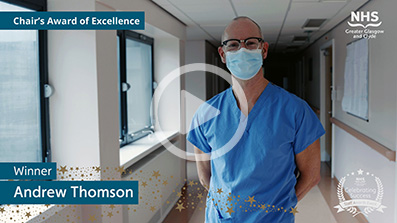
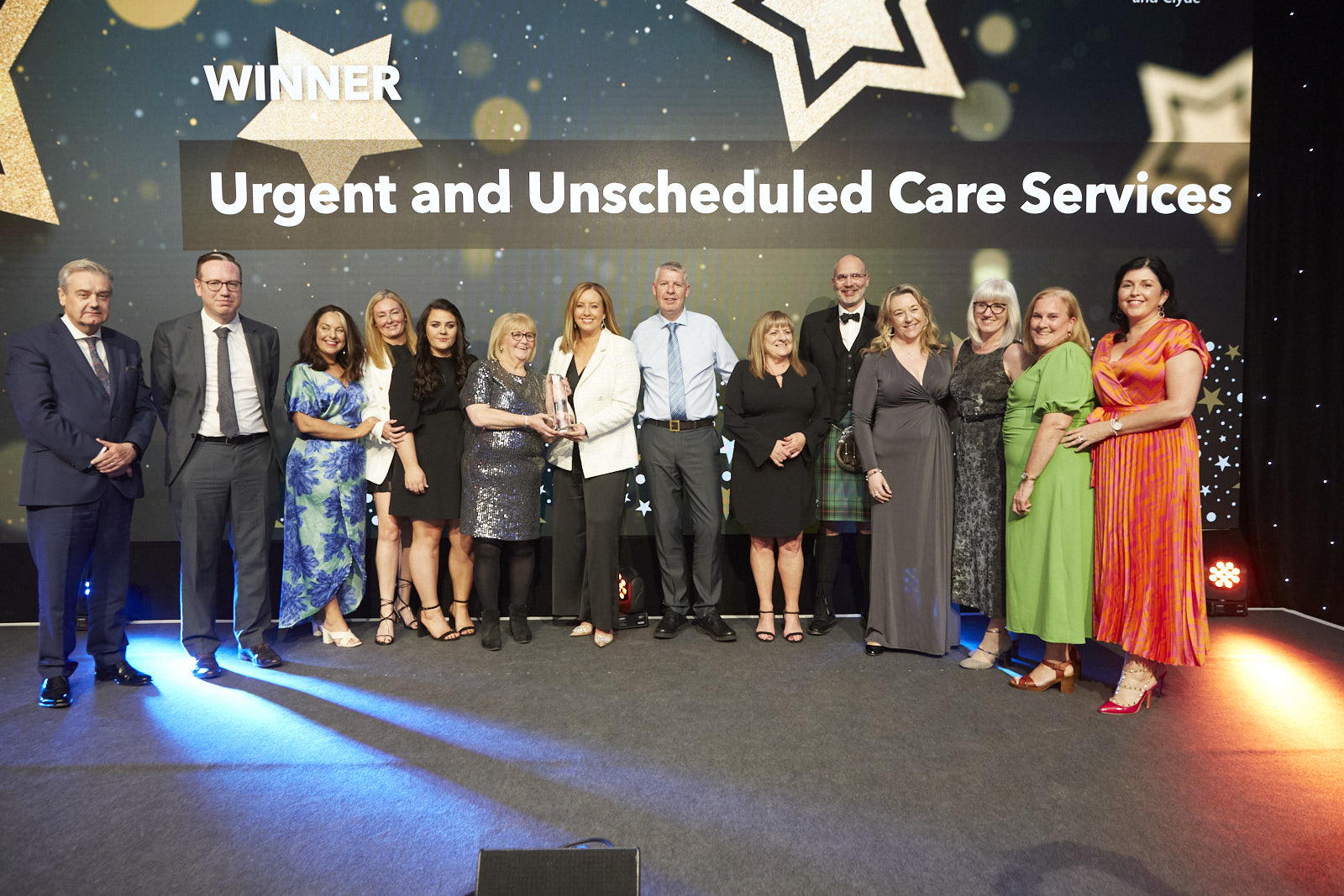
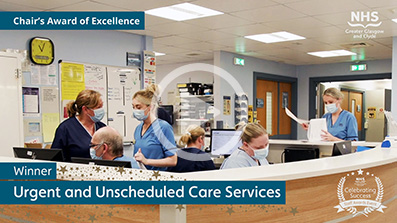
This year the Chair, Prof John Brown CBE, presented two awards which recognise outstanding achievement, expertise, and dedication in patient care. In common with all the other awards, these celebrate our people’s collective efforts and the lasting impact they have had on the lives of the people of Greater Glasgow and Clyde.
Andrew Thomson
One of Andrew’s patients was going through a high risk pregnancy, when her husband sadly passed away after a two week battle with cancer. On hearing the news, Andrew called to offer his condolences and also talk about how he and his team could support the patient during this heart breaking time.
Andrew has an incredible way of communicating with patients and their families, with empathy and intuitiveness in abundance.
Unscheduled and Urgent Care Services
Due to unprecedented pressures, our Urgent and Unscheduled Care services have adapted to new and ever-changing situations which have been nothing short of remarkable. From the launch of the Flow Navigation Centre and Mental Health Assessment Units, to the ongoing dedication, commitment and professionalism of our EDs, IAUs, Community Pharmacies, MIUs, in-hours and Out of Hours GP Services, who have worked tirelessly with the support of diagnostic services.
At the start of the pandemic, it became clear that those who became very ill with Covid need a place where they could be seen and assessed safely and away from non-Covid patients.
Our Community Assessment Centres were created. This significant project required input from all of the eHealth teams to ensure the centres had all the necessary telephony and IT kit. They also needed to be set up very quickly.
eHealth teams responded to the needs of the service, working above and beyond to introduce new processes to book in Covid patients outwith hospital settings. The staff showed immense flexibility and changed their hours of work and their roles. The success of the CACs was due to the commitment, flexibility and team working across eHealth to support the Board in its response to the pandemic.
Was this helpful?
Yes
No
Thanks for your feedback!
The William Cullen Prize for Excellence In Teaching and the William Cullen Prize for Service Innovation are awarded in collaboration with the Royal College of Physicians in Edinburgh.
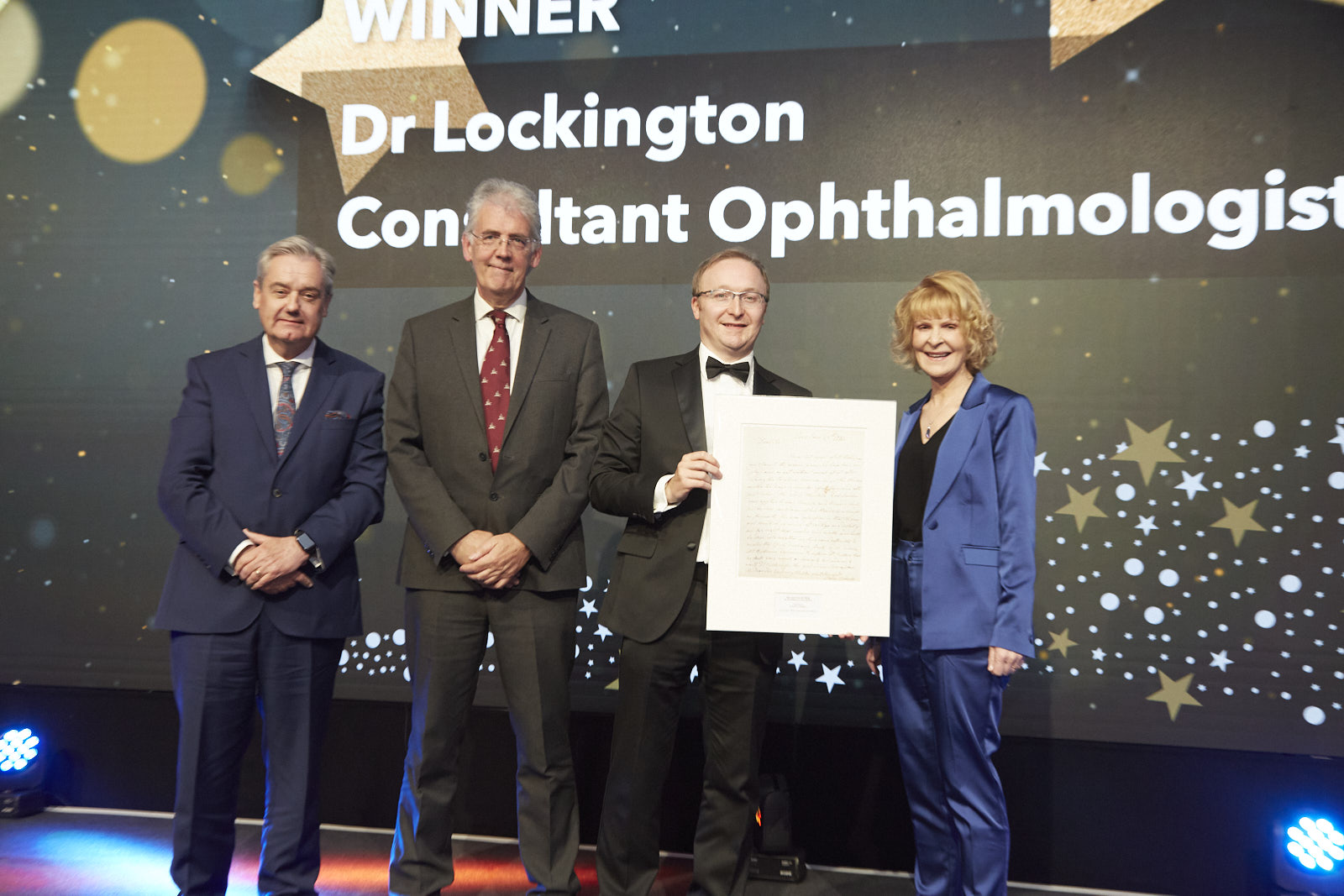
William Cullen Prize for Innovation
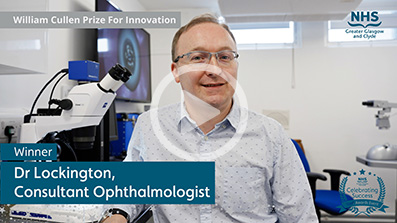
Dr David Lockington is a Consultant Ophthalmologist based in Gartnavel General Hospital.
Dr Lockington identified the opportunity to transform unused rooms within the Tennent Institute of Ophthalmology library into a state of the art teaching suite for ophthalmology training. There are now three rooms which consist of an ophthalmic simulation area, a computer room for trainees and a seminar room.
The suite allowed simulated microsurgical skills to be developed and maintained during lockdowns, and is now used regularly by trainees and the wider multidisciplinary team. This development has been extremely well received by local trainees, and has addressed previously identified surgical training gaps.
Local ophthalmology training has been enhanced significantly, and to illustrate the impact, this initiative has since been replicated in other UK centres.
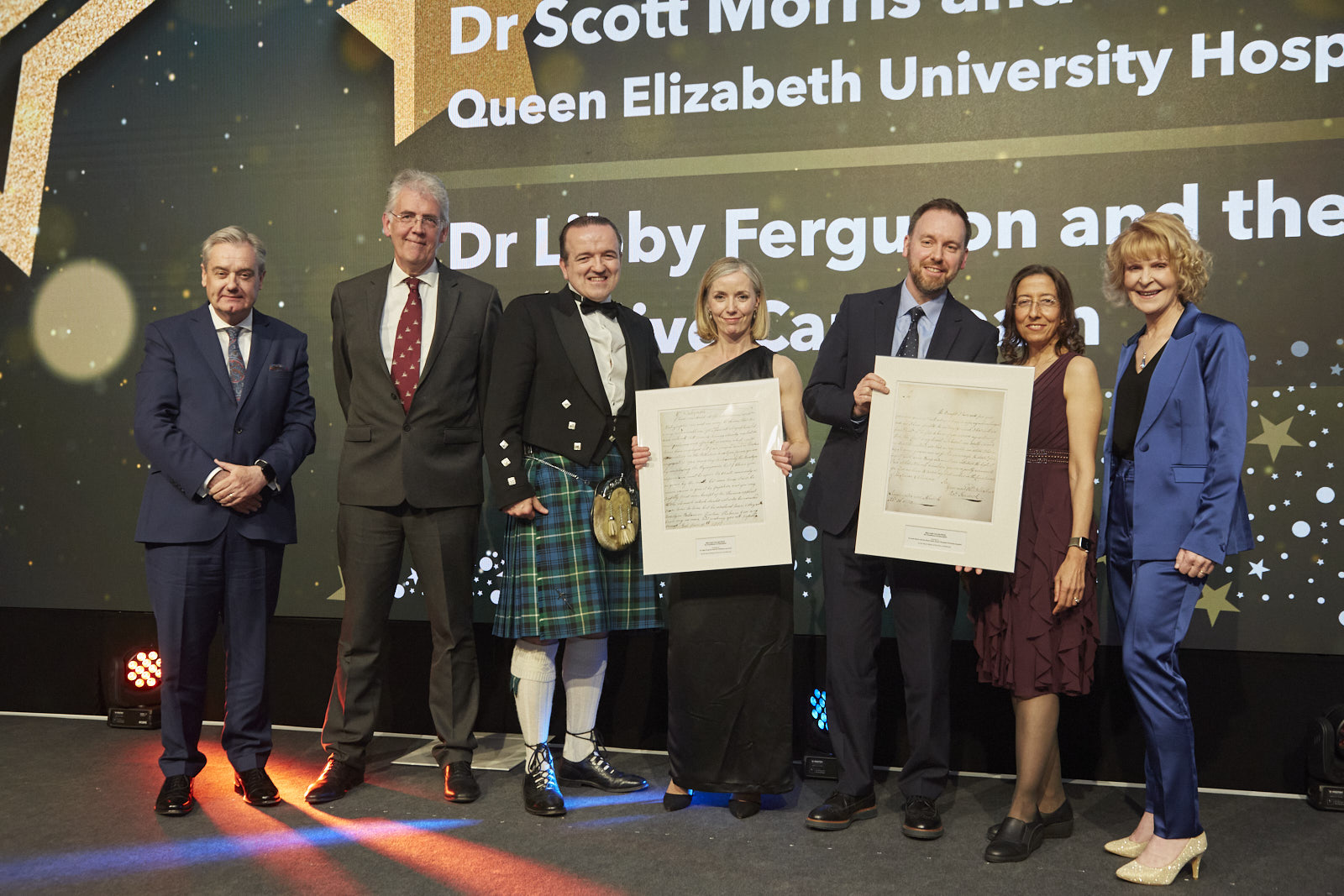
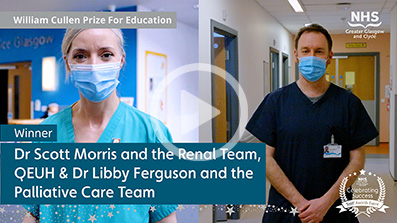
William Cullen Prize for Education – Joint Winners
Doctor Scott Morris is the Clinical Director for the Renal Unit, based in the Queen Elizabeth University Hospital, though which provides a full range of renal services to the West of Scotland.
This unit has for some time demonstrated a high standard of teaching and training, as evidenced by consistent and positive feedback from trainees. Trainees emerge as highly trained renal physicians, having been supported by a skilled group of established Consultants with a range of subspecialty interests.
The experience gained while attached to the unit is clearly valued by trainees, who highlight in particular the supervision they receive within the department, the supportive environment and the overall level of satisfaction working within a very strong team.
Dr Libby Ferguson and the Palliative care team based in the Marie Curie Hospice in Glasgow continue to provide an extremely high standard of clinical training which trainees recognise with positive responses to the Scottish trainee survey and National training survey.
There is a strong culture of educational governance identified within the centre. Trainees attached to the team there give very positive feedback in all areas, with Foundation trainees in particular highlighting the very supportive and educational environment provided by the team, and General Practice Specialty Trainees similarly appreciating the education and experience that is provided.
Was this helpful?
Yes
No
Thanks for your feedback!
Staff Awards 2025
Every day our staff and volunteers go above and beyond to provide the best possible care and support to patients, relatives and staff. The Celebrating Success Awards held on 28th May 2025, are an opportunity for us to recognise that, and this year’s winners are fantastic examples of the hard work and incredible dedication all our staff display year round.
Every award winner and nominee should be immensely proud of themselves for the contribution they make to the delivery of healthcare in Scotland.
Find out about the winners and nominees from each award category below.
The winners were also announced live on the night on our social media channels (follow the #ggcawards hashtag).
All NHS Greater Glasgow and Clyde employees can self-refer to the Occupational Health Service to access a wide range of confidential support services including counselling and psychological therapies.
The NHS Scotland Pension Scheme provides NHSGGC staff with a high-quality pension scheme that offers defined benefits at retirement and protection for your dependents based on your career average earnings.
The amount you pay towards your pension scheme depends on your ‘pensionable pay’ (which is your salary, wages, fees and any other regular payments but not any bonuses, expenses or overtime payments).
NHSGGC contributes 20.9% of your pensionable pay into the scheme on your behalf.
Key features of the NHS Scotland Pension Scheme include:
Benefits accrued on a Career Average Revalued Earnings (CARE) basis.
Normal pension age the same as the your State Pension Age.
Pension accrual rate of 1/54th of pensionable earnings each year.
Benefits for active members revalued each year using the Consumer Prices Index (CPI) plus 1.5%.
Benefits for preserved members increased using the CPI each year.
Valuable death benefits for your dependents.
Option to take part of your pension and continue working.
Enhanced pension for working longer than normal pension age.
Option to purchase additional pension.
Option to buy out the actuarial reduction if retiring from age 65 and before state pension age.
Option to take up to 25% of pension pot as a tax-free lump sum.
Staff are welcome to opt-out of the NHS Scotland Pension Scheme at any time. Staff are also welcome to contribute to an alternative pension provider if this is preferable.
Was this helpful?
Yes
No
Thanks for your feedback!
NHS Greater Glasgow and Clyde is a Living Wage employer and, as such, the lowest available salary of £23,240 translates into an hourly rate of £11.89 per hour, which is considerably above the Scottish Living Wage rate of £10.90 per hour.
Agenda for Change is the NHS pay system for all staff directly employed by NHSGGC (with the exception of some very Senior Managers, Doctors, and Dentists). The current Agenda for Change salary scales can be viewed at the NHS Scotland Management Steering Group website.
The salary scales for medical and dental professionals (including Consultants, Junior Doctors, the Scottish Public Dental Service, Specialty Doctors and Associate Specialists) can be viewed at the NHS Scotland Management Steering Group website.
The salary scales for very senior managers (including executive directors and senior management) can be viewed on the NHS Scotland Publications library.
Was this helpful?
Yes
No
Thanks for your feedback!
‘Growing our inclusive culture: Empowering everyone to promote Respect, Kindness and Equity.’
Thank you for attending the third annual NHSGGC Workforce Equality, Diversity and Inclusion (EDI) Conference, which was held on Thursday 14 August 2025, at the Queen Elizabeth University Hospital, Teaching and Learning Centre.
The workforce conference began with powerful opening remarks from Professor Jann Gardner, NHSGGC Chief Executive, followed by Dr Lesley Thomson KC, NHSGGC Board Chair. Delegates also received a comprehensive overview of the NHSGGC Workforce Equality Group Action Plan 2025-2026 from Liam Spence, Head of Staff Experience.
The 2025 EDI conference theme was “Growing our inclusive culture: Empowering everyone to promote Respect, Kindness and Equity”. The day included an inspirational keynote presentation from Dr Barbara Banda, you can view Barbara’s presentation here, presentation.
Through her consultancy, Neish Training, Gillian works across the UK with individuals and organisations in all sectors to help them fulfil their potential. The focus of her work is power, whether challenging the power inequities of racism, sexism and the other ‘isms’ or developing personal power through personal development programmes. Gillian designed and facilitates NHSGGC’s Leadership Programme for staff from Black and Minority Ethnic communities.
Led by Close the Gap, this session by Collett O’Connor explored how gender norms and stereotyping about women’s capabilities and interests can result in a segregation in the types of work that men and women do and how these can often underpin violence against women. The term ‘violence against women’ refers to violent and abusive behaviour that is carried out against women, primarily by men, as a result of their gender. This abusive behaviour can be physical, emotional, psychological, sexual or economic and stems from women’s deep-rooted inequality.
Police Scotland’s Lyndsay Brown led this session about hate crime, behaviours which are both criminal and rooted in prejudice. The legal definition of hate crime is “any crime which is understood by the victim or any other person as being motivated (wholly or partly) by malice or ill will towards a social group.”
The person experiencing hate does not always need to be in one of these groups. We looked at why the act or offence was committed and the perceptions of those involved.
This breakout was presented by Steven Reid and focuses on the importance of “reasonable adjustments” for staff with disabilities or long-term health conditions, as required by the Equality Act 2010. Steven’s talk provided strong examples of adjustments, such as changes to the workplace or working arrangements. It also specifically addresses neurodiversity, noting that it’s a natural variation and not a disorder. The presentation encourages managers to have early and sensitive discussions with staff to ensure they have the support they need to thrive at work.
Dr Noreen Shields introduced the new NHSGGC Equality Scheme for 2025-2029, which outlines the Board’s commitment to creating a more fair and inclusive workplace. The scheme incorporates engagement and feedback from staff, patients and community groups. It sets out new equality outcomes and lays out the responsibilities of managers and staff in promoting equality and tackling discrimination. It also explains the process used to identify and deliver areas of improvement and the role we all share to help create a fairer NHSGGC.
This session took delegates through some of the key principles of Speaking Up and being an Active Bystander, empowering staff across NHSGGC to challenge poor behaviours. Drawing on lessons from our Sexual Harassment: Cut It Out programme, Anthony Craig, Senior EDI Advisor, showed delegates when we challenge poor behaviours, we can shift the boundaries of what is considered acceptable within our workplace culture.
Civility Saves Lives (CSL) breakout session was delivered by Julie Pearson and covered how we treat each other at work. The aim of the CSL campaign in NHSGGC is to encourage positive workplace relationships and environments where the culture is improved by promoting the value of kind, caring and respectful interactions. The campaign also aims to raise awareness and understanding of the impact that rude, unprofessional and unproductive behaviour has and how calling it out with a compassionate approach can help to address incivility.
Was this helpful?
Yes
No
Thanks for your feedback!
Workforce Strategy 2025-2030
The Workforce Strategy 2025-2030 sets out how NHS Greater Glasgow and Clyde will support, develop, and sustain its workforce over the next five years. Building on the achievements of the 2021–2025 strategy, it responds to the changing healthcare landscape and outlines how we will continue to make NHSGGC a great place to work.
Centred around four community pillars: Safety, Health and Wellbeing; Culture and Leadership; Learning and Careers; and Recruitment and Retention – the strategy defines how we will strengthen our workforce to deliver safe, high-quality and person-centred care.
Our focus is on developing a skilled, inclusive, and adaptable workforce, supported by strong leadership, partnership working, and digital innovation. This strategy aligns with national priorities under Transform and Reform, ensuring NHSGGC’s workforce is equipped to meet the evolving needs of our patients, service users and communities.
In order to achieve the ambitions outlined within the Workforce Strategy 2025-2030, a suite of supporting strategies and plans have been developed to operationalise the actions contained within the Strategy.
Staff Health Strategy 2023-2025
NHS Greater Glasgow and Clyde continues to prioritise the health and wellbeing of our workforce. Our current and future staff are our greatest strength and this Strategy underpins the Board’s Workforce Strategy and reflects our aspirations to be a Better Workplace.
The focus of the Staff Health Strategy 2023-2025 has moved towards recovery from the COVID-19 pandemic and support to staff to improve their wellbeing as new challenges arise. We have a strong foundation to build upon as evidenced by the many initiatives that have been introduced and embedded, including the Active Staff Programme, provision of Mental Health Support and the ongoing rollout of Peer Support. None of this is possible without the help and support of local teams across the organisation and Staff Partnership colleagues. Our staff equalities forums and the Staff Health Working Groups in Acute Services and our six Health and Social Care Partnerships also have a key role to play in delivering the actions which will flow from our strategic intent.
Internal Communications and Employee Engagement Strategy 2022-2025
Engaging internal communications and high levels of employee engagement are crucial to continually developing our aim of being a better workplace. This underpins all our NHSGGC’s Workforce Strategy actions.
The NHSGGC Chief Executive and Employee Director have reinforced their joint commitment to improving the safety, health and wellbeing culture within NHSGGC, through the development of the SHaW Framework.
All staff have a responsibility for safety, health and wellbeing within NHSGGC. A set of guidance documents outlined the roles and responsibilities for employees, managers and directors.
Workforce Plan 2022-2025
Each year NHSGGC is required by the Scottish Government to develop and publish a workforce plan which sets out the strategic direction for workforce development and the resulting changes to our workforce over the next year and beyond.
The NHSGGC Workforce Plan is developed using the NHS Scotland six steps methodology and the NHS Careers Framework. Both of these workforce models enable us to take a coherent view of the workforce across all job families and sub-groups. The Career Framework in particular is a useful tool for modelling and implementing workforce change and we are promoting and encouraging the use of this tool in NHSGGC.
Local workforce planning activity is managed within the Acute Services Division and within the Health and Social Care Partnerships (HSCPs). In addition, there are workforce plans which focus on cross sector issues and plans based on service delivery models.
The workforce implications of service change and redesign are also set out in NHSGGC’s financial and service plans at Board and Divisional/HSCP level. These workforce implications highlight any planned recruitment activity and are further analysed in the project implementation documents (PIDs) which are prepared to support any significant service change and which set out the financial, workforce and equality impacts of any proposed changes.
All of the above workforce information is analysed and summarised by the workforce planners in order to develop the annual NHSGGC Workforce Plan.
To help us achieve this vision, we have three ambitions:
Attract, retain and value the most skilled, diverse and talented people from our local communities and around the world, proving we are a world-class public sector organisation.
Empower our Human Resources and Organisational Development workforce to deliver a digitally-enabled world-class recruitment and onboarding service for our future talent that is inclusive and person-centred.
Ensure use of high-quality data to drive forward workforce planning and recruitment initiatives as we strive to be a world-class public service.
Our Recruitment and Attraction Plan sets out how we will achieve these ambitions, ensures recruitment and selection is inclusive and attracts candidates from diverse backgrounds, and develops NHSGGC under our corporate objective of ‘Better Workplace’.
Workforce Equality Action Plan
The Board Workforce Equality Group (WEG) aims to further develop NHSGGC as an inclusive organisation that engages with staff across all aspects of employment, in a way that reaches to the core of our organisational values and meets and exceeds our legal requirements as an equal opportunities employer. The WEG is responsible for the NHSGGC Workforce Equality Plan. The group includes representatives from the Staff Disability Forum, the Black and Minority Ethnic Staff Network, the LGBT+ Forum, staff-side, Human Resources and the Equality and Human Rights Team.
Our staff are treated fairly and consistently, with dignity and respect, in an environment where diversity is valued.
Our data collection is legally compliant and is used to improve equality and diversity of our workforce.
We can demonstrate that we are an exemplar employer by participating in recognised equality frameworks and charters.
We have taken all the actions in our control to reduce equal pay gaps by sex, disability and ethnicity.
Staff from equality groups are fully engaged in contributing to the Workforce Equality Group.
National workforce strategies
The NHSGGC Workforce Strategy 2021-2025 has been supported, driven, shaped and complemented by a suite of national workforce strategies aimed at Scotland’s health and social care workforce.
Health and social care: national workforce strategy
It supports their tripartite ambition of recovery, growth and transformation of their workforce and the actions they will take to achieve their vision and ambition.
Health and social care delivery plan
The Health and social care delivery plan sets out the Scottish Government’s programme to further enhance health and social care services. Working so the people of Scotland can live longer, healthier lives at home or in a homely setting and they have a health and social care system that:
is integrated;
focuses on prevention, anticipation and supported self-management;
will make day-case treatment the norm, where hospital treatment is required and cannot be provided in a community setting;
focuses on care being provided to the highest standards of quality and safety, whatever the setting, with the person at the centre of all decisions; and
ensures people get back into their home or community environment as soon as appropriate, with minimal risk of re-admission.
Previous strategies
Previous strategies and plans supporting the Workforce Strategy can be accessed below
Workforce Strategy 2021-2025
Our Workforce Strategy 2021-2025 set out NHSGGC’s priorities for developing, supporting, and sustaining our workforce through a period of significant change and recovery following the COVID-19 pandemic. This strategy has now concluded and been superseded by the Workforce Strategy 2025–2030, which builds on the progress and learning from this period.
Staff Health Strategy 2021-2023
NHSGGC has been and continues to be very mindful of the need to ensure we maximise all our efforts to ensure we can support the health and wellbeing of our workforce.
Our current and future staff are our greatest strength and this strategy underpins the Board’s Workforce Strategy and reflects our aspirations to Grow Our Great Community.
In order to ensure we are best placed to reflect and recover from the COVID-19 pandemic, as well as deliver our corporate objectives and transformation ambitions we need to ensure that our workforce are supported to deliver the changes we need to make. We recognise that our staff need time to recover and reflect on the impact of the pandemic on their mental health and wellbeing and whilst Mental Health was one of our top priorities in our previous strategy it is a key component of our ambitions for our Staff Health Strategy for 2021-2023.
Was this helpful?
Yes
No
Thanks for your feedback!
Medical Director, Dr Scott Davidson, in collaboration with The Royal College of Physicians of Edinburgh, will once again present two prestigious awards for Medical staff.
The William Cullen Prize for excellence in teaching and a separate William Cullen prize for service innovation will recognise a clinician, or clinician and team, as having made a significant contribution to local teaching or service innovation in Greater Glasgow and Clyde.
The winners of each Prize will receive a framed print of a William Cullen letter which will be selected from the Royal College’s archive. The William Cullen Prizes will be presented at our Celebrating Success Event.
We currently have recognition awards for medical teaching based on performance in the national trainee and student surveys. The overall William Cullen Prize winner will be selected from that cohort of around 20 of our top performers.
Innovation Prize
To enter or nominate for the William Cullen Prize Innovation award please complete this form. Dr Davidson and a panel of senior medical staff will form the judging panel.
Nomination Form
Closing date for nominations was Wednesday 16th April 2025.
Was this helpful?
Yes
No
Thanks for your feedback!
Agenda for Change
Pay Journey Tool
Details regarding the Agenda for Change Pay Reform (May 2019) can be found via the link below:
As part of the three year Agenda for Change pay deal agreed in 2018, NHS Scotland Employers and Staff Side also agreed to develop guidance around the use the Time Off In Lieu (TOIL), further to the provision set out in Section 3 of the Agenda for Change Handbook.
Please find attached the following new NHS Scotland Circular:
Click the link below for access to the terms and conditions of service for the appropriate grades of doctor/dentist. These links take you to the Management Steering Group’s website, where information on nationally agreed payscales, terms and conditions is regularly updated
Scottish Public Pensions Agency (SPPA) administers pensions on behalf of the Scottish Government for employees of the National Health Service in Scotland as well as Teachers, the Police and Firefighters.
If you would like further information on your pension please contact SPPA directly on 01896 893 000 or alternatively their website provides extensive guidance (link above).
Recent Updates
Scottish Public Pensions Agency – Changes to our Retirement Application Forms February 2022
Based on feedback from you, we have made some changes to our retirement forms, modifying the NHS RET form into two separate forms, one for Practitioner members called the PRAC:RET and one for all other NHS workers called the NHS:RET.
This process will make things simpler for you, allowing a smoother process from application to calculation.
PRAC:RET Form
The new Practitioner retirement form should be used by any member that has held Practitioner service at any time during their career.
The PRAC:RET form has undergone cosmetic changes and the priority of the Practitioner elements have been re-ordered. Further explanations have been added regarding Practitioner terminology, to make filling in the form easier.
NHS Scotland Staff Pension Policy on Recycling Employers Contribution (REC)
The Scottish Government has introduced a new Policy to introduce an option for employees who are current or deferred members of the NHS Pension Scheme. The Scottish Government and NHS Scotland recognise that a number of employees are disproportionately impacted by additional tax charges and may find their future benefits are affected. This is because employees are or may be affected by the Annual Allowance (AA).
To apply to the Scheme you should complete the application at the link below, and submit this with all required documentation to RECPayment@ggc.scot.nhs.uk. If you have any specific queries in relation to this, please contact us through this email address.
Neither NHS Greater Glasgow and Clyde nor SPPA can provide financial advice, therefore employees who believe they may be impacted by the AA tax charge are encouraged to seek independent financial advice prior to applying for the REC payment.
The 2015 Remedy is the term used for the pension scheme changes announced by the UK government. This was in response to the 2018 Court of Appeal ruling that found the pension scheme reforms introduced on 1 April 2015 discriminated against younger members of the legacy schemes.
As part of your personal retirement planning you may have considered how the 2015 Remedy affects you. To provide clarity on this area, NHS Staff Benefits have produced a short information video outlining the 2015 Pension Reforms and addressing questions regarding tax free sums and pension information post April 2022. Supporting the video are 2015 Remedy Scheme Frequently Asked Questions which can be found on the Scottish Public Pensions Agency website.
Advice can be discussed by contacting the NHSGGC HR Support and Advice Enquiry Team on 0141 278 2700 option 2.
Planning to retire
Full information on the NHS Pensions Schemes is available on the SPPA Web Page. This page provides links to information on:
About NHS Pensions
Your memebrship
Retiring from the NHS
Receiving your pension
Scheme governance and legislation
NHS Factors
NHS Forms
Pensions Tax Lesgislation
2015 Remedy and NHS FAQs
You can find quick links below to selected areas on the SPPA web page. This follows feedback from NHSGGC staff identifying the most frequently requested information.
Pension calculators; This sections provides the following calculators which can be assessed from the page link here.
All calculators are based on Microsoft Office Excel:
NHS Pension Calculator
Pension Lump Sum Calculator
Additional Pension Calculator
Preserved Benefits Estimate Calculator
Pension estimates and annual benefit statements; Your annual benefit statement estimates your pension benefits accrued up to the end of the most recent financial year based on your pensionable service and / or salary details as confirmed by your employer. Information on how to access to your statement and other information can be found here.
Please note that not all information on the SSPA NHS Pensions Scheme page is included in this quick links page. Full information can be found by navigating from the SSPA home page to ensure you have all the information your require for your unique pension circumstances.
Working and Retirement Options under the NHS Pension 1995 Scheme
You may be a member of the NHS Superannuation Scheme approaching a point in your career where you are unsure of the financial options available to you regarding the continuation of work or making a decision to retire.
By registering on a Pre-Retirement Financial Awareness event you can receive information relating to scheme decisions and relevant Independent Financial Advice. For information and access to an even, please visit Pre-retirement Financial Awareness – NHSGGC
The pre-retirement financial awareness event has been designed to equip you with information and tools prior to submitting your forms to SPPA via your line manager and payroll. During the course we will discuss wider retirement related topics with a focus on financial issues. The workshop provides the opportunity to seek free independent financial advice from Poise Financial Planning Ltd (no obligation consultation on request)*
*Disclaimer: NHS Staff Benefits in association with Poise Financial Planning Ltd are responsible for financial advice not your employer, in accordance with the Financial Conduct Authority’s regulations. Your employer cannot recommend Poise Financial Planning Ltd but we can confirm they are registered with and regulated by the Financial Conduct Authority to give independent financial advice.
Changes to Disclosure Scotland (April 2025)
From April 2025, the law around the Protecting Vulnerable Groups (PVG) scheme has changed. These changes mean that more roles will now be legally classed as “regulated work.” As a result, some staff who haven’t needed PVG membership before will now need to join the scheme.
Why this matters The PVG scheme helps ensure people working with vulnerable groups (protected adults and/or children) don’t have a known history of harmful behaviour. The changes are part of wider updates to disclosure legislation being rolled out by Disclosure Scotland.
All staff in regulated roles were required to be PVG members, or have submitted their application, by 30 June 2025. Employees who have not yet submitted their application must do so by Sunday 10 August 2025.
Failure to apply by this date, without valid extenuating circumstances, will lead to a formal investigation under the NHS Scotland Workforce Investigation Policy. Further information regarding this is available via July 2025 – PVG Update and August 2025 – PVG Update.
More information You can read more about the PVG changes on the Disclosure Scotland website.
Information webinars
A series of 30-minute webinars were delivered to staff and line managers throughout April and May. These sessions provided an overview of the changes being made to the PVG Scheme and to allow line managers to ask any additional questions.
A copy of the slides used within the webinar can be accessed and reviewed.
Update: Friday 09 May 2025
Disclosure Scotland have released specific guidance for the health sector. This includes information about changes to the disclosure system and the PVG scheme.
This guidance should be used alongside Schedule 2 and Schedule 3 of the Protection of Vulnerable Groups (Scotland) Act 2007 (the PVG Act) and the following guidance produced by Disclosure Scotland:
How do I know if I am working in a ‘Regulated Role’
The Recruitment Service will write to all staff who will be affected by these changes.
Disclosure Scotland have produced an online guidance tool and specific guidance for the health sector, which NHSGGC will use to help us determine if a role needs PVG Scheme membership. If we are unsure, we will contact Disclosure Scotland for further guidance.
In summary, ‘regulated roles’ within NHSGGC predominantly fall into one of the following categories:
Individuals providing direct care to vulnerable groups.
Individuals who have contact* with vulnerable groups as part of their role.
Individuals who work in a hospital,** and have the opportunity for unsupervised contact* with vulnerable groups.
Individuals who are managers or supervisors of somebody working in a regulated role.
Definitions
* Contact refers to: physical contact; visual communication; written communication; verbal communication; or having power and influence over an individual (i.e. making operational or strategic decisions that could impact a number of children or protected adults).
** Hospital refers to: clinics; health centres; treatment centres; care facilities; mental health units; community hospitals; and ‘any other premises used for the reception, treatment or care of persons suffering from illness, or for preventive medicine or medical research’.
I am already a PVG Scheme member connected with NHSGGC, do I need to do another one?
Disclosure Scotland provides NHSGGC with a list of individuals whose PVG Scheme membership is connected to NHSGGC (known as an ‘interested party’). HR will review this list and contact you if further action is required.
I am already a PVG Scheme member with another organisation, do I have to do another one?
Some individuals may already be a PVG Scheme member with another organisation. However you will need to undertake a further application to allow NHSGGC to become an ‘interested party’ in your PVG membership .
How do I apply for PVG when I’m contacted?
You’ll receive clear instructions from the Recruitment Service, including how to complete your application and what ID to provide.
Do I have to pay for PVG Scheme membership
No. The cost of your PVG membership will be paid by NHSGGC. This applies if you are joining the PVG Scheme for the first time, or if you are applying for NHSGGC to be listed as an interested party in your membership.
What happens when my PVG certificate is shared with NHSGGC
Disclosure Scotland will decide what information to share with NHSGGC.
If your PVG Scheme membership is returned with no information recorded on it, the details of your certificate will be logged on the HR system and there will be no further action required.
If your PVG Scheme membership is returned with details of your criminal history recorded on it, your certificate will be reviewed and risk-assessed by a small panel consisting of HR, staff side and management. The panel will consider multiple factors including:
the nature of the conviction(s)
when the conviction(s) occurred
the impact on your role(s) within NHSGGC
I am concerned what my criminal history will show.
If you have a criminal record, it doesn’t automatically mean you can’t work in a role that requires PVG membership. Disclosure Scotland will assess whether any information on your record is relevant to the type of work you do. Many people with past convictions are still able to work with vulnerable groups.
Only certain types of offences will affect PVG membership. Disclosure Scotland considers:
The nature and seriousness of the offence
How long ago it happened
Whether it’s relevant to the role
Whether there’s a pattern of behaviour
If your application raises concerns, Disclosure Scotland will contact you and give you a chance to respond before any final decision is made.
If you’re worried, you can speak in confidence with HR or your staff side representative.
What if I don’t want to join the PVG scheme?
If your role legally requires PVG membership and you choose not to join, you may not be able to continue in your post from 01 July 2025.
What if I do not submit my PVG application by 30 June 2025
The law makes it clear that individuals must have submitted their PVG Scheme application by 30 June 2025. If your role legally requires PVG membership and you have not submitted your application by 30 June 2025, you may not be able to continue in your post from 01 July 2025.
Will my employment be affected by something on my criminal record?
Not necessarily. Many people with previous convictions can still work in regulated roles. Disclosure Scotland assesses the relevance and seriousness of any information before deciding. If there are concerns, you’ll be contacted and given a chance to respond.
What ID do I have to send to the NHSGGC Recruitment Service
You must provide ID which confirms your full name, date of birth and current address. This can be a single document, or a combination of documents. Acceptable documents include:
Passport (any current and valid passport)
Biometric residence permit
Current driving licence photocard – (full or provisional)
Birth certificate
Adoption certificate (issued within UK and Channel Islands)
Marriage/civil partnership certificate (issued within UK and Channel Islands)
Immigration document, visa, or work permit
HM Forces ID card
Firearms licence
Mortgage statement (issued in last 12 months)
Bank or building society statement (issued in last 3 months)
Bank or building society account opening confirmation letter (issued in last 3 months)
Credit card statement (issued in last 3 months)
Financial statement, for example pension or endowment (issued in last 12 months)
P45 or P60 statement (issued in last 12 months)
Council Tax statement (issued in last 12 months)
Utility bill (not mobile telephone bill) (issued in last 3 months)
Benefit statement, for example Child Benefit, pension (issued in last 3 months)
Central or local government, government agency, or local council document giving entitlement, for example from the Department for Work and Pensions, the Employment Service, HMRC (issued in last 3 months)
Irish Passport Card
Cards carrying the PASS accreditation logo (must still be valid)
Letter from head teacher or college principal (for 16 to 19 year olds in full time education – only used in exceptional circumstances if other documents cannot be provided)
I have been sent an application form by Disclosure Scotland but the link has ‘expired’
The link to complete your Disclosure Scotland application is time-limited to 14 days.
If the link has expired, you will need to contact ggc.pvg.recruitment@nhs.scot who will need to withdraw your current application and start a new one. It is important you follow the instructions provided, and complete your application within 14 days of receiving your link to complete the application form.
I do not have a work or personal email address. What do I do?
Disclosure Scotland applications are usually completed online and need a valid email address – this can be your work email address (if you have been supplied one), or a personal one. If you don’t have an email address, contact ggc.pvg.recruitment@nhs.scot. They can support you to set one up or, where necessary, request a paper-based application.
Paper forms are available but not recommended, as they take longer and can delay the outcome.
Will be data be handled securely?
In addition to the NHSGGC security and data handling policies, your data will be handled by the NHSGGC Recruitment Service, in line with the agreed Data Protection Impact Assessment. The Recruitment Team are trained in handling sensitive information, with clear lines of escalation where it is required.
If you have any concerns with how your data is being handled with this exercise, you should contact ggc.pvg.recruitment@nhs.scot in the first instance, who will escalate your concerns to the appropriate person/team.
This guide explains the changes so everyone understands what to expect.
What is the PVG Scheme?
The PVG Scheme helps keep people safe. It checks that people who work with children or protected adults do not have a known history of harmful behaviour.
If you work in a role where you help, support, care for, or have power or influence over children or protected adults, you may need to be a PVG member.
This includes many NHS roles, support roles, managers, and people who make decisions that affect vulnerable groups
What is changing in April 2026?
PVG membership will last 5 years – not for life
From 1 April 2026, anyone joining the PVG Scheme will receive a 5‑year membership. After 5 years, you must renew your membership to stay in the PVG Scheme.
Existing members will move to the 5‑year system too
If you already have lifetime PVG membership, you will not lose it suddenly.
Instead, Disclosure Scotland will move people over in phases, starting with people who first joined the scheme in 2011. You do not need to do anything unless you submit a new PVG application after 1 April 2026 – then you’ll automatically move to a 5‑year membership.
Renewing your PVG membership will be separate from applications
Renewing every 5 years will be a different process from applying for a PVG check. You’ll mainly renew through your online Disclosure Scotland account. A paper option will exist for people who need it.
Organisations (like NHSGGC) will be told when renewals are due
Disclosure Scotland will warn employers at least 3 months before someone’s membership is due to expire.
No change to how you apply right now
The April 2026 update does not change how staff apply for PVG today. Please do not apply early. Continue using the normal process.
Who does this affect?
You may be affected if you:
work with patients, children or protected adults
support people through care, treatment or advice
supervise staff working with vulnerable groups
make decisions that may impact children or protected adults
have access to areas where vulnerable people are present
This applies to employees, students, volunteers, contractors, line managers, and senior leaders.
Do not reapply early – wait for instructions or the renewal notice.
If your role needs PVG membership
Keep following current NHSGGC and Disclosure Scotland processes. There is no change before April 2026.
If you are unsure whether your role needs PVG
Use the official role‑checker tool on MyGov.Scot. You can also speak to HR or your line manager.
After April 2026 – what will happen?
Here are easy examples based on Disclosure Scotland’s case studies:
Example 1: New member after 1 April 2026
Jordan applies on 26 April 2026 → membership lasts until 26 April 2031 → must renew to stay in the scheme.
Example 2: Current member applies after 1 April 2026
Anna joined in 2019 and applies again in 2026 → she is moved to 5‑year membership → renewal due in 2031.
Example 3: Current member who does not apply
Sam joined in 2016 → she will be moved to 5‑year membership later, when her “join order” comes up → she does nothing until contacted by Disclosure Scotland.
Why these changes are happening
These changes help:
keep people safer
make the PVG system simpler
allow people to update their roles more easily
keep information more accurate over time
They also support the law that made PVG membership mandatory for regulated roles from April 2025.
We use cookies to analyse traffic to our site and to enable certain functions such as forms and YouTube videos. These do not collect personal information. By clicking "Accept All", you consent to our use of cookies, or you can customise the options.
This website uses cookies
Websites store cookies to enhance functionality and personalise your experience. You can manage your preferences, but blocking some cookies may impact site performance and services.
Essential cookies enable basic functions and are necessary for the proper function of the website.
Name
Description
Duration
Cookie Preferences
This cookie is used to store the user's cookie consent preferences.
30 days
CloudFlare provides web performance and security solutions, enhancing site speed and protecting against threats.
Sequence rules uses cookies to track the order of requests a user has made and the time between requests and makes them available via Cloudflare Rules. This allows you to write rules that match valid or invalid sequences. The specific cookies used to validate sequences are called sequence cookies.
session
cf_ob_info
The cf_ob_info cookie provides information on: The HTTP Status Code returned by the origin web server. The Ray ID of the original failed request. The data center serving the traffic
session
cf_chl_rc_m
These cookies are for internal use which allows Cloudflare to identify production issues on clients.
session
__cfruid
Used by the content network, Cloudflare, to identify trusted web traffic.
session
__cf_bm
Cloudflare's bot products identify and mitigate automated traffic to protect your site from bad bots. Cloudflare places the __cf_bm cookie on End User devices that access Customer sites that are protected by Bot Management or Bot Fight Mode. The __cf_bm cookie is necessary for the proper functioning of these bot solutions.
session
__cflb
When enabling session affinity with Cloudflare Load Balancer, Cloudflare sets a __cflb cookie with a unique value on the first response to the requesting client. Cloudflare routes future requests to the same origin, optimizing network resource usage. In the event of a failover, Cloudflare sets a new __cflb cookie to direct future requests to the failover pool.
session
_cfuvid
The _cfuvid cookie is only set when a site uses this option in a Rate Limiting Rule, and is only used to allow the Cloudflare WAF to distinguish individual users who share the same IP address.
session
cf_clearance
Whether a CAPTCHA or Javascript challenge has been solved.
session
cf_use_ob
The cf_use_ob cookie informs Cloudflare to fetch the requested resource from the Always Online cache on the designated port. Applicable values are: 0, 80, and 443. The cf_ob_info and cf_use_ob cookies are persistent cookies that expire after 30 seconds.
session
__cfwaitingroom
The __cfwaitingroom cookie is only used to track visitors that access a waiting room enabled host and path combination for a zone. Visitors using a browser that does not accept cookies cannot visit the host and path combination while the waiting room is active.
session
cf_chl_rc_i
These cookies are for internal use which allows Cloudflare to identify production issues on clients.
session
cf_chl_rc_ni
These cookies are for internal use which allows Cloudflare to identify production issues on clients.