To ensure we’re maximising rest periods for women staying at our maternity wards, we have changed when partners, key supporters, friends and family can visit.
Please note, women can continue to have up to two people with them during labour and birth. This has not changed.
When partners or key supporters can visit the maternity wards
We have an open visiting policy for a woman’s partner or key supporter between 8.00am to 10.00pm.
Partners cannot stay overnight.
Please be assured that our wonderful team of midwives, maternity support workers and maternity care assistants will be on hand to support women with everything they need throughout the night, including feeding support.
Overnight stays can happen only if a woman or baby has particular needs and partners will be allocated a side room for sleeping by the Senior Charge Midwife in this instance.
When friends and family (general visitors) can visit the wards
We appreciate that this is an exciting time for family and friends who are eager to visit their loved ones, however, to allow meal and rest periods for women staying on the maternity wards, we’ve made some changes to when people can visit.
There are set visiting times for up to two visitors (other than the woman’s partner).
Visiting times
10.00am – 12.00pm
2.00pm – 5.00pm
6.00pm – 8.00pm
Why have we made these changes?
We are continuously listening to the women, families, and staff on wards to ensure that we’re providing them with the most comfortable and safe environment.
In February 2024, we introduced open visiting in our maternity wards, where visitors could come at any time of the day and into the evening. Partners could also stay overnight.
To find out how well this was working for our patients, we asked our maternity staff and women who had given birth in the last six months what they thought. We heard from 240 staff and over 1000 women.
The majority of women and staff wanted a new approach to visiting and partners staying over to maximise comfort and rest.
Most staff felt concerned about the impact that the number of day visitors and partners staying overnight was having on the women and babies in their care.
Partners staying overnight meant a lack of privacy for other women which was affecting some women’s ability to sleep, feel confident to breastfeed, or even go to the toilet.
More than half of women we surveyed said they had been disturbed by other people’s visitors and partners.
While women said that having their partners overnight was helpful and supportive, they also said that current facilities were not comfortable for the partner, nor were there toilet or shower facilities for them.
No change. Women can bring up to two support people of their choice to any appointments. We encourage people to not bring their other children to these appointments.
During labour and birth, the immediate period after birth in labour suites, alongside midwife units
No change. When a woman is admitted to the labour suite or alongside midwife unit, they are able to have up to two support people of their choice with them.
Frequently Asked Questions
Who can access a side room on the ward and have their partner stay over?
The Senior Charge Midwife on each ward makes decisions about who is able to access a side room during their stay. Each ward has a small number of ensuite side rooms. Most of our beds are in four-bedded bays.
Reasons why a woman may be able to access a side room:
Experiencing a loss or bereavement
Their baby is preterm or unwell and not able to be with them
Their baby is preterm, or they have twins and they are needing additional care while on the postnatal ward
The woman’s psychological interventions or social care team has advised that they require someone to stay overnight
The woman is required to stay with us for an extended period
Isn’t it important for my partner to stay to bond with the baby?
We understand the nervousness that some partners may have about not being with the baby to bond overnight. Bonding between a partner and the baby is so important and we appreciate the eagerness to do so as soon as possible.
Please be assured that this bond isn’t just made in the first few hours of the baby’s life. Building this strong relationship happens over many days, weeks and months.
The aim is that the women and the partner will be more rested overnight. It is important for to get as much sleep as possible in those first few days of parenthood.
Will I get the help and support I need if my partner isn’t with me overnight?
Certainly. The ward team is made up of midwives, maternity support workers and maternity care assistants who are there to support you. We encourage everyone to ask for any help they need both before and after the birth, including learning about feeding your baby. If you need an interpreter, the staff can arrange this for you.
We hope this new approach to visiting will provide a calm, safe environment for all the women and babies staying with us.
If you have any questions or worries about these changes, please speak to your community midwife.
Within the Princess Royal Maternity Hospital we have an Alongside Midwifery Unit, also known as our AMU. This is our hospitals midwife led unit which we are recommending to all women that are low risk of labour and birth complications.
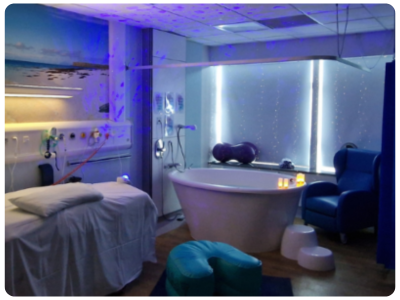
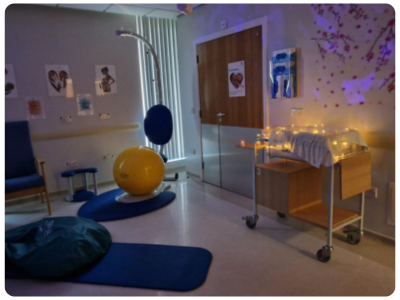
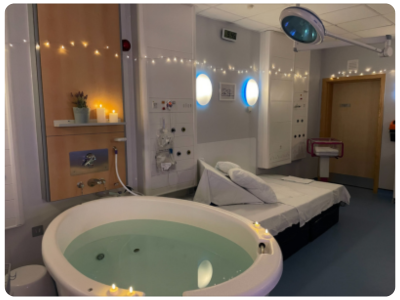
The birthing rooms within the unit are designed to have a homely and relaxing feel and are equipped with mood lighting, speakers and aromatherapy diffusers. We also have lots of equipment to support you in upright and active birth including birthing balls, CUB chairs and large birthing pools. Within the unit we can offer gas and air, morphine and water immersion for pain relief and we can also support you in waterbirth.
The unit is minutes away from labour ward should you request any alternative pain relief such as an epidural or if you or your baby require any additional support. Please talk to your midwife at your next appointment if you are interested in using our AMU for your labour and birth.
Changes to NHSGGC Maternity Visiting and Support from Partners
To ensure we’re maximising rest periods for women staying at our maternity wards, we have changed when partners, key supporters, friends and family can visit.
The AMU at the Queen Elizabeth University Hospital (QEUH) is a wonderful, new exciting Midwifery led birthing unit situated alongside our very popular Labour Suite. We have 3 ensuite rooms available, 2 have state of the art birthing pools. We, as a Team, encourage all pregnant women with no antenatal risk factors to experience intrapartum Midwife led care and birth their babies within our AMU.
The rooms are comfortable and spacious with space to mobilise during labour, a birthing couch and recliner chairs are supplied for those times when our labouring women wish to rest. However, upright and active positions are encouraged during labour and birth. Aids such as peanut balls birthing balls, ballet bars and rebozo sling with chair is available to facilitate this. Hydrotherapy pools in the rooms are a fantastic option for not only pain relief but also to aid comfort and support a weightless freedom of movement which helps our women get their bodies into optimal positions to birth their babies. Our staff are trained to welcome your little ones into the world underwater if this is your preferred birth plan.
We encourage all our women to eat and drink throughout labour, so please remember to pack your favourite energy boosting snacks into your bag.
We have Bluetooth speakers in the rooms for your birthing playlist. The speakers also have vibrant laser lights should you wish this for your environment. We also provide oil diffusers. We can provide some aromatherapy oils to diffuse but if you have a preferred scent then please bring it with you. Fairy lights and battery operated candles are in all AMU rooms.
Pain relief options within the AMU are hydrotherapy, gas and air, TENS and morphine injections. If you wish to use hypnotherapy/meditation techniques during your labour our staff are more than happy to support you. We would encourage you to take the time to consider your plans and document them into your BadgerNotes birth plan, this way all your care providers will know your wishes in advance.
We will listen to your babys heartbeat every 15 minutes in the first stage of labour and every 5 minutes in the second stage of labour using a pinard stethoscope and/or a handheld doptone machine. If we find your baby needs some further monitoring then a wireless CTG machine will be commenced for at least 20 minutes. If we have any concerns during your labour, fully informed discussions with yourself and birthing partner will take place prior to a possible transfer to obstetric led care and your allocated Midwife will remain with you at all times.
Once your baby is born and all is well you may be offered the opportunity to go home that day. We encourage a minimum of 6 hours after birth to stay and have a rest in our department. During this short stay your baby would have a hearing screen as standard, a full neonatal examination, we would support your choice of feeding and supervise this if required, you would have some observations taken and if all remains well then you should be spending your first night as a family in your own home. During some very busy periods this option is not always available but we always aim to provide it.
If you are interested in chatting to us about our AMU at QEUH please speak with your named midwife.
Changes to NHSGGC Maternity Visiting and Support from Partners
To ensure we’re maximising rest periods for women staying at our maternity wards, we have changed when partners, key supporters, friends and family can visit.
The Royal Alexandra Maternity hospital is the first building on the right hand side when you enter the site. The maternity building is physically linked to the adult hospital via a link corridor and has beautiful views towards The Braes.
There are around 3,200 births at the Royal Alexandra Maternity unit each year.
Changes to NHSGGC Maternity Visiting and Support from Partners
To ensure we’re maximising rest periods for women staying at our maternity wards, we have changed when partners, key supporters, friends and family can visit.
Within the labour ward, we encourage birthing partners to be present to support women through throughout their birth experience.
Birthing partners are encouraged to update friends and family on a woman’s progress thus limiting the number of direct calls to labour ward and ensuring that women remain informed and at the centre of all discussions surrounding the communication of their baby’s birth.
Visiting within high dependency will be determined by the woman’s condition.
Partners will be supported to visit and additional visitors will be guided by the woman’s condition and activity within the area.
Neonatal Unit
Call: 0141 314 7035
Services and Outpatients
Day Care Unit
Call: 0141 314 6724
Early Pregnancy Assessment Unit (EPAS)
Call: 0141 314 6953 or 0141 314 6746
Community Midwives
Call: 0141 314 7371
Main Reception
Call: 0141 314 6686
Maternity Triage
Call: 0141 314 6067
This is a 24 hour service for women booked at the Royal Alexandra Hospital who may have concerns about their pregnancy.
The Maternity building is physically linked to the children’s and adult hospitals via a walkway bridge.
The Queen Elizabeth University Hospital also has a foetal medicine unit providing specialist diagnostic facilities and treatment to unborn babies from across Scotland. The unit is equipped with three treatment rooms, scanning facilities, counselling facilities and separate waiting areas. There is one theatre, within Labour Ward, which is equipped with special laser technology used to provide treatment to babies while they are still in the womb (interventional fetal therapy).
Getting Around Our Campus
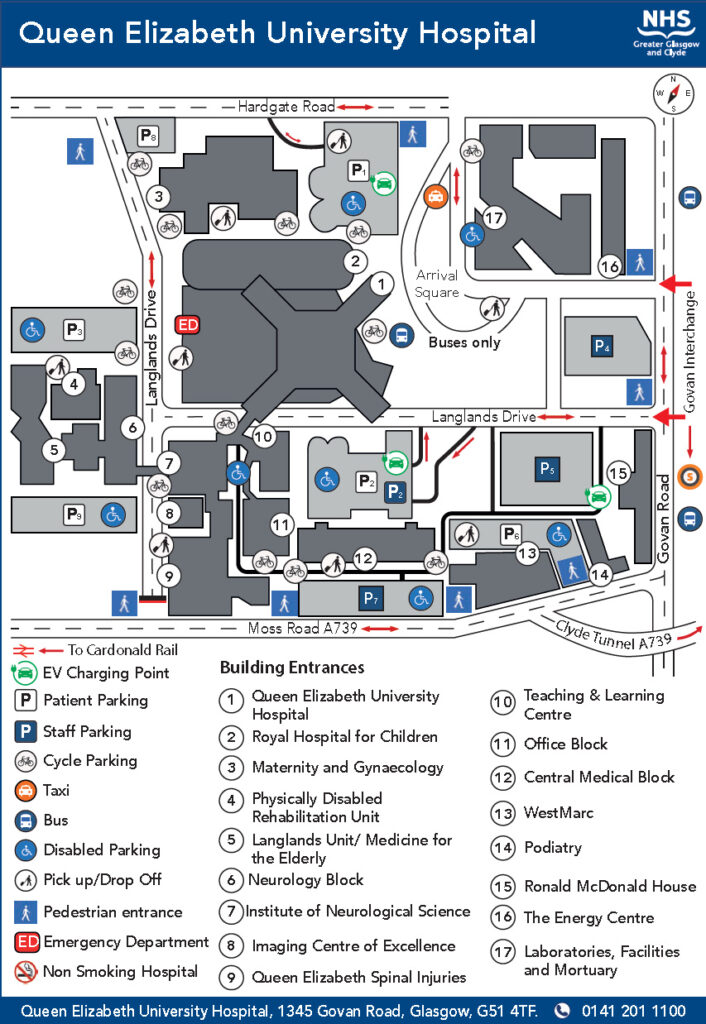
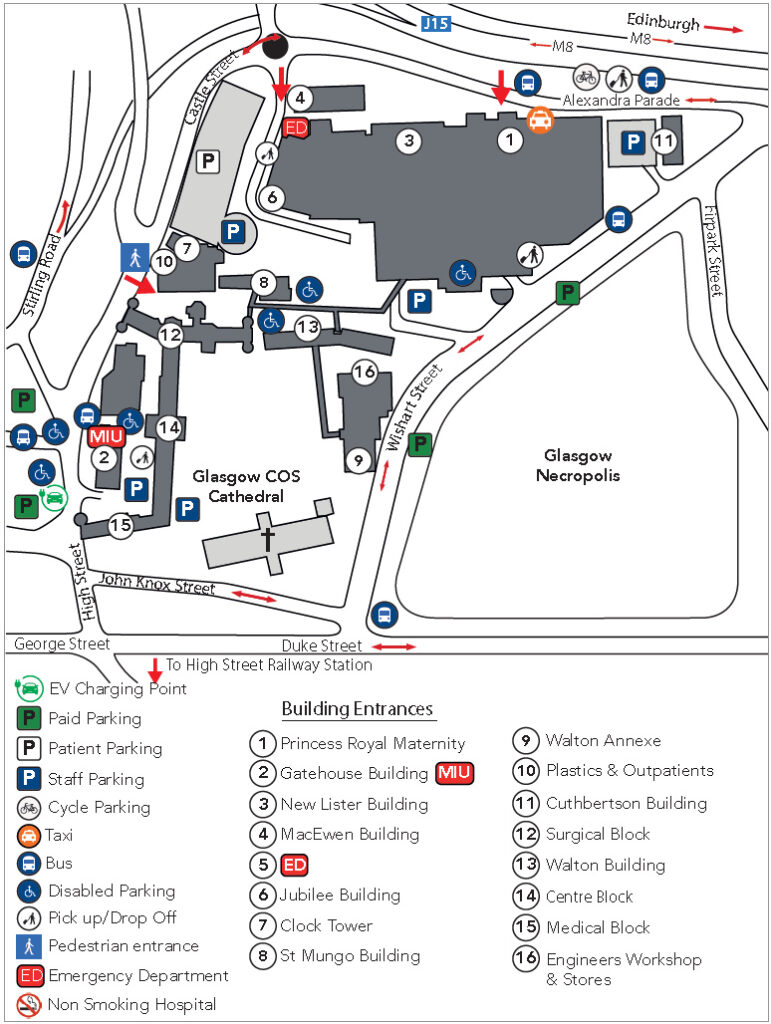
Click the image below to view / download a PDF of the site map, which also includes travel directions.
Changes to NHSGGC Maternity Visiting and Support from Partners
To ensure we’re maximising rest periods for women staying at our maternity wards, we have changed when partners, key supporters, friends and family can visit.
Location: Located within Royal Hospital for Children (RHC)
Labour Ward
Call: 0141 201 2292
Within the labour ward, we encourage birthing partners to be present to support women through throughout their birth experience.
Birthing partners are encouraged to update friends and family on a woman’s progress thus limiting the number of direct calls to labour ward and ensuring that women remain informed and at the centre of all discussions surrounding the communication of their baby’s birth.
Visiting within high dependency will be determined by the woman’s condition.
Partners will be supported to visit and additional visitors will be guided by the woman’s condition and activity within the area.
Services and Outpatients
Day Care Unit
Call: 0141 201 2274
Early Pregnancy Assessment Unit (EPAS)
Call: 0141 201 2331
Community Midwives
Call: 0141 201 2256
Antenatal Clinic
Call: 0141 201 2252
For appointments amendments please call Medical Records.
Maternity Triage
Call: 0141 232 4363
This is a 24 hour service for women booked at the Queen Elizabeth University Hospital who may have concerns about their pregnancy.
Changes to NHSGGC Maternity Visiting and Support from Partners
To ensure we’re maximising rest periods for women staying at our maternity wards, we have changed when partners, key supporters, friends and family can visit.
McColl’s Travel operate a bus service 340 between Helensburgh, Vale of Leven Hospital and the Royal Alexandra Hospital (Paisley), via Dumbarton and Alexandria, 7 days a week. This service is jointly funded by NHS Greater Glasgow and Clyde and SPT.
Small, intimate and beautifully designed. There are three large comfortable birthing rooms, one of which has a state of the art birthing pool. The rooms also contains en suite bath, shower and toilet facilities. To encourage you to be active in labour there is soft matting, birthing balls and a birthing couch.
The unit is located in a quiet peaceful area of the hospital and is easily accessed from the nearby free car park with its own dedicated entrance on the ground floor.
You and your birthing partner can be assured of first class facilities which have been designed with your comfort, privacy and safety in mind. You are very welcome to come and visit the unit and see these facilities. Please call 01389 817232 to arrange a tour.
Following the birth of your baby, you will continue to be accommodated within the unit in a single room.
Changes to NHSGGC Maternity Visiting and Support from Partners
To ensure we’re maximising rest periods for women staying at our maternity wards, we have changed when partners, key supporters, friends and family can visit.
Mother of Joshua: “I have never lived anywhere where the local midwifery unit is the team you rely on, I have only ever known maternity units that are medically based. When I became pregnant I knew straight away the CMU was where I wanted to have my baby. Many people tried to advise me often suggesting the bigger units. However I am so glad I stuck to my guns. My whole experience of the CMU has been fantastic. All the staff who have had an input into my care have been supportive and professional at all times.
The actual day I went into labour will always be a pleasant memory because of the amazing support I had over the phone from the midwives in the CMU. Their experience was invaluable and they gave reassurance and guidance which allowed me the confidence to stay at home as long as possible.
When I finally came into the CMU to have my baby the 2 midwives on that night were amazing. They kept me calm and had a big influence on the wonderful experience of labour I had. It was much less scary because of them and their kindness and invaluable experience. It is something I will always treasure.
Joshua was born in a most relaxing environment and it was all down to the wonderful place they call the Vale if Leven CMU and the wonderful staff who work here. Thank you all for the wonderful job you are doing and I hope you go on doing it for many years to come. My husband and I will certainly be recommending the CMU to whoever we can.”
Father of Joshua: “My wife has written her thoughts but I wanted to write mine down too. I am GP working locally and during my training I have seen many deliveries. However I have never seen a delivery in a midwife led unit. I must confess that I was really worried initially about our baby being born at the Vale. I asked myself the question what would happen if complication arose, because the nearest doctors were in the RAH in Paisley. Many of my GP colleagues had the opinion that the safest place to have a baby was where doctors work. I didn’t know where to go for the best, but as the delivery date approached I realized 3 things.
I have heard of lots of negative experience at other large maternity units
I have NEVER heard of a negative experience from the CMU at the Vale.
It seemed ridiculous not to use local services when everyone wants the Vale to stay open.
So we decided to stay with the CMU at the Vale and it was the best choice we made.
After Joshua was born we didn’t really know what we were doing! This was our first baby after all!! The midwives listened to our questions, explored our feelings and gave us the opportunity to make our own decisions after giving us the information. I have seen first-hand mothers panicking and midwives having no time to help. I have also seen mothers pushed home because of bed shortages. The Vale is so different. I’ll be recommending the Vale to all my Patients. Thank You!!!”
The Community Maternity Unit is small, intimate and beautifully designed. There is a large comfortable birthing room with a state of the art birthing pool. It also contains en suite bath, shower and toilet facilities.
To encourage you to be active in labour there is soft matting, birthing balls and a birthing couch. The room offers beautiful views down the River Clyde. You and your birthing partner can be assured of first class facilities.
It has been designed with your comfort, privacy and safety in mind. You are very welcome to come and visit the unit and see these facilities. Please call 01475 504619 or 01475 504775 to arrange a tour.
Following the birth of your baby, you will continue to be accommodated within the unit in a two bedded room until you are both ready to go home.
Changes to NHSGGC Maternity Visiting and Support from Partners
To ensure we’re maximising rest periods for women staying at our maternity wards, we have changed when partners, key supporters, friends and family can visit.
Midwives care for women and their babies. They prepare for the birth, assist the woman at the birth and provide practical and emotional advice and support in the care of the newborn baby.
They take specialist training after qualifying as a nurse, or train directly as a midwife.
The 25 Midwives at Inverclyde CMU between them have decades of training and experience in caring for mums to be and delivering babies.
Many, if not most, live locally and know the community and its people very well – our midwives often meet people in the street they delivered as newborn babies!
Mum’s Journey
Follow the steps of mum’s journey, from the early days of pregnancy through to baby’s first few days, by clicking the links below.
You’re Pregnant
When you become pregnant, your first contact is with a midwife, who records details of your medical history and assesses how healthy you are. The midwife will find out if your pregnancy is progressing smoothly.
If there are no problems with either your health or that of your unborn baby, you will be able to receive all your care at the Inverclyde CMU all the way through to giving birth. You will be able to do this even if this is your first baby.
If you’re expecting twins (or even more babies!), you will receive all your care from midwives up until the time you are due but – purely as a precaution – you will be asked to give birth in a consultant-led unit, usually the one at the Royal Alexandra Hospital.
If there are any concerns whatsoever about your health, or that of your baby, you will receive your care jointly between the local midwives and consultants at the Royal Alexandra Hospital. You will give birth at the Royal Alexandra Hospital.
However, for most mums this is just a precaution as most births go absolutely smoothly and good planning by staff will mean there is little to worry about.
During Pregnancy
At 12 weeks you will be offered an ultrasound scan and this will allow midwives to estimate when your baby is due.
During your pregnancy you will be invited to attend a series of workshop sessions which are designed to help you prepare for birth and getting ready to be a mum. These will cover subjects like:
Relaxation techniques
Parenting skills
Breastfeeding
We don’t forget about your partner or birth supporter either – they can come to workshop sessions too and find out how they can help you during the birth and beyond.
A blood test is offered at 15 – 16 weeks into the pregnancy in order to screen for any problems. Four or five weeks later, this is followed by a second ultrasound scan, which is intended to provide a more detailed look at the baby – by this time you will be starting to feel the baby’s first movements.
At 24 weeks you will have an ante-natal appointment with your midwife, during which she will check the baby’s growth and listen to his or her heartbeat. If you are a first-time mum, you will have another appointment with the midwife at 32 weeks.
At 34 weeks, you are getting close to the time of the birth. You will be offered more blood tests to find out if you need extra iron and you will be given a chance to look around the CMU’s birthing suite. At 38 weeks first-time mums will have another appointment with their midwife.
When the time comes to give birth to your baby, it is important that you feel relaxed in your surroundings.
Labour and Birth
Inverclyde CMU’s birthing suite, along with the rest of the unit, was completely refurbished and is state of the art.
In particular, we have installed a new birthing pool, which you can use to help you stay comfortable during labour and give birth in if you choose. We also provide birth mats, birthing balls and birthing stools. You can bring in your own CDs, or choose from a selection we provide, and have the lights dimmed in order make the birth as peaceful and private as possible.
It is these kinds of things that can help you in controlling pain. Before giving birth, your midwife will have spent some time discussing this with you and will help you to overcome your worries and fears.
Massage, relaxing music, breathing techniques and the birthing pool can make all the difference – but if these are not enough, you can have Entonox (gas and air) and, if appropriate, the drug pethidine to help make contractions less pain. Like every drug, this has drawbacks and these will have been explained to you by your midwife.
The Princess Royal Maternity is designed to accommodate the delivery of up to 6000 babies each year. It has five clinical floors and provides state-of-the-art equipment for mothers and babies, with the added benefit of clinical services, including Adult Intensive Care, on the same site.
Click the image below to view / download a PDF of the site map, which also includes travel directions.
Changes to NHSGGC Maternity Visiting and Support from Partners
To ensure we’re maximising rest periods for women staying at our maternity wards, we have changed when partners, key supporters, friends and family can visit.
Within the labour suite, we encourage birthing partners to be present to support women throughout their birth experience.
Birthing partners are encouraged to update friends and family on a woman’s progress thus limiting the number of direct calls to the labour suite and ensuring that women remain informed and at the centre of all discussions surrounding the communication of their babies’ birth.
Visiting within high dependency will be determined by the woman’s condition. Partners will be supported to visit and any additional visitors will be guided by the woman’s condition and activity within the area.
Neonatal Ward – Intensive Care Unit and Special Care
Call:
Intensive Care Unit: 0141 451 5221
Special Care: 0141 451 5222 or 0141 451 5223
Ward 56 Gynaecology
Ward Clerk – 0141 201 3370 (this phone is not manned 24 hours)
Women should call 0141 347 8422 to make an appointment with a midwife as soon as they know they are pregnant. We urge all mums-to-be, even those with children already, to book into their local maternity services by week 12 of their pregnancy.
Community Midwives
Call: 0141 201 3438
Women should call 0141 347 8422 to make an appointment with a midwife as soon as they know they are pregnant. We urge all mums-to-be, even those with children already, to book into their local maternity services by week 12 of their pregnancy.
Day Care Unit
Call: 0141 201 3418
This is for women with high-risk pregnancies.
Women should call 0141 347 8422 to make an appointment with a midwife as soon as they know they are pregnant. We urge all mums-to-be, even those with children already, to book into their local maternity services by week 12 of their pregnancy.
Maternity Triage
Call: 0141 201 3452
This is a 24 hour service for women booked at the Princess Royal Maternity who may have concerns or anxieties about their health or pregnancy.
Women should call 0141 347 8422 to make an appointment with a midwife as soon as they know they are pregnant. We urge all mums-to-be, even those with children already, to book into their local maternity services by week 12 of their pregnancy.
Spiritual Care – Chapel and Quiet Room
Call 0141 211 4661 to contact the Healthcare Chaplains for the Princess Royal Maternity.
There is a small Chapel on the 4th floor of the Maternity building, open 24 hours a day. It offers a peaceful space for patients, visitors and staff for the purposes of reflection, meditation and prayer. There is also a Quiet Room adjacent to the chapel.
For lots of families, choosing to birth their baby at home comes with a wide range of benefits and can be the safest place to give birth. There are also circumstances, where birthing within the hospital is advisable due to additional risk factors affecting you, your pregnancy or your baby.
Changes to NHSGGC Maternity Visiting and Support from Partners
To ensure we’re maximising rest periods for women staying at our maternity wards, we have changed when partners, key supporters, friends and family can visit.
Can I give birth in the CMU if it is my first baby?
If you have a healthy, single pregnancy with no medical or obstetric complications, you can choose to have your baby in the CMU.
Yes. Options for place of birth will be discussed with you at booking and during your pregnancy.
Why may I not be able to give birth at the CMU
The midwives at the CMU consider your and your babies’ health to be of paramount importance and therefore any medical or pregnancy related conditions have to be considered in deciding the best place to have your baby.
What if a complication happens during labour?
Because you have experienced a fit, healthy pregnancy, you are less likely to experience complications, however should the need arise, the highly skilled midwives will manage the situation appropriately and will accompany you to the consultant led unit.
What management strategies can I use during labour?
Midwives find that support offered by them and your birthing partner, in a warm, friendly environment enables you to maintain control of your labour and reduces the need for intervention and drugs.
Who can be with me in the CMU?
Bring with you the one or two people you choose to offer you support at this time.
What pain relief can I have in labour?
There is also a wide range of pain relief.
Midwives find that support offered by them and your birthing partner, in a warm, friendly environment enables you to maintain control of your labour and reduces the need for strong pain relief.
Was this helpful?
Yes
No
Thanks for your feedback!
Cookie Consent
We use cookies to analyse traffic to our site and to enable certain functions such as forms and YouTube videos. These do not collect personal information. By clicking "Accept All", you consent to our use of cookies, or you can customise the options.
This website uses cookies
Websites store cookies to enhance functionality and personalise your experience. You can manage your preferences, but blocking some cookies may impact site performance and services.
Essential cookies enable basic functions and are necessary for the proper function of the website.
Name
Description
Duration
Cookie Preferences
This cookie is used to store the user's cookie consent preferences.
30 days
CloudFlare provides web performance and security solutions, enhancing site speed and protecting against threats.
Sequence rules uses cookies to track the order of requests a user has made and the time between requests and makes them available via Cloudflare Rules. This allows you to write rules that match valid or invalid sequences. The specific cookies used to validate sequences are called sequence cookies.
session
cf_ob_info
The cf_ob_info cookie provides information on: The HTTP Status Code returned by the origin web server. The Ray ID of the original failed request. The data center serving the traffic
session
cf_chl_rc_m
These cookies are for internal use which allows Cloudflare to identify production issues on clients.
session
__cfruid
Used by the content network, Cloudflare, to identify trusted web traffic.
session
__cf_bm
Cloudflare's bot products identify and mitigate automated traffic to protect your site from bad bots. Cloudflare places the __cf_bm cookie on End User devices that access Customer sites that are protected by Bot Management or Bot Fight Mode. The __cf_bm cookie is necessary for the proper functioning of these bot solutions.
session
__cflb
When enabling session affinity with Cloudflare Load Balancer, Cloudflare sets a __cflb cookie with a unique value on the first response to the requesting client. Cloudflare routes future requests to the same origin, optimizing network resource usage. In the event of a failover, Cloudflare sets a new __cflb cookie to direct future requests to the failover pool.
session
_cfuvid
The _cfuvid cookie is only set when a site uses this option in a Rate Limiting Rule, and is only used to allow the Cloudflare WAF to distinguish individual users who share the same IP address.
session
cf_clearance
Whether a CAPTCHA or Javascript challenge has been solved.
session
cf_use_ob
The cf_use_ob cookie informs Cloudflare to fetch the requested resource from the Always Online cache on the designated port. Applicable values are: 0, 80, and 443. The cf_ob_info and cf_use_ob cookies are persistent cookies that expire after 30 seconds.
session
__cfwaitingroom
The __cfwaitingroom cookie is only used to track visitors that access a waiting room enabled host and path combination for a zone. Visitors using a browser that does not accept cookies cannot visit the host and path combination while the waiting room is active.
session
cf_chl_rc_i
These cookies are for internal use which allows Cloudflare to identify production issues on clients.
session
cf_chl_rc_ni
These cookies are for internal use which allows Cloudflare to identify production issues on clients.