Sleep plays a vital role in good health and wellbeing throughout your life. Getting enough quality sleep at the right times can help protect your mental health, physical health, quality of life. Poor sleep is associated with increased chronic pain and exacerbation of musculoskeletal symptoms. Sleep problems are dose-dependently associated with risk of chronic pain in the low back and neck/shoulders.
Poor sleep has also been associated with increased risk of injury within the endurance sporting population. Therefore it is an important part of patient management to assess sleep and impact on health and presenting condition.
Alcohol consumption in the UK has more than doubled since 1950 and in Scotland this increased consumption has brought with it an increase in alcohol-related harm. Changing Scotland’s Relationship with Alcohol: A Framework for Action sets out action to address alcohol misuse by:
The negative effect of smoking on health is well documented.
With regard to MSK conditions is known to reduce bone mineral density, connective tissue integrity and have a deleterious effect on local vasculature and therefore healing.
If you are overweight or living with obesity, lowering your weight can help reduce your risk of developing serious long term issues like diabetes and cardiovascular disease for example. It is also a risk factor for a host of foot and lower leg problems.
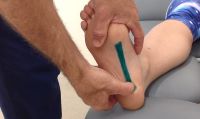
There can be many causes of pain under the heel, but probably the most common one is irritation to the plantar fascia – sometimes called plantar fasciitis. The plantar fascia is a band of thick tissue which runs from your heel bone to your toes. If you bend your big toe back, you should see it become prominent on the sole of your foot. It helps to supports the arch of your foot but if it gets overloaded it can become thickened and cause discomfort under your heel. You can see the inside band of the plantar fascia in the picture below with the thumb pressing on the common site of pain.
Symptoms of Plantar Fasciitis
A classic symptom of plantar fasciitis is pain on the first steps after getting up from a period of sitting, or first thing in the morning when getting out of bed – again, usually in that area being pressed above. Sometimes it eases of a little when actually walking, only to come back again when you stop for a rest.
Please watch the video below for more information on pain in the sole of the heel and how to manage it.
Don’t expect things to improve overnight though. It takes time for muscles and joints to adapt and get stronger.
Please note: If you do not see any sign of improvement after 6 to 8 weeks of following the advice and exercises please phone 0141 347 8909 for more advice and support.
Was this helpful?
Yes
No
Thanks for your feedback!
“If exercise were a pill, it would be one of the most cost-effective drugs ever invented”
Dr. Nick Cavill
Physical activity
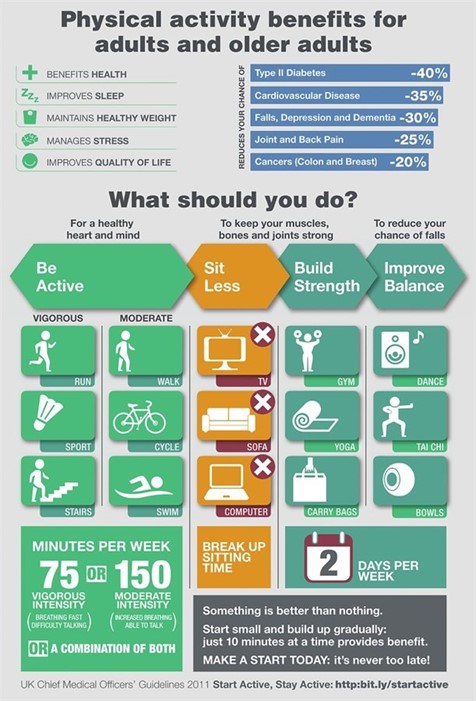
Evidence shows that the people of Scotland need to be more active with 73% of children and 40% of adults not achieving recommended activity levels. Walking improves health. There was good evidence for the health benefits of walking – as the infographic below demonstrates. As well as having significant physical health benefits such as improving heart, lung and joint health, there are also major improvements in mental health as well as the social aspect. It is a simple, cheap and effective way to maintain a healthy BMI and a improve quality of life.
Paths For All is an excellent website with great information aiming to get people walking everyday. Visit their website.
Parkrun
Parkrun is also an excellent option. Parkruns are free, weekly, community events all around the world. Saturday morning events are 5k and take place in parks and open spaces.
On Sunday mornings, there are 2k junior parkruns for children aged four to 14. It is a positive, welcoming and inclusive experience where there is no time limit and no one finishes last. Everyone is welcome to come along, whether you walk, jog, run, volunteer or spectate. Visit the website for more information about a Parkrun close to you.
Couch to 5k
A week-by-week description of the 9-week set of Couch to 5K podcasts. Each week involves 3 runs. Visit the website for more information.
There is good evidence to suggest that strength training is useful in reducing injuries – in some cases it is reported to reduce sports injuries to less than one third and overuse injuries by half. This doesn’t necessarily mean joining a gym and doing weights. Simple exercises performed safely, and in the comfort of your own home can be just as good.
There is also good evidence to support exercise and resistance training for managing cardiovascular disease risk factors and peripheral arterial disease (PAD). PAD is when there is reduced muscle blood supply to the lower limb which can cause muscle weakness, cramp or discomfort in the lower limb.
Due to this, some people believe the pain induced by it can be harmful. This might lead to increased sedentary behaviour, reduced aerobic capacity or cardiorespiratory fitness, and reduced muscle strength and endurance, all impairing walking ability further and ultimately reducing quality of life. If you want to speak to someone before beginning exercise, please contact on the number below. Visit the Physical Activity, Strengthening & Falls Prevention page for further information.
Recent research also shows strong evidence of strength training having a positive effect on musculoskeletal disorders as regards employees who work in physically demanding jobs.
Sarcopenia
Sarcopenia is a condition characterized by loss of skeletal muscle mass and function. Its development may be associated with conditions that are not exclusively seen in older persons, although it is primarily a disease of the elderly. Sarcopenia is characterized by progressive and generalized loss of skeletal muscle mass and strength and it is strictly correlated with physical disability and mortality. It is highly correlated with frailty and risk of falls in eldery (see falls below). Risk factors for sarcopenia include age, gender and level of physical activity.
There is an established link between inactivity and losses of muscle mass and strength, this suggests that physical activity should be a protective factor for the prevention but also the management of sarcopenia.
Please speak to your GP or any of the Allied Health professionals that you may havean appointment with – for example Podiatrist, Physiotherapist, Occupational therapist – for more information and advice if required.
Risk of falls
Falls are a common, but often overlooked, cause of injury. Around 1 in 3 adults over 65 who live at home will have at least one fall a year, and about half of these will have more frequent falls. Exercises that target balance, gait and muscle strength have been found to prevent falls in these people. Exercise reduces the number of falls over time by around one quarter (23% reduction) which means if there were 850 falls in 1000 people followed over 1 year, exercise would result in 195 fewer falls. Read the Cochrane Review on Exercise for preventing falls in older people living in the community.
This study that provides evidence foot and ankle problems are important risk factors for falls in older people – particularly reduced ankle flexibility, hallux valgus deformity, decreased tactile sensitivity and decreased toe plantarflexor strength, and doing some simple exercises to address these modifiable risk factors may be beneficial in reducing falls.
The video below demonstrates some exercises you may find useful.
Please note: If you want to speak with someone for more advice and support regarding exercises please phone 0141 347 8909.
Was this helpful?
Yes
No
Thanks for your feedback!
An ankle sprain, or going over on your ankle, is one of the most common musculoskeletal injuries. It can result in damage to the ligaments on the outside of the ankle.
It usually occurs when the ankle is turned in and pointed down with the forefoot taking the weight. Ligaments are strong tissues around joints which attach bones together to provide support and approximately 75% of ankle injuries involve the ligamentsshown in green in the picture below, with the peroneal muscles (muscles on the outside of the leg) being represented by the red dotted line and the tendon(s) in purple.
Generally speaking, ankle sprains usually heal well, and most people will be able to get back to normal activities within 6 to 8 weeks. It is important however to make sure that the muscles and ligaments are strong enough to allow you to go back to full activity.
One of the biggest risk factors to an ankle sprain is a previous ankle sprain that has not had the appropriate rehabilitation. Read more.
Symptoms of ankle sprain
You may see some bruising and swelling in the early stages along with the pain, and find it difficult to walk normally. An xray is not always required unless there is tenderness in the bone at the outside of the ankle or foot or, you cannot walk for 4 steps.
Exercises and support
In the early stages, there is good evidence for anti-inflammatory medication and early movement – for instance in a seated or lying position, draw circles with your foot in both directions as often as you can and within your pain limits. Also, including balance and strengthening exercises is effective at increasing the movement at the ankle as well as preventing further injury.
The videos below demonstrate exercises that should help. Don’t expect things to improve overnight. It can take time for the ligaments and muscles to adapt and improve.
Please Note: If you do not see any sign of improvement after 6 – 8 weeks of following the advice and exercises, please phone 0141 347 8909 for more advice and support.
Was this helpful?
Yes
No
Thanks for your feedback!
The ankle joint is formed by the lower end of the tibia (shin bone) and the talus (ankle bone).
Symptoms of ankle arthritis?
In normal joints there is a layer of tough slippery material called cartilage, which acts as a shock absorber and allows smooth gliding motion. In osteoarthritis the cartilage thins out and becomes rough. When this happens the tissues in your joint work harder in a process of wear and repair.
Often extra bits of bones form which, together with scarring of the joint lining, are responsible for joint stiffness.
Pain and stiffness are the two main symptoms of ankle arthritis.
Causes of ankle arthritis?
Most cases of ankle arthritis are secondary to injury, for example, occurring years after an ankle fracture or even several severe sprains. It can also be caused by rheumatic conditions such as rheumatoid arthritis or gout which can lead to damage and destruction of joints.
In some cases of ankle osteoarthritis there is no known cause (other than genetic). In this situation, other joints may be affected such as your hands, knees, or hips, and there may be a family history of similar issues.
We are more prone to develop osteoarthritis over time and it is more common in people over 40. Being overweight is also an important factor in causing osteoarthritis in weight bearing joints.
What tests are there?
In the majority of cases of ankle osteoarthritis you do not need an x-ray or any other tests to confirm what is wrong, unless your problem is severe enough that we may consider surgery.
What can you do to help your ankle osteoarthritis?
There are many non-surgical treatments that can help:
Diet: Losing weight will reduce the strain on your ankles
Medication:Painkillers such as paracetamol can reduce the pain. Follow the advice from your community pharmacist or other healthcare professional about taking medication. It is important to take medication regularly
Ice packs:Ice packs can also help with pain
Exercise: Exercise helps build the strength of the muscles, which can take the strain off the joint and you can choose from many non-impact activities such as swimming or cycling
Footwear: Supportive boots, shoes or insoles may help
Walking aids: A walking stick or cane can be very helpful.
What else can be done?
Most patients with ankle arthritis respond to non-surgical treatments where these have been tried and failed then there may be other options. If your pain does not start improving after a period of 3 months of following the advice above, please phone 0141 347 8909 to see a healthcare professional who can assess your foot.
Some patients may be referred on for a surgical opinion.
Types of Surgery
Keyhole (arthroscopy) surgery
Keyhole (arthroscopy) surgery may be helpful in some patient in earlier stages but when the problem progresses there are 2 main surgical options.
Ankle fusion (arthrodesis)
Ankle fusion (arthrodesis) this is where the ankle is surgically stiffened by fusing your tibia (shin) to your ankle (talus). The damaged joint surfaces are removed and held together with some metalwork. This converts a stiff, painful joint into a stiff but pain-free one.
Ankle replacement (arthroplasty)
This is where the worn-out ankle joint is replaced by resurfacing the ends of your tibia and talus with metal components with a plastic insert in-between them to allow gliding.
One option or the other may be better for certain people depending on a number of reasons.
Both operations mean you would need to spend several week in a plaster cast and/ or boot and would require most people to be off from work in a physical job for around 4-6 months.
Where can I find more information?
Versus Arthritis
Offers a selection of self-help booklets, which can be downloaded on the Internet.
The Achilles tendon is the biggest and strongest tendon in the human body. Achilles tendinopathy is a condition that can cause pain, swelling, stiffness and weakness of the Achilles tendon. It is a very common injury reported in runners, however, it is not exclusive to this population as people who have a more sedentary lifestyle will also suffer from it.
Symptoms of Achilles Tendinopathy
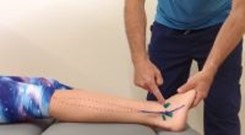
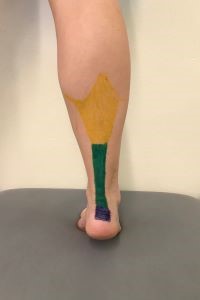
Pain generally tends to be worse in the morning, or during and after exercise. Some swelling and/or pain can occur around the tendon and calf area – most often in the areas shown below. The tendon may be very tender to touch and you may have increased discomfort wearing shoes that press against it.
The blue coloured area is the insertion point of the the tendon into the heel bone and the green coloured area is roughly the tendon itself with the yellow area the musculotendinous junction
Causes of Achilles Tendinopathy
The reasons for developing Achilles tendinopathy are varied but there are some common factors that seem to be important. The research consistently shows that reduced strength and endurance in the calf muscles is a major factor in developing Achilles tendinopathy. Also, being overweight will add more stress to the already struggling tendon. Footwear choice is important as the wrong shoes may aggravate the problem.
Please watch the video below for more information on pain at the back of the heel and how to manage it.
More advanced/progressive loading exercises
As the initial exercises become easier and less painful, it is important to progress and make the rehabilitation more challenging in order to improve the strength and endurance of the muscle/tendon unit. This progression is vital to ensure that the muscles and tendon are capable of coping with whatever activity you want to return to. The video below shows 5 videos that will take you through this progression.
Please make sure that you are comfortable and ready before making the step up to more challenging rehabilitation, and if in doubt, stay with the current plan until you are.
Please note: If you do not see any sign of improvement after 6 – 8 weeks of following the advice and exercises, please phone 0141 347 8909 for more advice and support.
Podiatrists are allied health professionals (AHP) who are trained to prevent, diagnose, treat and rehabilitate conditions affecting the feet and lower limbs. They provide assessment, management and foot health education to patients-enabling self care where appropriate
Will I receive podiatry?
A podiatry assessment will be provided to assess foot health needs
We aim to provide rapid access for any non-healing would -called and ulcer- in the foot and ankle.
Our service follows the Scottish Government Personal footcare Guidelines (2003), which mean we do not provide personal footcare such as simple toenail cutting or routine skin care. More information on Personal Footcare can be found here
Can I receive a home visit?
The NHS GG&C podiatry service provides home visits -also known as domiciliary visits- to patients who are totally bed bound or chair bound. We encourage all our patients to attend their community clinics as treatment is safer and more appropriate clinical environment. Appointments can be made on days and times that are convenient to you.
If you have had an acute episode of illness and are clinically too unwell to travel to a clinic, then please make your GP or health care professional aware so we can arrange a temporary home visit for you.
Please note: All new home visit requests must come through your GP or appropriate health care professional. All new patients will receive a telephone or video consultation in the first instance to ensure you are triaged to the appropriate place.
You are not eligible to receive a home visit if:
You attend any other NHS appointments – for example, GP, hospital, dental – with or without assistance.
You attend hairdressers, shops, post office etc.
You visit friends or family.
Prior to a home visit
You will be notified on the day of your visit by telephone. We will ask you if there are any special arrangements – such as a key box number- in order to gain access to your home. To help support the podiatrist please ensure:
You wear socks or pop socks where possible instead of tights
There is good lighting and adequate space to help provide care
Your home is smoke free
All pets are in a cage or in another room
Your feet are clean and dry
During your visit
The podiatrist will update your medical history and medication. We will assess your foot and lower limb care needs and discuss an appropriate management plan. Treatment will be provided if required.
Following your visit
If assessed suitable for a clinic appointment, details on how to arrange this will be given. Similarly, if a return domiciliary visit is required, then this will be discussed and agreed.
Contact information
North GGC Hub telephone – 0141 531 6261
South GGC Hub telephone – 01475 501 206
Was this helpful?
Yes
No
Thanks for your feedback!
What is a Pressure Ulcer?
Site currently under construction. Information to follow
Was this helpful?
Yes
No
Thanks for your feedback!
Practice Based Learning in Podiatry
The Podiatry Service offers an innovative and soundly governed Practice Based Learning (PrBL) programme. We utilize a blended learning provision which is centred on a Peer Assisted Learning (PAL) model. We aim to engage students in a programme of meaningful clinical thinking with the objective of maximising their capabilities and confidence within clinical decision making whilst delivering optimal person centred care.
Over the course of an academic year, we offer in excess of one thousand placement weeks. Placements are offered to both institutes in Scotland offering entry qualifications into Podiatry. The institutions offering Podiatry at undergraduate level are Glasgow Caledonian University (GCU) and Queen Margaret University . Various options of study are available depending upon eligibility criteria being met.
As the primary PrBL provider for the GCU Podiatry programme, we host Level 1 to Level 4 students at the Department of Podiatry, Queen Elizabeth University Hospital (QEUH) throughout Trimester A and Trimester B which acts as our placement hub. Block placements occur during Trimester A, B and C within the single service seperate from our placement hub.
Additionally, as the need for PrBL placements for all AHP professions increase, we aim to explore new and innovative methods of offering cross-profession PrBL opportunities through both face-to-face and digital platforms.
The Podiatry Service works collaboratively with its academic colleagues ensuring alignment to learning outcomes with quality underpinning every placement hour.
We are keen to hear the voice of the student and their experience at the end of each placement. Using a student-based audit enables an understanding of what worked and what didn’t to inform changes to the PrBL programme.
Are you thinking about studying Podiatry and want to find out more? Consider joining our ‘Get Ready For’ programme.
Return to Practice in Podiatry
The Podiatry service offers an excellent opportunity for podiatrists who wish to return to podiatry practice and require to re-register with the Health and Care Professionals Council (HCPC). Our fully funded learning programme will support you in your return to practice. Candidates who successfully achieve registration will be eligible to apply for Band 5 posts within NHS Boards.
We offer a structured development opportunity to support and consolidate knowledge, skills and competence in supportive learning environments. Your individual learning and support framework will have full mentorship from our team of practice educators and practice development.
In this post you will:
Have the opportunity to provide podiatric care in a variety of clinical environments. You will be supported by your mentor using various supervisory methods.
Provide a high level of both palliative and corrective care as outlined in the agreed management plan.
Liaise with or referring to other Health Care Professionals (HCPs) or Agencies as appropriate.
Plan and organise own workload to ensure effective caseload management of a diverse range of patients
Knowledge, Experience and Qualifications
You must hold a BSc (Hons) Podiatry or Diploma in Podiatry and will be required to complete a period of supervised practice. The length of supervised practice will be detailed by the HCPC Returning to Practice Requirements. You will demonstrate the ability to work as part of a team. Evidence of prioritisation, planning and organisation of workload are essential.
Roles and Responsibilities
You will create a portfolio to showcase your learning and development.
Adapt your learning needs through reflective practice and feedback to develop professional knowledge and skills.
Read and understand the HCPC Standards of Proficiency.
We offer this opportunity on a fixed term basis and will accommodate the return to practice requirement of the applicant. There is flexibility across whole and part time working.
For initial discussion please contact Julie Braidwood on Julie.Braidwood@nhs.scot or Pamela Price on Pamela.Price@nhs.scot
The PREPARE Project
What is PREPARE?
The Pre Registration Podiatry: Accessible Recruitment & Employment (PREPARE) Project is an innovative approach to growing our workforce by enabling people into the profession of Podiatry. The service employs PREPARE trainees on an annex 21 basis to undertake a BSc (Hons) in Podiatry. PREPARE Trainees receive full employee benefits as per Agenda for Change terms and conditions.
How does PREPARE work?
The Podiatry Service has an agreement with Glasgow Caledonian University (GCU) which has condensed the teaching timetable to three full days, instead of spreading it over five days. This is in line with student feedback across the institution and would benefit the student experience. There is no change to programme or module learning outcomes. PREPARE Trainees have dedicated time to engage within the academic content up to 3 days per week with the remaining 2 days being specified by service led duties. Trainees engage in service-led duties 5 days per week during non term time.
Why is PREPARE needed?
Through widening access to those who are not able to leave full time employment to access adult learning opportunities we believe this novel approach to meeting the workforce challenges stands to safeguard frontline Podiatry services in NHSGGC for the intermediate and long term future. Investment in ‘Earn to Learn’ schemes enhance graduate capability by providing integration across service delivery which enables extensive clinical exposure, whilst undertaking graduate level study.
Continuation of employment to a Band 5 Podiatrist is subject to successful completion of the BSc (Hons) Podiatry and Health & Care Profession Council (HCPC) registration. For the Health Board, these graduates will have extensive clinical experience, alongside a detailed knowledge of policies and procedures. The Podiatry service will employ 4 PREPARE trainees per academic year from 2023 to 2027.
What Next?
Are you thinking about studying Podiatry and want to find out more? Consider joining our ‘Get Ready For’ programme.
Hear from a PREPARE Trainee and their experience in the video below.
Was this helpful?
Yes
No
Thanks for your feedback!
Podiatry patient consultations are delivered in a range of ways including telephone, video and face to face. You will be asked for more information at your first telephone call to best support your needs. Please note, this may not include face to face attendance.
Podiatry does not provide personal footcare. Please refer to the personal footcare resource page for help.
Telephone
0800 592 087 OR 0141 347 8909
Monday to Friday 8.00am – 8.00pm Saturday 9.00am – 1.00pm
We use cookies to analyse traffic to our site and to enable certain functions such as forms and embedded videos. These do not collect personal information. By clicking "Accept All", you consent to our use of cookies, or you can customise the options.
This website uses cookies
Websites store cookies to enhance functionality and personalise your experience. You can manage your preferences, but blocking some cookies may impact site performance and services.
Essential cookies enable basic functions and are necessary for the proper function of the website.
Name
Description
Duration
Cookie Preferences
This cookie is used to store the user's cookie consent preferences.
30 days
CloudFlare provides web performance and security solutions, enhancing site speed and protecting against threats.
Sequence rules uses cookies to track the order of requests a user has made and the time between requests and makes them available via Cloudflare Rules. This allows you to write rules that match valid or invalid sequences. The specific cookies used to validate sequences are called sequence cookies.
session
cf_ob_info
The cf_ob_info cookie provides information on: The HTTP Status Code returned by the origin web server. The Ray ID of the original failed request. The data center serving the traffic
session
cf_chl_rc_m
These cookies are for internal use which allows Cloudflare to identify production issues on clients.
session
__cfruid
Used by the content network, Cloudflare, to identify trusted web traffic.
session
__cf_bm
Cloudflare's bot products identify and mitigate automated traffic to protect your site from bad bots. Cloudflare places the __cf_bm cookie on End User devices that access Customer sites that are protected by Bot Management or Bot Fight Mode. The __cf_bm cookie is necessary for the proper functioning of these bot solutions.
session
__cflb
When enabling session affinity with Cloudflare Load Balancer, Cloudflare sets a __cflb cookie with a unique value on the first response to the requesting client. Cloudflare routes future requests to the same origin, optimizing network resource usage. In the event of a failover, Cloudflare sets a new __cflb cookie to direct future requests to the failover pool.
session
_cfuvid
The _cfuvid cookie is only set when a site uses this option in a Rate Limiting Rule, and is only used to allow the Cloudflare WAF to distinguish individual users who share the same IP address.
session
cf_clearance
Whether a CAPTCHA or Javascript challenge has been solved.
session
cf_use_ob
The cf_use_ob cookie informs Cloudflare to fetch the requested resource from the Always Online cache on the designated port. Applicable values are: 0, 80, and 443. The cf_ob_info and cf_use_ob cookies are persistent cookies that expire after 30 seconds.
session
__cfwaitingroom
The __cfwaitingroom cookie is only used to track visitors that access a waiting room enabled host and path combination for a zone. Visitors using a browser that does not accept cookies cannot visit the host and path combination while the waiting room is active.
session
cf_chl_rc_i
These cookies are for internal use which allows Cloudflare to identify production issues on clients.
session
cf_chl_rc_ni
These cookies are for internal use which allows Cloudflare to identify production issues on clients.
session
Statistics cookies collect information anonymously. This information helps us understand how visitors use our website.
We use Microsoft Clarity to understand how users interact with our website, including information such as clicks, scrolling and navigation behaviour, to help improve our services.
Microsoft Clarity uses cookies and similar technologies. These are only set if you accept analytics cookies.
If you choose not to accept analytics cookies, Clarity will operate in a limited mode using non-cookie-based data, which does not track users across pages or visits.
The data collected is behavioural and technical in nature and does not directly identify individuals. Sensitive information such as names, email addresses and form inputs is automatically hidden and not recorded or viewed.
Some information, such as device and approximate location data will still be collected and is treated as personal data in accordance with data protection legislation.
This will not be used for any purpose other than analytics and will not be used to identify you.
We use Microsoft Clarity to understand how users interact with our website, including information such as clicks, scrolling and navigation behaviour, to help improve our services.
Microsoft Clarity uses cookies and similar technologies. These are only set if you accept analytics cookies.
If you choose not to accept analytics cookies, Clarity will operate in a limited mode using non-cookie-based data, which does not track users across pages or visits.
The data collected is behavioural and technical in nature and does not directly identify individuals. Sensitive information such as names, email addresses and form inputs is automatically hidden and not recorded or viewed.
Some information, such as device and approximate location data will still be collected and is treated as personal data in accordance with data protection legislation.
This will not be used for any purpose other than analytics and will not be used to identify you.