Full details of the services provided by other Scottish Genomic Network Laboratories, including request forms, can be found on the Aberdeen, Dundee and Edinburgh laboratory websites.
A list of all genomic tests commissioned by NHS England for rare and inherited disorders, and cancer can be found in The National Genomic Test Directory.
Service Status
NPM1 MRD: Communication has been received from Lothian HMDS regarding ongoing issues with NPM1 MRD. Lothian are actively troubleshooting their assay and reviewing past results.
All patient samples referred to Laboratory Genetics in Glasgow are being directed to Synnovis/Guy’s Hospital Laboratory for NPM1 MRD analysis until further notice. We will provide further updates as available (05/02/26).
Sending a sample for Genetic testing
Each request accepted by the laboratory for testing is considered an agreement between the user and laboratory. Please see the Terms and Conditions of Service
Sample acceptance criteria / mandatory information
Either a completed request form or a detailed letter must be sent with each patient sample. Forms can also be requested by telephoning the department on 0141 354 9300 or downloaded from the list using ‘Request Forms (Germline and Somatic)’ tab below.
As a minimum, two pieces of patient identifying information must be provided on both the form and the sample container, e.g. name and CHI number. Specimens may be rejected if the form and the sample container do not have the same 2 patient identifiers.
Consent for testing
Discussions regarding testing and/or storage of genetic material is the responsibility of the referring clinician and a summary of clinical consent will be included in the patient’s health record. Consent is implied by submitting the sample for testing to the laboratory.
Further Analysis on Previously Stored Sample
For clinical users that wish to request further genetic testing for patients where we already have an appropriate specimen in the laboratory, the Further Analysis Request Form needs to be filled in. This will automatically send the request to the genetics laboratory. The request will be actioned by the laboratory or someone from the laboratory will contact the referring clinician if there are any issues or if further information is required.
Accreditation and Quality Management
The Laboratory Genetics department is accredited by the United Kingdom Accreditation Service (UKAS) to ISO 15189 standards. The scope of accredited services are listed within our UKAS schedule of accreditation.
As part of our quality management system and to ensure that we are meeting the needs of our users, we are always keen to receive any comments you may have regarding the quality of the service we provide and would welcome any suggestions on ways in which we might be able to improve the service. If you are not satisfied with any aspect of the service, please contact the Quality Manager.
Haemato-oncology send away tests – all referrals for specialist testing must be sent via Laboratory Genetics for processing and forwarding to appropriate test centre
Laboratory Genetics forms part of the West of Scotland Centre for Genomic Medicine and is co-located with the Clinical Genetics Service at the Queen Elizabeth University Hospital in Glasgow. The Laboratory provides a comprehensive diagnostic genetic service for the patients of the West of Scotland (population >2.7 million) and offers specialised testing to the whole of Scotland, the UK and overseas.
The laboratory is a member of the Scottish Strategic Network for Genomic Medicine, with laboratories also located in Aberdeen, Dundee and Edinburgh. The Laboratory Services are funded by National Services Division of NHS Scotland (NSD) and are commissioned to work together to provide a comprehensive genetics service to the patients of Scotland.
The Laboratory Genetics department is accredited by the United Kingdom Accreditation Service (UKAS) to ISO 15189 standards. For more information see Accreditation and Quality Management section under Information for Service Users.
More Information
Our Services
The department offers Germline and Somatic testing, full details of which can be found under the Information for Service Users link.
For Clinical Genetics please call 0141 354 9200 (internal 59200)
Opening Hours
Monday to Friday, from 8.30am – 5.00pm
The laboratory does not offer an out of hours service but it may be possible to arrange the analysis of urgent samples out with these times, by prior arrangement. The department is closed during public holidays.
In September 2006 the Scottish Government introduced a national authorisation form for post-mortem examinations. By law this is the only “consent form” that can be accepted. The authorisation form, together with two types of information leaflets and a summary form are contained within a distinctive dark blue sleeve for adults and a pale green one for children and infants.
Current guidelines recommend that only senior medical staff should obtain authorisation. Junior doctors or ward staff should act as witnesses.
It is important that the authorisation form is completed correctly; otherwise the post mortem may not be carried out.
The nearest relative, or a nominated person must be given the top (white) copy and the other two copies (pink and blue) are retained.
The form is a legal document and must not be altered without the relatives consent. Any changes must be made by having all three copies together and only writing on the top white copy to ensure that all the forms are identical.
Post-Mortem Examination
Small samples of tissue, for histological purposes only, will be retained in every post-mortem to confirm macroscopic findings unless consent for this is withheld.
Detailed neuropathological examination of the brain is best done if the organ is first immersed in formalin for three weeks. If the patient has died due to a complex neurological disorder (e.g. MS, dementia, Parkinson’s disease) and it is considered that examination of the brain is very important, then specific permission to retain the brain after the post-mortem should be obtained and noted in section 2A and 2B of the authorisation form.
In cases where there is an infectious risk to those handling the body after death (i.e. pathologists, mortuary technicians, undertakers) e.g. deaths from tuberculosis, AIDS, hepatitis B or C etc. the body must be transported to the mortuary in a cadaver bag with “danger of infection” stickers attached and clearly visible.
In cases of “bodies donated to medical science” or any other issue, please contact the mortuary staff.
Delivery of Request Authorisation Form to the Pathology Department
Authorisation forms are available from the mortuary offices during working hours and from the booking in areas in every mortuary.
Wards should arrange for collection/delivery of authorisation forms together with the summary and case records. Do not use internal mail.
All post mortems will be carried out within the mortuary at the Queen Elizabeth University Hospital, with all adult NHS post mortems being carried out on Tuesdays and Thursdays only.
Reporting Post-Mortem Findings
On completion of the PM the pathologist will contact the requesting clinician and where practical invite them to come and discuss the findings in the mortuary at their earliest convenience. If the requesting clinician is unable to attend the mortuary, then a summary of the finding is provided via email.
A preliminary PM report is dispatched to the Consultant in charge of the patient within three working days of the PM. Case notes are normally returned with the full PM report within 3-4 weeks.
Copies of the final report, which includes histological findings, are sent to the patient’s GP and hospital consultant usually within two weeks (this can be longer if additional tests are required) of the autopsy.
Fiscal Post Mortems
Deaths must be discussed with the procurator fiscal under the following circumstances:
Uncertified death
Any death which was caused by an accident due to the operation of a vehicle, or which was caused by an aircraft or rail accident.
Any death associated with employment, by accident, industrial disease or poisoning.
Any death due to poisoning (coal gas, barbiturate, etc.).
Any death where the circumstances would seem to indicate suicide.
Any death where there are indications that it occurred under an anaesthetic.
Any death resulting from an accident in the home, hospital or institution or any public place.
Any death following abortion.
Any death apparently caused by neglect (malnutrition).
Any death occurring in prison or a police cell where the deceased was in custody at the time of death.
Any death of a new-born child whose body is discovered.
Any death (occurring not in a house) where the deceased’s residence is unknown.
Death by drowning.
Death of a child from suffocation (including overlaying).
Where a death occurred as a result of smallpox or typhoid.
Any death as a result of fire or explosion.
Any sudden and unexplained death.
Any other death due to violent, suspicious or unexplained cause.
Deaths of foster children.
Any complaint concerning care or treatment of the deceased noted by nursing or medical staff.
Do not issue a death certificate until the case has been discussed with Fiscal.
If the Fiscal decides to instruct a post mortem, the body will be removed to QEUH Mortuary. Fiscal post mortems are carried out 5 days per week.
Request for Pacemaker/Loop Recorder/Other Cardiac Device Removal
A pacemaker or other metal containing cardiac device must be removed from a body prior to cremation. This can be done by the technical staff in the mortuary at the QEUH provided that written consent from relatives for removal and retention has been obtained and delivered to the QEUH mortuary prior to the body being released to the funeral director. This service is not generally available at other mortuaries. If the pacemaker has not been removed the MCCD must indicate that a pacemaker is in situ.
Examination of the Body by a Clinician
Clinicians wishing to view remains should phone the mortuary staff to arrange a time to visit the mortuary and conduct a viewing.
Contacts:
Mortuary Operations Manager
0141 451 5815
Mortuary Post Mortem Manager
Mortuary Scheduling and Performance Manager
0141 451 5795
0141 451 5815
Mortuary Contact Numbers:
Queen Elizabeth University Hospital (QEUH)
0141 354 9357
Glasgow Royal Infirmary (GRI)
0141 201 3186
Gartnavel General Hospital (GGH) – Enquiries should be directed to QEUH mortuary
Contact QEUH0141 354 9357
Royal Alexandra Hospital (RAH)
0141 314 6648
Inverclyde Royal Hospital (IRH) – Currently closed for refurbishment
Contact QEUH0141 354 9357
Vale of Leven (VOL) – Enquiries should be directed to QEUH mortuary
0141 354 9357
Was this helpful?
Yes
No
Thanks for your feedback!
The Mortuary provides comprehensive mortuary services for adults and children in NHSGGC including services for the Crown Office Procurator Fiscal Service (COPFS) and Police Scotland.
The Mortuary is located mainly on level 0 with some facilities also on level 1 of the Laboratory Medicine & Facilities Management Building at Queen Elizabeth University Hospital (QEUH).
QEUH Mortuary Services
Body store facilities for Queen Elizabeth University Hospital Campus and wider Health Board area, Police Scotland and Crown Office and Procurator Fiscal Service (COPFS).
Autopsy services for NHSGGC – all adult, paediatric and perinatal post-mortems are undertaken within the facility.
Paediatric and perinatal autopsies for other Scottish Health Boards.
Paediatric Forensic autopsies undertaken on behalf of COPFS undertaken by NHSGGC Paediatric Pathologists.
Adult Forensic autopsies undertaken on behalf of COPFS undertaken by visiting Forensic Pathologists from University of Glasgow, Department of Forensic Medicine.
Opening Hours
The mortuary is staffed and open 24 hours/day, 365 days/year for the receipt of bodies from the QEUH Campus and on behalf of Police Scotland and COPFS
Viewings are by appointment only.
Normal working day (Monday to Friday) from 8:30am to 4:30pm
Out of Hours (Saturdays and Public Holidays) from 10:00am to 2:00pm
Service hours and contact information for on-site mortuary and satellite sites as follows:
Mortuary Site
Hospital Address
Location Within Hospital
Contact
Working Hours
Queen Elizabeth University Hospital (QEUH)
1345 Govan Road, Glasgow, G51 4TF
Separate entrance at side of Laboratory Medicine Building
0141 354 9357 Robert Cast
Monday to Friday from 8:30am – 4:30pm.
Out of Hours (Saturdays and Public Holidays) from 10:00am – 2:00pm.
Royal Alexandra Hospital (RAH)
Corsebar Road, Paisley, PA2 9PN
When coming from Paisley town centre direction enter via the second hospital entrance (not the main one at car park and follow road to the end.
0141 314 6648
Monday to Friday from 8:30am – 4:30pm.
Inverclyde Royal Hospital (IRH)**
Larkfield Road, Greenock, PA16 0XN
Report to main hospital information desk
Contact QEUH0141 354 9357
Please contact the number listed for further information
Glasgow Royal Infirmary (GRI)
84 Castle Street, Glasgow, G4 0SF
Enter hospital grounds at traffic lights via the small road between the hospital and Glasgow Cathedral. The mortuary door is located under the canopy.
0141 201 3186
Monday to Friday from 08:30am – 4:30pm.
Gartnavel General Hospital (GGH)
1053 Great Western Road, Glasgow, G12 0YN
Report to hospital admissions desk
Contact QEUH0141 354 9357
Unmanned Site*
Vale of Leven (VoL)
Main Street, Alexandria G83 0UA
Enter hospital from Main Road Alexandria, stay on the internal road to the top of the hill and the mortuary is the first low building on the right
Contact QEUH0141 354 9357
Unmanned Site*
*Service hours for Vale of Leven Hospital and Gartnavel General Hospital Satellite sites
**Closed for refurbishment
A body receipt and release service is provided in conjunction with Facilities Management colleagues. Viewing can be accommodated on request by telephoning QEUH Mortuary on 0141 354 9357
Was this helpful?
Yes
No
Thanks for your feedback!
Please click on the relevant boxes below for more information on the histology services offered by the department.
Further information can be found in the departmental user manual or by contacting the department: 0141 354 9513 (89513) or 0141 354 9514 (89514)
Digital Pathology
NHS Greater Glasgow and Clyde Pathology Department is undergoing a digital transformation whereby glass slides are digitised and are able to be viewed on digital workstations, rather than microscopes. This change is being undertaking in partnership with Philips Healthcare.
The transformation will take several years to complete for histology (and longer for cytology where the technology is less mature). We are following national guidelines and best practice recommendations from the Royal College of Pathologists (RCPath) and pathologists reporting digitally are following the RCPath validation process. Digital Pathology is being incorporated into our quality management system and we are working towards UKAS extension to scope.
We fully believe that this development will deliver both quality and safety benefits to our service users.
Clinical Tests Available
Name of Test
Specimen/Container Requirements
Further Information:
Routine Histopathology including Immunohistochemistry and Molecular Analysis
Fix specimens as soon as possible (except where the testing requires fresh samples).
Fix the specimens with 10% Neutral Buffered formalin (ideally at least 10 times the volume of the specimen should be used, however this will not be practical for larger specimens, in this case aim for at least 3 times the volume of the specimen).
Package according to legislation with a minimum: ·leak proof container (specimen) ·sealable bag containing absorbent material ·secondary, opaque container (this can contain multiple specimens)
Fresh Samples – only send samples fresh if there is a clinical need, otherwise fix as per instructions. If in doubt, please discuss with the appropriate consultant pathologist.
Do not add any fixative! Send the sample fresh and immediately!
Place in clearly labelled container Indicate “For Frozen Section” on form and include details of who to contact with report.
Contact the laboratory (89513 or 89514) upon specimen dispatch
Do not send fresh specimens with a known/suspected danger of infection (e.g. TB, HIV, COVID-19 etc.)
Package according to legislation with a minimum: ·leak proof container (specimen) ·sealable bag containing absorbent material ·secondary, opaque container (this can contain multiple specimens)
Fresh Samples – Only send samples fresh if there is a clinical need, otherwise fix as per instructions. If in doubt, please discuss with the appropriate consultant pathologist.
Samples to be placed in a purple specimen bag.
Contact lab (89513 or 89514) in advance with details of the: ·Expected arrival/delivery time ·Patients name/identifier ·Name and contact details of the caller ·Page / contact details for communicating the results (confirm if the same as the caller)
Immunofluorescence Skin, Renal and Conjunctival Biopsies
Do not fix the sample in formalin!
Send skin, renal or conjunctival biopsies in Michel’s Media
Place in clearly labelled container
Specimens that are suspected or are known danger of infection with category 2 organisms (e.g. HIV, Hep B, Hep C) are accepted for testing.
Do not send fresh specimens with a known/suspected danger of infection from Category 3/4 organisms (e.g. TB, HIV, CJD, etc.)
Michel’s Media must be stored between 2-250c prior to use. Michel’s Media is capable for preserving the specimen for up to 5 days without any deterioration.
Michel’s Media is available upon request from:
Pathology Department, Level 3, Laboratory Medicine and Facilities Management Building, Queen Elizabeth University Hospital, 1345 Govan Rd, Glasgow, G51 4TF (0141 354 9518 or 9518).
Samples to be placed in a purple specimen bag.
Neurosurgical Intraoperative Samples (Brain smear or frozen section)
Do not add any fixative!
Send the sample fresh and immediately!
Place in clearly labelled container Contact the laboratory (89530 or page 17627) upon specimen dispatch
Contact lab (89530 or page 17627) at least 24 hours in advance with details of the: ·Surgical Procedure ·Location ·Expected arrival/delivery time ·Patients name/identifier ·Name and contact details of the caller ·Page / contact details for communicating the results (confirm if the same as the caller)
Samples to be placed in a purple specimen bag.
Neurosurgical biopsy for Paraffin Histology
The sample should be fixed with 10% formal saline
Do not fix with 10% neutral buffered formalin!
Contact the laboratory (89530 or page 17627) upon delivery
10% formal saline will be supplied by the Neuropathology section of the lab when requested by theatre.
Samples to be placed in a purple specimen bag
Amputation
The orthopaedic theatre should contact Pathology specimen reception (89513 or 89514) at least 24 hours before procedure is scheduled so that a suitable specimen container can be supplied
Large amputations that have a high ratio of surface area covered by skin should be sent fresh and not fixed
To contain potential leakage amputations should be placed into a large plastic bag or wrapped in drapes before being put into the specimen container.
Never use yellow or orange bags/containers as this corresponds to the code for waste incineration
Products Of Conception
Please ensure the specimen arrives with a fully completed specimen request form and a fully completed consent form (Form 2)
Pregnancy Loss Form 2: Authorisation for burial or cremation following pregnancy loss up to 23 weeks and 6 days gestation.
SD8 Form: Is required in addition to a completed Form 2, if making their own arrangements
Lymph Nodes for Suspected Lymphoma
Samples should be received fixed in 10% Neutral Buffered Formalin and sent to the department as soon as possible.
If there is a need to send a fresh sample (e.g. microbiology, genetic testing) the department should be contacted on 89513/89514 and this discussed with a consultant pathologist before being sent.
Placenta
The Placental Request Form must be used Please see the full Placenta Histology Requests section for more information on the clinical information required and how these specimens are triaged within the department.
The form must include the following information: ·Mother’s name ·Mother’s date of birth ·Address ·Hospital number and CHI number ·Date of delivery ·Date placenta sent for pathology examination ·Referring Hospital ·Referring Consultant ·Midwife or trainee doctor’s name and contact extension/bleep number ·Gravida and parity ·Gestation ·Apgars of the baby/babies delivered ·Weight of the baby/babies delivered
Samples to be placed in a purple specimen bag.
Urgent Paediatric Specimens Frozen Sections
Fresh tumour Biopsies
Fresh Tumour Resections
Any queries regarding urgent specimens should be addressed by telephoning the paediatric office on 89478 and asking to speak to the duty paediatric pathologist.
If advice/assistance is urgently required out of hours, please contact switchboard who can contact a paediatric pathologist.
The paediatric laboratory team may be contacted on 89531.
All cases must be booked in advance (ideally the day before) by telephoning 89478 and discussing the case with the duty paediatric pathologist.
The paediatric laboratory team may be contacted on 89531. Package according to legislation with a minimum: ·leak proof container (specimen) ·sealable bag containing absorbent material ·secondary, opaque container (this can contain multiple specimens)
All fresh paediatric specimens must be conveyed immediately in person or by porter to pathology (3rd floor, Laboratory Medicine Building). The surgical team is responsible to arrange this.
Samples to be placed in a purple specimen bag.
Routine Paediatric Specimens
Fix as per routine histopathology specimens above, unless the specimen is indicative of paediatric neoplasia/cancer/tumour. In this case telephone the paediatric office on 89478 and asking to speak to the duty paediatric pathologist.
Paediatric rectal biopsies for diagnosis of Hirschsprung’s disease may be sent in formalin
Paediatric tonsils do not need to be sent fresh unless there is a high clinical suspicion of malignancy. These specimens may be sent in formalin.
The paediatric laboratory team may be contacted on 89531. Package according to legislation with a minimum: ·leak proof container (specimen) ·sealable bag containing absorbent material ·secondary, opaque container (this can contain multiple specimens)
All fresh paediatric specimens must be conveyed immediately in person or by porter to pathology (3rd floor, Laboratory Medicine Building). The surgical team is responsible to arrange this.
Samples to be placed in a purple specimen bag.
Paediatric Renal Biopsies
Contact lab (89531) with as much notice as possible before taking a biopsy, the case may need to be discussed with the duty pathologist before proceeding.
The deadline for same day processing is 1:00pm Native & Transplant Biopsies:These specimens will normally be collected in theatre by a biomedical scientist who will separate the sample for immunofluorescence and electron microscopy.
Adult Renal Biopsies (Medical/Native/Transplant)
If urgent the specimen should be sent directly to the laboratory by porter/ courier.
The deadline for same day processing is 1:00pm
Each patient sample should be received in 3 parts: Main (largest) sample in formalin, a sample in buffer for immunofluorescence and a sample in 2% Glutaraldehyde for electron microscopy.
The clinical information must specify if the renal biopsy is Transplant, Native (Medical) or other
The specimen must be handed to a member of laboratory staff on delivery. Freshly prepared glutaraldehyde has a 7 day shelf life and must be stored to 4-80c prior to use.
Buffer and Glutaraldehyde are available with advance notice from: Pathology Department, Level 3, Laboratory Medicine and Facilities Management Building, Queen Elizabeth University Hospital, 1345 Govan Rd, Glasgow, G51 4TF (0141 354 9513 or 9514).
All unused Glutaraldehyde should be returned to the EM unit for disposal.
Samples to be placed in a purple specimen bag.
Adult Renal Biopsies (Tumour/Cancer/RCC)
Fix specimens in formalin as soon as possible
The clinical information must specify that the renal biopsy is querying Tumour/Cancer/RCC.
Samples to be placed in a purple specimen bag.
Cardiac Transplant Biopsies (Adult)
If Urgent the specimen should be sent directly to the laboratory by taxi/courier.
The deadline for same day processing is 1:00pm
Contact the laboratory reception (89513 or 89514) to inform them of the biopsy and indicate whether this is a routine or urgent biopsy. This information will be passed to the duty cardiac pathologist.
Alternatively, contact the duty cardiac pathologist directly to discuss the case.
The specimen must be handed to a member of laboratory staff on delivery Samples to be placed in a purple specimen bag.
Native Cardiac (Endomyocardial) Biopsies
If urgent the specimen should be sent directly to the laboratory by taxi/courier.
The deadline for same day processing is 1:00pm
Contact the laboratory reception (89513 or 89514) to inform them of the biopsy and indicate whether this is a routine or urgent biopsy. This information will be passed to the duty cardiac pathologist.
Alternatively, contact the duty cardiac pathologist directly to discuss the case. If a storage/metabolic disorder is being considered, then contact the duty cardiac pathologist to discuss the need for sampling for electron microscopy.
If urgent, the specimen must be handed to a member of laboratory staff on delivery
Muscle Biopsy
Contact lab (89530 or page 17627) with as much notice as possible before receipt of the biopsy.
The laboratory can receive muscle biopsies between 9:00am – 4:00pm, Monday – Friday (excluding public holidays). Specimens must be placed in a dry, clean universal container. No saline, gauze or formalin should be used.
If the sample will take longer than 20 minutes to reach the department it is recommended that the universal container (Not the muscle directly) is put into a bag of ice.
Contact lab (89530 or page 17627, for external sites: 0141 354 9530) with as much notice as possible providing details of the: ·Any Danger/Risk of Infection ·Expected arrival/delivery time ·Patients name/identifiers ·Name and contact details of the caller ·Page/contact details for communicating the results (confirm if the same as the caller)
The specimen must be handed to a member of laboratory staff on delivery Samples to be placed in a purple specimen bag.
Nerve Biopsy – for Frozen Section
Do not add any fixative! Send the sample fresh and immeadiately!
Place in clearly labelled container Contact the laboratory (89530 or page 17627, for external sites: 01413549530) upon specimen dispatch
Contact lab (89530 or page 17627) at least 24 hours in advance with details of the: ·Surgical Procedure ·Location ·Expected arrival/delivery time ·Patients name/identifier ·Name and contact details of the caller ·Page / contact details for communicating the results (confirm if the same as the caller)
Pathology Duty Consultant is notified of frozen section request 24 hours in advance of sample collection, via Pathology Specimen Reception on 0141 354 9513 or 0141 354 9514 (89513 or 89514)
As per national guidance, the department will routinely process requests for frozen section analysis unless the clinician or request form indicate the patient potentially being COVID positive.
On the day of surgery, theatre staff notify Pathology reception that the frozen section is on its way to the Laboratory.
Failure to pre-book an intra-operative frozen section may result in delays in reporting and in exceptional circumstances the request being declined.
When pre-booking an intra-operative frozen please provide the following details:
Patient’s name and CHI number
Requesting clinician
Theatre name/number including hospital
Likely time of operation
Contact number
Specimen type
The Consultant Pathologist will phone the result to the requesting clinician on the contact number given.
Queen Elizabeth University Hospital (QEUH)
An intra-operative frozen section service is available Monday to Friday from 9:00am to 5:00pm
Golden Jubilee National Hospital (GJNH)
An intra-operative frozen section service is provided, on site at GJNH, Monday to Thursday from 9:00am to 1:00pm. Any cases requiring a frozen section should be recorded on the GJNH theatre lists.
To arrange an intra-operative frozen section out with these times please contact the Duty Pathologist via Pathology Specimen Reception at QEUH on the telephone number below.
These specimens will be transferred to Pathology Department at QEUH for processing and should be sent by taxi to:
Specimen Reception (L3/B/021),
NHSGGC Pathology Department
Level 3, Laboratory Medicine and Facilities Management Building
Queen Elizabeth University Hospital
Tel: 0141 354 9513 (89513) or 0141 354 9514 (89514)
It is the responsibility of staff at GJNH to arrange rapid transfer of these specimens to QEUH as per local protocol.
Labelling Frozen Section Specimens
The normal requirements for labelling specimens and request forms apply to frozen sections in addition to the following criteria on the request form:
Hospital
Theatre
Date and time of request.
Requesting clinician
Alerts to known or suspected danger of infection
Clinical History
Theatre contact number
Transporting Urgent Fresh Specimens
QEUH site:
Fresh (unfixed) specimens should be sent directly to:
Specimen Reception (L3/B/021),
NHSGGC Pathology Department
Level 3, Laboratory Medicine and Facilities Management Building
Queen Elizabeth University Hospital
Tel: 0141 354 9513 (89513) or 0141 354 9514 (89514)
Other Sites
Fresh (unfixed) specimens taken at other sites out with stated service provision at GJNH and GRI should be sent directly to the Pathology laboratory at QEUH by courier.
The courier should be telephoned by theatre staff, telephone Eagle Couriers on 08451231230 at least 30 minutes before the specimen is available on the day of the operation.
The information required by Eagle couriers includes:
Hospital site
Theatre collection point
Advise that this is an “Emergency Pathology Specimen”.
Codes used for each location should be as per local protocols.
Please telephone Pathology Specimen Reception on 01413549513 or 01413549514 (89513 or 89514) when the courier is on the way
Fresh/Urgent Paediatric Specimens
Paediatric Rectal biopsies for diagnosis of Hirschsprung’s disease via Acetylcholinesterase histochemistry must be sent fresh (not fixed) as is done for frozen sections (see above).
Please ensure that for all specimens indicative of paediatric neoplasia/cancer/tumour that the paediatric team are notified (89531) in advance of submission and the specimens are submitted fresh/unfixed as is done for frozen sections (see above).
Orthopaedic Amputations
The orthopaedic theatre should contact Pathology Specimen Reception at least 24hrs before procedure is scheduled on 01413549513 or 01413549514 (89513 or 89514) to request that a dedicated large amputation specimen container is sent to relevant theatre.
Specimens such as amputations that have a high ratio of surface area covered by skin should be sent unfixed. If there is a surgical stocking, leave in place.
Reasons for this are:
Poor penetration of skin by formalin
Moving and handling considerations
To contain potential leakage, put the amputation into a large plastic bag or wrap in drapes as appropriate and then put into the amputation container. Never use yellow or orange bags or containers as this corresponds to the code for waste incineration.
Please follow the instructions for transporting urgent fresh specimens above. It is important to advise the courier that this is a large specimen (requires van rather than motorcycle courier).
Paediatric Specimens
Paediatric rectal biopsies for diagnosis of Hirschsprung’s disease do not need to be sent fresh.These specimens may be sent in formalin. There is no requirement to discuss these cases with the duty pathologist.
Paediatric tonsils do not need to be sent fresh. These specimens may be sent in formalin. Lymph node excision biopsies querying malignancy vs infection MUST be discussed well in advance with the duty consultant paediatric pathologist.
Please ensure that for all specimens indicative of paediatric neoplasia/cancer/tumour that the day duty pathologist is notified in advance of submission and the specimens are submitted as specified by the day duty pathologist’s instructions. ALL fresh specimens including frozen sections must be discussed directly with the day duty pathologist well in advance of submission.
Urgent Paediatric Specimens
The following procedures must be followed for all urgent paediatric fresh specimens including frozen sections, fresh tumour biopsies and fresh tumour resections.
Any queries regarding urgent specimens should be directed to the duty Paediatric pathologist by telephoning the paediatric office on 89478 and asking to speak to the duty paediatric pathologist. Please note: there is no formal OOH Paediatric Pathology on-call service. If advice/assistance is urgently required out of hours, please contact switchboard who can contact a paediatric pathologist. The paediatric laboratory team may be contacted on 89531.
Discussion with the duty pathologist – All Cases
All cases must be booked in advance (ideally at least the day before) by telephoning 0141 354 9478 (89478) and discussing the case and your requirements with the duty consultant paediatric pathologist. Please provide patient details, including name and CHI number, date of surgery, approximate time of surgery and a contact number for theatre.
The surgeon or interventionalist performing the biopsy / resection must speak directly to the duty Paediatric pathologist prior to the procedure in every case to establish the specimen requirements. Failure to follow this procedure may render the biopsy un-interpretable.
The instructions below are general instructions and must not replace a case by case discussion with the duty pathologist.
Tissue for frozen section should be kept dry and placed in a suitable container labelled with the patient’s details (ideally a small plastic dish wrapped in a yellow plastic bag). Do not place small biopsies on paper, wrap them in gauze or paper or place in saline.
Unless indicated otherwise by the day duty pathologist, all fresh tumour biopsies should be placed in PINK tissue culture fluid for transport to the laboratory.
Unless indicated otherwise by the day duty pathologist, all fresh tumour resections should be kept dry and placed in a suitable container labelled with the patient’s details.
Transport to the Laboratory –All Cases
All fresh paediatric specimens must be conveyed immediately in person or by porter to pathology (3rd floor, Laboratory Medicine Building). It is the responsibility of the surgical team to arrange urgent transport of the specimen to pathology. The sample must not be sent via the POD system and must not be placed in a purple bag. It must be taken directly to pathology specimen reception on the 3rd floor. The specimen should be marked as “Urgent. Frozen section.”Staff transporting the specimen must inform specimen reception staff that it is an urgent fresh specimen for frozen section.
When the specimen leaves theatre, theatre staff must inform the laboratory by telephoning 89531.
Paediatric Renal Biopsies
The following procedures must be followed for all paediatric renal biopsies:
Discussions with the Duty Pathologist and the Laboratory
All Renal biopsies must be discussed with the Duty Paediatric Pathologist on 89478 as well as with laboratory staff on 89531 (see below).
These specimens will be collected in theatre by a biomedical scientist who will separate the sample for immunofluorescence and electron microscopy. Notification of such biopsies to the laboratory must be done as far in advance of the biopsy as possible by telephoning 89531. Failure to do so may result in delay since staff will have to be available to attend theatre to undertake this procedure.
Drop in fetal growth of > 2 quartiles or > 50 percentiles
Absent or reversed EDF on umbilical artery Dopplers
Spontaneous preterm delivery or prolonged preterm rupture of membranes less than 32/40
Iatrogenic preterm delivery less than 32 weeks
Severe early onset (less than 32/40) pre-eclampsia requiring iatrogenic delivery
Massive abruption with retroplacental clot
Fetal hydrops
Severe fetal distress defined as: pH<7.05 or base Excess > -12 or scalp lactate >4.8mmol/l
Severe maternal sepsis requiring adult ICU admission
Severe fetal sepsis requiring ventilation / level 3 NICU admission
Caesarean hysterectomy for morbidly adherent placenta and
Monochorionic twins with twin to twin transfusion.
Required Data Terms
Listed below are the data items that are required for pathological examination of placentas. Obligatory data items are in bold and the remainder should be added as required. Please include these data items on the pathology request form accompanying the placentas.
Please write clearly on the forms
· Mother’s name
· Mother’s date of birth
· Address
· Hospital Number and CHI number
· Date of delivery
· Date placenta sent for pathology examination
· Referring Hospital
· Referring consultant
· Midwife or trainee doctor’s name and contact extension / bleep number
· Gravida and Parity
· Gestation
· Indication for examination (see below)
· Livebirth (Y/N):
· Birth Weight and Centile:
· Mode of delivery:
In cases of stillbirth / late miscarriage, page 2 of the placenta form must be completed by a doctor of ST7 or consultant level. Please provide the following information:
Presence or absence of maceration
Interval between IUD diagnosis and delivery
Additional clinical details including any relevant antenatal history
Placentas not Requiring Pathological Examination
Any placentas not indicated for placental examination by our local protocol do not need to be sent for pathology. If sent to pathology, they will be stored with no initial examination. A brief report indicating the placenta has been stored will be issued shortly after the placenta is received (generally within a fortnight). These placentas will be retained for 3 months in the pathology department prior to disposal. Full macroscopic examination with histology will only be performed on request with additional clinical details indicating why such examination is required.
Placentas with the following are not indicated for examination and do not need to be sent to pathology unless there are additional relevant indications:
Pre-eclampsia with onset after 32/40 and not requiring iatrogenic delivery
Maternal sepsis not requiring adult ICU admission
Maternal pyrexia
Possible abruption
Fetal distress not fulfilling the following criteria: pH<7.05 or base Excess > -12 or scalp lactate >4.8mmol/l
Maternal Group B streptococcus
Maternal diabetes or other maternal disease with normal pregnancy outcome
Known trisomy 13, 18, 21 / Turners
Congenital anomaly
Uncomplicated twin pregnancy
Twin placentas for assessment of chorionicity
“Gritty” placenta
Placenta praevia
Post-partum haemorrhage
Polyhydramnios
History of previous molar pregnancy
Cholestasis
Hepatitis B/C, HIV
Single umbilical artery
Uncomplicated velamentous cord
Placenta with accessory lobe
Normal pregnancy
Was this helpful?
Yes
No
Thanks for your feedback!
The Electron Microscopy (EM) service is a highly specialised sub-division of Pathology and provides a diagnostic ultrastructural pathology service for both adult and paediatric cases including a national paediatric cilial diskenesia (PCD) service in addition to a regional and supra-regional service for renal, muscle and nerve.
Within the EM unit the main function is to undertake specialist specimen processing and analysis using a transmission electron microscope (TEM) to evaluate diagnostically significant pathological changes observed in disease tissue at the ultrastructural level, the most significant of which are digitally captured to provide interpretative reports for the consultant pathologists as an aid to effective diagnosis and treatment.
Location
The EM service is situated on the second floor (L2/B 086-090) of the Laboratory Medicine and Facilities Management Building located at the Queen Elizabeth University Hospital.
Laboratory Hours
9:00am to 5:00pm from Monday to Friday (excluding public holidays). There is no out of hours service.
Specialist Advice
Further advice, if urgent can be sought from the Speciality Manager, Jennifer Sweeney (0141 3549420) or the relevant pathologist. For non-urgent enquiries please contact the EM laboratory on 0141 3549422 or email. Please contact the department before sending an unexpected/unusual sample.
Clinical Tests Available
Test Name
Specimen/Container Requirements
Further Information:
Electron Microscopy
Specimens for electron microscopic analysis should ideally be no larger than 1-2 mm3and placed into a vial of fresh 2% Glutaraldehyde fixativeas soon as possible after specimen retrieval.
Blood/Fluid Specimens should be discussed with the EM unit directly. (0141 3549420 or 01413549422).
If specimens are sent through the post they must comply with post office regulations.
EM sampling from a histology wax block must be accompanied by a representative light microscopy slide.
Freshly prepared glutaraldehyde has a 7 day shelf life and must be stored to 4-80c prior to use.
This fixative is available with advance notice from:
Electron Microscopy Unit, Pathology Department, Level 2, Laboratory Medicine and Facilities Management Building, Queen Elizabeth University Hospital, 1345 Govan Rd, Glasgow, G51 4TF (0141 3549420 or 01413549422).
All unused Glutaraldehyde should be returned to the EM unit for disposal.
Samples to be placed in a purple specimen bag.
Primary Cilial Diskenesia Service
Specimens are only accepted in the laboratory if taken from the clinic
Specimens should be placed into M199 media with penicillin-streptomycin added – supplied by the EM laboratory.
Specimens for EM analysis should ideally be no larger than 1-2mm3 and placed into a vial of fresh 2% Glutaraldehyde fixative as soon as possible after specimen retrieval apart from blood/fluid specimens which must be discussed with EM unit directly.
Freshly prepared glutaraldehyde has a seven-day shelf life and must be stored between 4-80c prior to use. This fixative is available with advanced notice from the Electron Microscopy Unit, NHSGGC Pathology Department, Level 2, Facilities Management and Laboratory Medicine Building, Queen Elizabeth University Hospital, 1345 Govan Road, Glasgow, G51 4TF (0141 3549422).
Each specimen must be accompanied by a request form with the minimum of 3 matching patient identifiers.
Due to the small size of the specimen container, there is limited space for patient’s details but at least the patients CHI and first and surname must be provided on the specimen container.
Requests for urgent results should be clearly marked on the request form and contact telephone or bleep numbers provided. The consultant pathologist should be notified first by telephone, if an urgent result is required.
Transport/Handling
Specimens should be sent for EM analysis in the same manner as routine histopathology specimens.
If specimens are sent through the post they must comply with post office regulations. EM sampling from a histological wax block must be accompanied by a representative light microscopy slide.
All unused Glutaraldehyde should be returned to the EM unit for disposal.
Results
EM Analysis should normally be available within 5-12 days once the sample has been received by the department for processing. This may change due to service provision. If appropriate any samples marked as urgent will have an accelerated turnaround.
Sample results are affected by a number of factors including delay in fixation, use of inappropriate fixative/old fixative and incorrect sample size (1-2mm3 is recommended; if a sample is too big this can cause sub-optimal fixation, if too small will not give a good representation of morphology).
Was this helpful?
Yes
No
Thanks for your feedback!
The Diagnostic Cytology Laboratory is part of the NHSGGC Pathology Department.
Address
Cytology Laboratory,
The Laboratory Medicine Building, Level 3,
Queen Elizabeth University Hospital
1345 Govan Road,
Glasgow
G51 4TF.
Opening Hours
The working hours for the Diagnostic Cytology Laboratory are:
Monday to Friday from 9:00am – 5:00pm
Saturday from 8:00am – 12:00pm
Specimens should be sent to the laboratory as soon as possible.
If a specimen is taken out of hours, the specimen should be placed in a fridge overnight and sent to cytology immediately the next morning.
Please use a 30 ml white topped universal container or trap without the tubing
See below for specimens requiring a differential cell count. Please send the specimen immediately.
If this is not possible, the specimen(s) can be refrigerated overnight but must be delivered at the earliest opportunity the next day.
Samples to be placed in a purple specimen bag.
Brushings should be sent in preservcyt vial available from the laboratory:
Cytology Department, Level 3, Laboratory Medicine and Facilities Management Building, Queen Elizabeth University Hospital, 1345 Govan Rd, Glasgow, G51 4TF (0141 354 9569).
Bronchial Differential Cell Counts
Specimens requiring a differential cell count must be clearly described/marked on the request form.
Please use a 30 ml white topped universal container or trap without the tubing.
Specimens for bronchial differential cell counts must be lavages in saline (the test requires mucoid material).
Please send the specimen immediately. If this is not possible, the specimen(s) can be refrigerated overnight but must be delivered at the earliest opportunity the next day.
Differential cell counts cannot be performed on patients who are positive for COVID-19
Samples to be placed in a purple specimen bag.
Pancreatic Brushings
Do not fix sample in formalin, please use Preservcyt solution.
Please send the specimen immediately. If this is not possible, the specimen(s) can be refrigerated overnight but must be delivered at the earliest opportunity the next day.
Preservcyt solution is available with advance notice from:
Cytology Department, Level 3, Laboratory Medicine and Facilities Management Building, Queen Elizabeth University Hospital, 1345 Govan Rd, Glasgow, G51 4TF (0141 354 9569).
Samples to be placed in a purple specimen bag.
Fine Needle Aspirate (FNA):Head & Neck, Breast, Lymph Node etc.
FNA specimens should be sent on 4 glass slides: 2 slides air dried and 2 slides treated with Cytofixx solution.
Please send us 2 alcohol fixed and 2 air dried slides.
Do not fix sample in formalin, please send fresh and with no additives.
Please use a 30 ml white topped universal container
Please do not add EDTA
This test has been fully validated within the cytology department but is not UKAS accredited.
Samples to be placed in a purple specimen bag.
Serous Effusions
Do not fix sample in formalin, please send fresh and with no additives.
The volume of sample sent should be a minimum of 75ml if possible, but preferably no more than 150ml. Unless the sample is a peritoneal washing, for these a larger volume is required, we recommend at least 300 ml.
Please send the specimen immediately. If this is not possible, the specimen(s) can be refrigerated overnight but must be delivered at the earliest opportunity the next day.
Samples to be placed in a purple specimen bag.
Urine Samples
Do not fix sample in formalin, please send fresh and with no additives.
Do not send a urine sample taken early in the morning or shortly after waking (midstream, not first in the morning).
The volume of sample sent should preferably be 50ml
Please send the specimen immediately. If this is not possible, the specimen(s) can be refrigerated overnight but must be delivered at the earliest opportunity the next day.
Samples to be placed in a purple specimen bag.
Cerebrospinal Fluid (CSF)
Do not fix sample in formalin, please send fresh and with no additives.
A volume of at least 2ml is required.
Please send the specimen immediately.
Samples to be placed in a purple specimen bag.
Flow Cytometry
Do not send to Cytology Department. Send to Haemato-Oncology, Gartnavel.
Samples need to be analysed by the lab within 72 hours of sample collection-This is especially important for patients with a clinical history including Lymphoma
Samples to be placed in a purple specimen bag.
Samples should be sent directly to Flow Cytometry laboratory by porter/courier:
Haemato-Oncology, Gartnavel General Hospital, Paul O’Gorman Building, 21 Shelley Road, Glasgow, G12 0XB (0141 3017729)
Specimen Repertoire
Specimen types routinely processed by the Diagnostic Cytology Laboratory include:
Serous Fluids Cytology
Ascitic fluid, pericardial fluid, peritoneal washings and pleural fluid.
Respiratory Cytology
Bronchial aspirates, bronchial lavages, bronchial brushings and sputa.
Brushings Specimens
Pancreatic biliary, ureteric and common bile duct.
Fine Needle Aspiration (FNA) Cytology
Superficial FNA’s taken from thyroid, breast, lymph node, supraclavicular and submandibular. Endoscopic FNA’s including TBNAs (Transbronchial needle aspirations) from lymph nodes or masses, FNA from pancreas, stomach or oesophagus and fine needle biopsy (FNB) from pancreas/nodes.
Cerebrospinal Fluid (CSF)
CSF and other neuropathology fluids are processed by cytology and reported by the Neuropathology Consultants.
Synovial Fluids (NB: This test is not UKAS accredited)
Synovial fluids are examined for the presence of monosodium urate and calcium pyrophosphate crystals in cytology. Synovial fluids are also examined for microscopic assessment if septic arthritis, inflammation or infection is queried. Any Synovial fluid specimens where septic arthritis is suspected must have a separate additional specimen and request form being sent to Microbiology. Bursa fluid and ganglion fluid may be examined for the presence of crystals and microscopic cell evaluation.
Other Fluids
Cyst Fluids (e.g. ovarian cyst, parotid and Thyroid)
Urine
Urine, ureteric washings and renal pelvic washings. Cytology can test for the presence of casts in urine.
Specimen Transport
Certain specimens for Diagnostic Cytology can be transported by the previously listed normal specimen transport methods as well as the internal pneumatic tube system
Specimens from the Queen Elizabeth University Hospital may be sent via the internal pneumatic tube system. Only the following specimens may be sent via the internal pneumatic tube system: Fluids, FNAs which are fluids (Not slides), respiratory specimens and CSFs. Please do not send specimens with a danger of infection via the pneumatic tube system. Please ensure all specimens are sent in leak-proof containers (white lidded, screw top universal tubes are ideal).
The Diagnostic Cytology laboratory should be contacted on 89569 before a specimen is sent through the pneumatic tube system. The pneumatic tube extension for cytology is 1616
Laboratory Acceptance Criteria
The Diagnostic Cytology laboratory follows the same specimen acceptance criteria as the pathology department.
Specimens that are Mislabelled/Erroneous/Have Insufficient Information
In the event that a specimen received in diagnostic cytology where the specimen and/or the request form has been mislabelled or erroneous, the team leader or appropriate biomedical scientist will make every attempt to contact the sender and clarify what has happened.
This may be by email or by telephoning the clinician given on the request form.
If the event that there is insufficient information to contact the source regarding a specimen e.g. specimen sent with no request form. The specimen will be kept for 1 week, in the hope that the laboratory will be contacted. If no contact has been made at the end of this period, the specimen will be discarded.
A cytology trakcare request form should be sent for cytology tests not a histopathology trakcare request form. The cytology department does issue reports via trakcare.
Danger of Infection (D.O.I) Specimens
Specimens taken specifically for the diagnosis of infectious diseases should NOT be sent to Cytology, but instead be sent directly to microbiology/virology as appropriate.
Specimens which are highly suspicious of, or from known Group 3 infectious diseases must be labelled as D.O.I
Examples of Group 3 Infectious Diseases
Coronavirus (COVID-19), Human Immunodeficiency Virus (HIV), Hepatitis C&D, Mycobacterium tuberculosis, and Creutzfeldt Jakob Disease (CJD)
CSF Cytology Specimens which are highly suspicious of CJD or known CJD should be labelled as D.O.I. A specimen should be sent directly to the Edinburgh CJD unit if there is a clinical suspicion of CJD.
Group 4 Infectious Diseases
Should not be sent to Cytology for processing. E.g. Viral haemorrhagic fever.
Sending a D.O.I Specimen to Cytology
Specimens which pose a risk from infectious diseases must:
Be placed in a D.O.I specimen bag (ONLY send D.O.I specimens in these bags)
Have a D.O.I label on the Specimen Container
Indicate there is a Danger of Infection by ticking the box on the request form
Describe the nature of the risk (known or highly suspicious of) on the request form
Urgent Specimens
Urgent specimens must be clearly labelled as urgent on the specimen request form.
The request form must also have the contact information of the clinician who requires the urgent result e.g. telephone number or page of the clinician. If a specimen is required urgently for a Multi-disciplinary Meetings (MDT), please put this on the specimen request form and the date of the MDT.
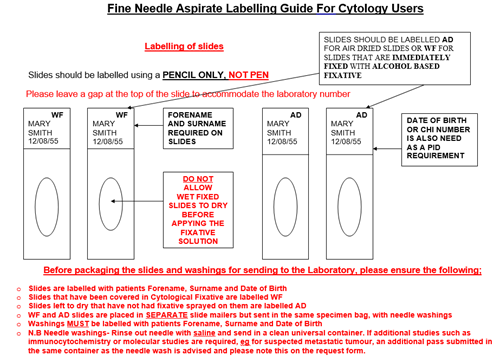
Fine Needle Aspirate Labelling Guide for Cytology Users
The specimen should be taken following the normal smear taking protocol.
The collected specimen should then be rinsed out into a Hologic™ Thin Prep Pap Test (LBC) specimen vial
Please ensure the vial is within the date specified. If it is out of date then it must NOT be used.
If a sample is received taken using an out of date vial, it will NOT be processed.
Each LBC sample should be placed in a clear polythene bag and sent to the laboratory in the appropriate white cervical cytology samples only (LBC) bag and accompanied with a Specimen Dispatch Note.
Hologic Aptima Multi Test Swab Specimen Collection Kit provided to patients by GP.
Please ensure the swab is within the date specified.If it is out of date then it must NOT be used.
If a sample is received taken using an out of date swab, it will NOT be processed.
Lab supplies GPs with Hologic Aptima Multi Test Swab Collection Kits
Each swab sample should be placed in a clear polythene bag and sent to the laboratory in the appropriate white cervical cytology samples only (LBC) bag and accompanied with a Specimen Dispatch Note.
The specimen should be taken as described in the handbook for Healthcare Professionals Taking Cervical Screening Tests supplied to smear takers by NSD. Other boards should follow their normal smear taking protocol. The collected specimen should then be rinsed out into a Hologic™ Thin Prep Pap Test (LBC) specimen vial.
Please ensure the vial is within the date specified. If it is out of date then it must not be used.
Requests for cervical smears should be generated electronically at the smear taker location using the Scottish Cervical Call and Recall computer system (SCCRS). If your patient is awaiting IVF please note this in the Clinical Comments box and the sample will be prioritized. The vial should be appropriately labelled using the bar coded SCCRS label and sent to the laboratory.
Each LBC sample should be placed in a clear polythene bag and sent to the laboratory in the appropriate White Cervical Cytology Samples Only (LBC) bag (NHSGGC) and accompanied with a Specimen Dispatch note.
Sample takers from other health boards should use their respective collection bags and tracker sheets as appropriate. Samples are then transferred on to the local ‘hub’ for forwarding to the lab in NHSGGC using the provided DX courier and collection/delivery bags.
In exceptional circumstances cervical smear samples can be sent to the laboratory accompanied by a paper request form. Smear takers who send paper requests with the sample to the laboratory must use the official SCCRS Cervical Cytopathology Request Form.
Smear takers must give a reason as to why a paper request was sent, such as SCCRS not working at smear taker location
Self-Sampling for HPV Screening Pilot
A Pilot/Trial of HPV Screening using swabs for self-sampling commenced 23/02/26 with selected GP practices across NHS Greater Glasgow & Clyde. Information kits and Instructions for both GPs and Patients are provided by Screening Oversight and Assurance Scotland (SOAS).
Samples are to be taken using the Hologic Aptima Multi Test Swab Specimen Collection Kit. This will be supplied to GP practices by the Cytology Department.
Please ensure the swab is within the date specified. If it is out of date then it must NOT be used. If a sample is received taken using an out of date swab, it will NOT be processed.
Requests for self-taken samples should be generated electronically by the GP practice using the Scottish Cervical Call and Recall computer system (SCCRS). The swab should be appropriately labelled using the bar coded SCCRS label and sent to the laboratory.
Each swab sample should be placed in a clear polythene bag and sent to the laboratory in the appropriate White Cervical Cytology Samples Only (LBC) bag (GGC) and accompanied with a Specimen Dispatch Note.
Contacts
The Cervical Cytology Department aims to provide the best possible diagnostic service. Should you have a general/technical enquiry or comments about any aspect of the service please contact:
The Andrology service is part of the Pathology Department based within the Laboratory Medicine and Facilities Management Building at the Queen Elizabeth University Hospital.
Laboratory Opening Hours are between 9:00am and 5:00pm, Monday – Friday.
The service is accredited by UKAS to ISO 15189: 2022 to perform the following diagnostic analyses:
Sub-Fertility
Post Vasectomy
Reversal of Vasectomy
Antegrade Ejaculation (spinal injuries)
Retrograde Ejaculation
Clinical Tests Available
Name of Test
Specimen/Container Requirements:
Further Information:
Semen Analysis
Semen analysis is strictly by pre-booked appointment only.
Andrology semen analyses are requested by clinicians/G.P.’s
The specimen should be brought by the patient at their appointment time:
Within 40 minutes of production for sub fertility and reversal of vasectomy.
Within two hours of production for post vasectomy.
A room is available for patients to produce their samples on site. This must be booked when making appointment.
Please refer to Patient leaflet for more information
Only Laboratory provided containers will be accepted for analysis.
These are available as part of the specimen kit. Specimen kits are available on request from:
Andrology Department, Level 3, Laboratory Medicine and Facilities Management Building, Queen Elizabeth University Hospital, 1345 Govan Rd, Glasgow, G51 4TF (0141 354 9488).
Arranging Semen Analysis Appointments
All requests for semen analysis can be made by the requesting clinician/GP or the patient themselves. Appointments are booked by telephoning the Pathology Department Office on 0141 354 9487, option 1 “Andrology Appointments”. This booking in service is available between 9:00am – 12:00pm and 1:00pm – 4:00pm Monday to Friday (excluding public holidays). We currently cannot accept requests via Trakcare.
If a patient can produce their sample at home and deliver it to the Lab within 40 minutes for sub fertility analysis and 2 hours for post vasectomy analysis, a drop-off only appointment should be booked. Patients that cannot make it from their home to the lab in these time limits should request a room-use appointment.
Patient Preparation
Each patient must be issued with a specimen kit before they attend their appointment. Please ensure that you complete the enclosed request form before issuing to the patient. We will only accept containers that are provided as part of these kits as these have been tested and passed a non-toxic by the laboratory. Some plastics are toxic to sperm and can affect sperm motility. Each kit consists of:
Directions to the Queen Elizabeth University Hospital
How the NHS handles your data 2018 leaflet
Patient information leaflet for either sub fertility or post vasectomy analysis
To obtain a supply of these kits please contact the laboratory on 0141 354 9488 from 9:00am – 5:00pm, Monday – Friday (excluding public holidays).
*For Retrograde analysis – the lab will supply a different container please contact the lab to discuss this.
Sample Minimum Acceptance Criteria
It is mandatory that samples are labelled with at least three unique identifiers which are as follows;
Surname
Forename
Date of Birth
CHI number
The request form data must match the above information on the sample, a lack of patient or sample information may result in the laboratory not performing the analysis.
Request form should also contain;
Forename and Surname
Patients address
Requesting clinician details including destination for report
Type of sample
All relevant clinical information
When attending for their appointment, patient will be asked to confirm the following information about their sample.
Date and time of sample production
Is the sample complete
When their last ejaculate occurred
WHO Reference Ranges for Sub Fertility
World Health Organisation (WHO) laboratory manual for the examination and processing of human semen (6th edition) (2021) lower reference values are shown in the table below.
The lower 5th percentile (with 95% confidence interval). These values represent the quality of various semen parameters where a couple achieved a natural pregnancy within 12 months of unprotected intercourse.
The TZI is one of the indices of multiple sperm defects (number of abnormalities per sperm). This is useful in understanding if there are issues regarding spermatogenesis (sperm production) and can be correlated to fertilisation rates. We do not routinely report the TZI. If this is required, please ensure you request this on the referral form or call the laboratory within 7 days of reporting. The categories of TZI are given below, although it is best to understand that the higher the number (maximum of 4) the higher the number of abnormalities per sperm.
TZI Number
Category
≤1.6
Normal
1.61 – 1.80
Borderline
>1.8
Pathological
Human Reproduction, Vol.26, No.12 pp. 3207–3212, C.L.R. Barratt, Bjorndahl, R. Menkveld and D. Mortimer 2011 ESHRE Special Interest Group for Andrology Basic semen analysis course: a continued focus on Accuracy, Quality, Efficiency and Clinical relevance
Turnaround Times
Results available electronically within 5 working days from receipt of specimen
Information for Patients
You have been asked to provide a semen sample as part of infertility investigation or after a vasectomy operation. Please do not attend the hospital without an appointment, we will not be able to analyse your sample.
For Sub-Fertility Patients (including Reversal of Vasectomy)
A semen analysis is usually advised if a couple are having difficulties becoming pregnant. This is an extremely common problem affecting up to one in seven couples in the UK. Among those experiencing difficulty, a male fertility problem is considered important in around 40 per cent of couples.
The sample will be analysed according to World Health Organisation (WHO) standards for volume, pH concentration, motility and morphology. Results will be sent to the referring doctor within 5 working days.
Please note the laboratory will not issue results to anyone other than the requesting doctor.
Please read all of the information provided in the specimen kit carefully as it contains essential information about your appointment and what the laboratory needs you to do so that they can analyse your sample.
For Post Vasectomy Patients
A semen analysis is advised to ensure your vasectomy operation has been successful. Samples can be analysed no earlier than 16 weeks after your operation and with a minimum of 24 ejaculations before sample production.
Please read all of the information provided in the specimen kit carefully as it contains essential information about your appointment and what the laboratory needs you to do so that they can analyse your sample.
Results will be sent to the referring doctor within 5 working days.
Please note the laboratory will not issue results to anyone other than the requesting doctor.
During this time contraceptive precautions should be taken until clearance has been given by your surgeon or doctor.
This is a placeholder tab content. It is important to have the necessary information in the block, but at this stage, it is just a placeholder to help you visualise how the content is displayed. Feel free to edit this with your actual content.
Accordion title 2
This is a placeholder tab content. It is important to have the necessary information in the block, but at this stage, it is just a placeholder to help you visualise how the content is displayed. Feel free to edit this with your actual content.
Factors That May Affect Semen Results
Some plastics are toxic to sperm so only specimen containers provided within the specimen kits will be accepted.
Extremes of temperature can damage sperm, please keep the sample at body temperature whilst it is being transported to the laboratory, for example by carrying it in your inside pocket.
A condom and/or artificial lubricant must not be used for semen collection as it will kill sperm.
Sperm motility can decline over time so it is important that the sample is examined in under an hour for infertility testing.
The number of days of sexual abstinence can affect sperm quality – Abstinence should be between 2-7 days for semen analysis.
The sperm are in the first part of the ejaculate so the whole sample needs to be collected.
Viscous samples or specimens where there is sperm agglutination/aggregation can affect semen analysis results.
Accordion title 1
This is a placeholder tab content. It is important to have the necessary information in the block, but at this stage, it is just a placeholder to help you visualise how the content is displayed. Feel free to edit this with your actual content.
Accordion title 2
This is a placeholder tab content. It is important to have the necessary information in the block, but at this stage, it is just a placeholder to help you visualise how the content is displayed. Feel free to edit this with your actual content.
Was this helpful?
Yes
No
Thanks for your feedback!
The Advanced Staining section of the laboratory comprises Immunocytochemistry, Immunofluorescence, Neuropathology, Enzyme Histochemistry (Muscle & Nerve biopsies) and Special Stains
Please see the full list of staining techniques and ICC markers that are under our scope of accreditation with UKAS for further details.
The accreditation section on the front page of this website details any staining tests/ICC Markers/other techniques that are not currently under our scope of accreditation.
See the sections below and the user manual for specific information on sending neuropathology specimens, muscle biopsies, nerve biopsies or specimens for immunofluorescence.
Neuropathology
Neurosurgical Biopsies for Intra-operative Diagnosis (Smear or Frozen)
The laboratory must be notified of all potential intra-operative investigations, a minimum of 24 hours in advance of surgery via 0141 353 9530 (89530) or by paging 17627. When initially contacting the lab, the patient name, CHI Number, surgical procedure, location and estimated time of biopsy should be provided so that appropriate medical and laboratory staff cover can be arranged.
Failure to notify the lab of a case in advance of the surgery taking place may lead to delays in obtaining an intra-operative report if pathologist/laboratory staff are unavailable or allocated elsewhere.
Ideally all intra-operative cases should be discussed with a neuropathologist at the appropriate MDT meeting.
Containers
Sterile, screw cap containers should be used and are stored and managed by theatres. Please contact: 0141 354 9530 (89530) if you urgently require additional containers, you will need to send a porter to collect them.
All containers should be clearly labelled with patient name, date of birth, CHI number, ward number and consultant.
If a specimen is small, the specimen can be put on a glass slide within the container. Please do not add any fluid to the container.
High-risk specimens must carry appropriate danger of infection and clinical information provided.
Point of delivery
Please contact Neuropathology 0141 354 9530 (89530) to alert us that a fresh specimen is on its way so that we can prepare for its arrival.
The specimen should be brought by the porter to:
Neuropathology, NHSGGC Pathology Department Level 3, Laboratories & Facilities Management Building Queen Elizabeth University Hospital Glasgow G51 4TF
It is the clinician’s responsibility to arrange immediate transportation of a specimen to Neuropathology.
The specimen must be handed to a member of Laboratory staff on delivery.
Neurosurgical Biopsy for Paraffin Histology
No prior notification is necessary.
Containers
Sterile, screw cap containers should be used and are stored and managed by theatres. Please contact: 0141 354 9530 (89530) if you urgently require additional containers, you will need to send a porter to collect them.
All containers should be clearly labelled with patient name, date of birth and CHI number.
High-risk cases must carry appropriate hazard labels.
Tissue Fixation
10% formal saline is supplied by the Pathology Specimen Reception when requested by theatres. Please contact 0141 354 9513 or 0141 354 9514 (89513/89514) when required.
Institute of Neurosciences Theatres
Please contact the department and organise a porter to bring suitable empty containers to the department.
Royal Hospital for Children Theatres
The neuropathology department supplies containers with 10% formal saline on request. Please contact the department before requesting a porter to come and collect the containers.
The container should be at least twice the volume of the specimen and filled with 10% formal saline.
Accompanying Information
Completed request forms should carry the consultant’s name, ward number, patient’s name, CHI number, address with post-code, date of birth, date of operation and relevant clinical information.
For more technical information/specimen enquiries, please contact Neuropathology on 0141 354 9530 (89530)
Point of Delivery
Neuropathology, NHSGGC Pathology Department Level 3, Laboratories & Facilities Management Building Queen Elizabeth University Hospital Glasgow G51 4TF
Muscle & Nerve Biopsies
Muscle Biopsy
Prior notification
Elective cases should be booked with the lab with as much notice as possible. The cases can be booked by contacting the neuropathology laboratory via 0141 354 9530 (89530) or through page 17627 or the appropriate consultant.
If there is a danger of infection, these cases must be discussed with medical staff before biopsy as the range of investigations which may be performed with these specimens is limited.
Fresh muscle specimens will only be accepted in Neuropathology from 9.00am to 4.00pm, Monday to Friday (excluding public holidays).
Any specimen arriving outside these hours will not be processed appropriately.
Specimens must be placed in a dry, clean universal container. No saline, gauze or formalin should be in the container. The muscle should be dropped into the container and the lid screwed on. The specimen should be transported immediately to Neuropathology.
If there is to be a delay of any longer than 20 minutes it is advisable that the universal container (not the muscle directly) should be transported on ice (not dry ice). If transported in this manner, the specimen container should be well insulated to prevent direct contact with the ice and potential damage to the muscle biopsy.
All containers should be clearly labelled with patient name, date of birth, CHI number, ward number and consultant. Universal containers must be placed in a specimen bag accompanied by a request card and muscle biopsy request form. This form also contains detailed handling instructions and our full delivery address.
High-risk cases must carry appropriate hazard labels.
Universal containers must be placed in a specimen bag accompanied by a request card and muscle biopsy request form.
Accompanying Information
A muscle biopsy request form and the completed request form must carry the consultant’s name, ward number, patient name, CHI number, address with post-code, date of birth, date of operation, relevant concise clinical data and the nature of the laboratory request. Muscle Biopsy request forms are linked here or available from the Pathology Lab. Tel. 0141 354 9530 (89530)
Point of delivery
Contact Neuropathology on 0141 354 9530 (89530) or page 7627 who will advise on delivery of specimen.
Neuropathology, NHSGGC Pathology Department Level 3, Laboratories & Facilities Management Building Queen Elizabeth University Hospital Glasgow G51 4TF
Elective cases that require a frozen section should be booked with the lab with as much notice as possible. Any nerves for neuropathology which do not require a frozen section should be sent in formalin.
Nerve biopsies which require frozen section must be booked in advance (more than 24 hours) by calling 0141 354 9530 (89530) or through page 17627 or the appropriate consultant. The cases can be booked by contacting the neuropathology secretaries via 0141 354 9486 (89486) or through page 17627 or the appropriate consultant.
If there is danger of infection, these cases must be discussed with medical staff before biopsy.
A service to receive unfixed nerve specimens can be offered until 4.00pm, Monday to Friday (excluding public holidays). Specimens must be placed in a dry, clean universal container. No saline, gauze or formalin should be in the container. (The nerve should be dropped into the container and the lid screwed on). The specimen should be transported immediately to neuropathology.
Please contact Neuropathology 0141 354 9530 (89530) to alert the team that a fresh specimen is on its way so that they can prepare for its arrival
High-risk cases must carry appropriate hazard labels.
Universal containers must be placed in a specimen bag accompanied by a request form.
All containers should be clearly labelled with patient name, date of birth, CHI number, ward number and consultant. Universal containers must be placed in a specimen bag accompanied by a request card.
Accompanying Information
Completed request forms must carry the consultant’s name, ward number, patient name, CHI number, address with post-code, date of birth, date of operation, relevant concise clinical data and the nature of the laboratory request.
Point of delivery
Neuropathology, NHSGGC Pathology Department Level 3, Laboratories & Facilities Management Building Queen Elizabeth University Hospital Glasgow G51 4TF
Contact: 0141 354 9530 (89530)
The specimen must be handed to a member of Laboratory staff on delivery.
Immunofluorescence
The pathology department offers a service for immunofluorescence testing on skin, renal, conjunctival and oral biopsies.
Skin, Renal, Oral and Conjunctival Biopsies requiring immunofluorescence should be placed in Michel’s fixative immediately after collection.
Michel’s media is capable of preserving fresh tissue for up to 5 days before there is any deterioration in the sample. The request form is checked for the date a sample is taken, to ensure that it has been received within time. Michel’s media is available from the pathology department upon request. The fixative should be stored between 2-250c and not be used after it has reached its expiry date.
Danger of Infection
Specimens that are suspected or are known to contain blood borne viruses (e.g. HIV, Hep B, and Hep C) are classified as Category 2 and can be dealt with using the appropriate safety precautions.
Specimens suspected or known to have Category 3 organisms (e.g. TB, Leprosy, and Anthrax) or Category 4 organisms (e.g. Ebola, Lassa Fever and Haemorrhagic Fever) or CJD are not suitable for analysis via immunofluorescence.
For further information regarding immunofluorescence or danger of infection samples, please contact the Immunocytochemistry Department of the pathology laboratory (0141 354 9518 or 89518).
Was this helpful?
Yes
No
Thanks for your feedback!
Cookie Consent
We use cookies to analyse traffic to our site and to enable certain functions such as forms and embedded videos. These do not collect personal information. By clicking "Accept All", you consent to our use of cookies, or you can customise the options.
This website uses cookies
Websites store cookies to enhance functionality and personalise your experience. You can manage your preferences, but blocking some cookies may impact site performance and services.
Essential cookies enable basic functions and are necessary for the proper function of the website.
Name
Description
Duration
Cookie Preferences
This cookie is used to store the user's cookie consent preferences.
30 days
CloudFlare provides web performance and security solutions, enhancing site speed and protecting against threats.
Sequence rules uses cookies to track the order of requests a user has made and the time between requests and makes them available via Cloudflare Rules. This allows you to write rules that match valid or invalid sequences. The specific cookies used to validate sequences are called sequence cookies.
session
cf_ob_info
The cf_ob_info cookie provides information on: The HTTP Status Code returned by the origin web server. The Ray ID of the original failed request. The data center serving the traffic
session
cf_chl_rc_m
These cookies are for internal use which allows Cloudflare to identify production issues on clients.
session
__cfruid
Used by the content network, Cloudflare, to identify trusted web traffic.
session
__cf_bm
Cloudflare's bot products identify and mitigate automated traffic to protect your site from bad bots. Cloudflare places the __cf_bm cookie on End User devices that access Customer sites that are protected by Bot Management or Bot Fight Mode. The __cf_bm cookie is necessary for the proper functioning of these bot solutions.
session
__cflb
When enabling session affinity with Cloudflare Load Balancer, Cloudflare sets a __cflb cookie with a unique value on the first response to the requesting client. Cloudflare routes future requests to the same origin, optimizing network resource usage. In the event of a failover, Cloudflare sets a new __cflb cookie to direct future requests to the failover pool.
session
_cfuvid
The _cfuvid cookie is only set when a site uses this option in a Rate Limiting Rule, and is only used to allow the Cloudflare WAF to distinguish individual users who share the same IP address.
session
cf_clearance
Whether a CAPTCHA or Javascript challenge has been solved.
session
cf_use_ob
The cf_use_ob cookie informs Cloudflare to fetch the requested resource from the Always Online cache on the designated port. Applicable values are: 0, 80, and 443. The cf_ob_info and cf_use_ob cookies are persistent cookies that expire after 30 seconds.
session
__cfwaitingroom
The __cfwaitingroom cookie is only used to track visitors that access a waiting room enabled host and path combination for a zone. Visitors using a browser that does not accept cookies cannot visit the host and path combination while the waiting room is active.
session
cf_chl_rc_i
These cookies are for internal use which allows Cloudflare to identify production issues on clients.
session
cf_chl_rc_ni
These cookies are for internal use which allows Cloudflare to identify production issues on clients.
session
Statistics cookies collect information anonymously. This information helps us understand how visitors use our website.
We use Microsoft Clarity to understand how users interact with our website, including information such as clicks, scrolling and navigation behaviour, to help improve our services.
Microsoft Clarity uses cookies and similar technologies. These are only set if you accept analytics cookies.
If you choose not to accept analytics cookies, Clarity will operate in a limited mode using non-cookie-based data, which does not track users across pages or visits.
The data collected is behavioural and technical in nature and does not directly identify individuals. Sensitive information such as names, email addresses and form inputs is automatically hidden and not recorded or viewed.
Some information, such as device and approximate location data will still be collected and is treated as personal data in accordance with data protection legislation.
This will not be used for any purpose other than analytics and will not be used to identify you.
We use Microsoft Clarity to understand how users interact with our website, including information such as clicks, scrolling and navigation behaviour, to help improve our services.
Microsoft Clarity uses cookies and similar technologies. These are only set if you accept analytics cookies.
If you choose not to accept analytics cookies, Clarity will operate in a limited mode using non-cookie-based data, which does not track users across pages or visits.
The data collected is behavioural and technical in nature and does not directly identify individuals. Sensitive information such as names, email addresses and form inputs is automatically hidden and not recorded or viewed.
Some information, such as device and approximate location data will still be collected and is treated as personal data in accordance with data protection legislation.
This will not be used for any purpose other than analytics and will not be used to identify you.