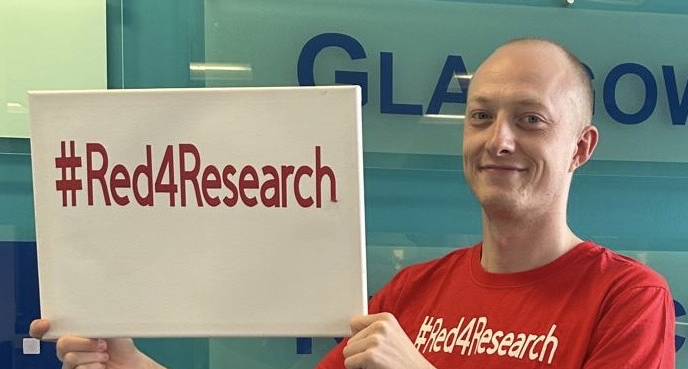
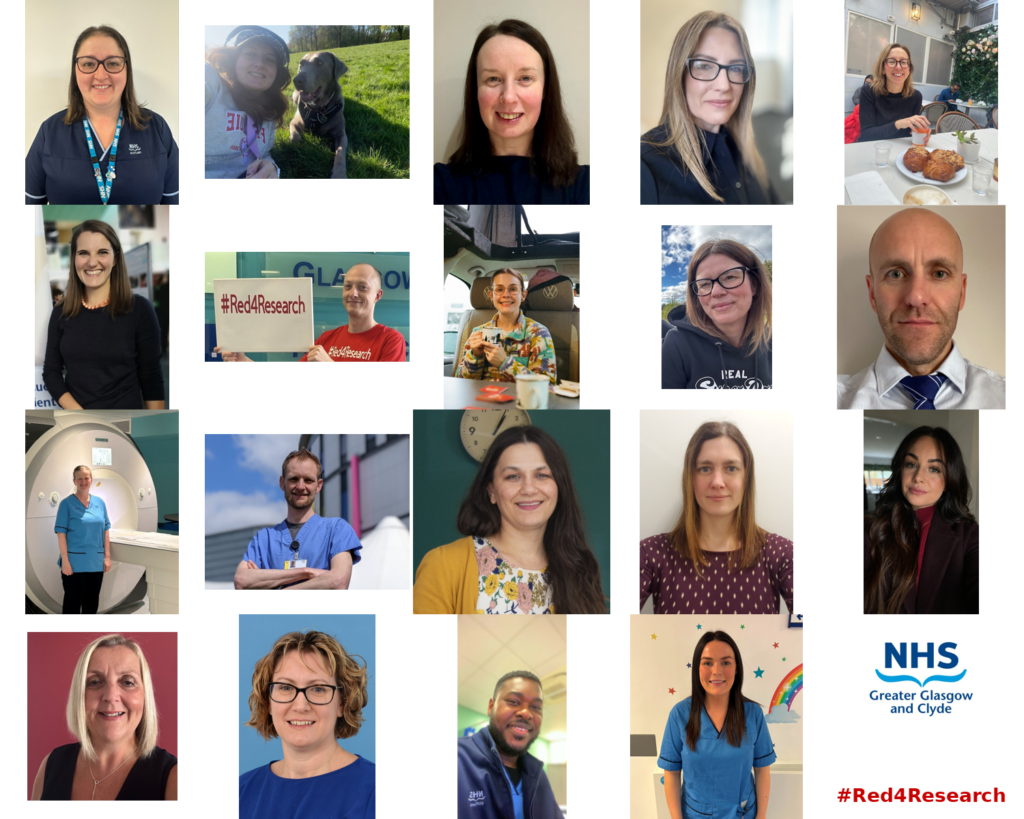
Staff across NHS Greater Glasgow and Clyde (NHSGGC) are coming together to mark Red4Research Day, celebrating the people who make life-changing health and care research possible.
The global awareness day highlights the collective effort behind research, recognising that it is only made possible by people working together to improve care.
Across NHSGGC, research is embedded in everyday care, with hundreds of studies taking place across specialties and thousands of patients taking part each year.
But at its heart, staff say, research is about the patients who ultimately benefit, and their desire to make a difference.
Research Administration Manager Edward Brockett, said: “The opportunity to get an insight into life-changing medicine interested me as I have experienced a direct positive impact from research.
“I was born with congenital heart disease and had to have open heart surgery before my first birthday.
“Being able to give something back has been so rewarding.”
Radiographer Evonne McLennan, based at the Queen Elizabeth University Hospital, said the favourite part of her job is the relationships she builds with patients throughout their time within a trial.
She said: “As a small department, we see the same patients regularly, which is really nice as we get to know each other.”
And Emily Caine, a Senior Research Nurse working in Paediatrics, said: “What I enjoy most about my role is being able to offer children and young people access to treatments that may not otherwise be available to them.
“Seeing the positive impact research can have on their lives, while helping shape future treatments, is incredibly rewarding.”
That shared sense of purpose is evident across the organisation. Dr Linsay McCallum, a Consultant Clinical Pharmacologist and Senior Research Fellow, said: “I am interested in the development and use of new medicines or optimising the use of current medicines, primarily for the prevention and treatment of cardiovascular disease.
“This interest motivated me to work in research and it gives me the opportunity to offer our patients in NHSGGC access to new medicines within our portfolio of clinical trials.”
For others, the focus is on tackling inequality and improving access, with Senior Research Nurse Philip Anim adding: “Coming from Ghana, I have seen first-hand how limited access to evidence-based care affects health outcomes.
“I wanted to be part of generating the evidence that improves care for people who need it most.”
Across different roles, NHSGGC staff share a common experience – that no two days are the same, and every role plays a vital part in delivering research.
From coordinating complex studies to supporting participants through trials, this work relies on strong teamwork and robust systems behind the scenes.
The support of the ethics, governance, systems and pharmacy teams underpins every study, ensuring safe set-up and delivery.
Alongside this, the NHSGGC Biorepository oversees the governance of biological samples, while the West of Scotland Safe Haven provides a secure, approved environment for using de‑identified health data to support research and innovation.
From coordinating complex studies to supporting participants through trials, this work relies on strong teamwork and robust systems behind the scenes.
The support of the ethics, governance, systems and pharmacy teams underpin every study, ensuring safe set-up and delivery.
Alongside this, the NHSGGC Biorepository oversees the governance of biological samples, while the West of Scotland Safe Haven provides a secure, approved environment for using de‑identified health data to support research and innovation.
Meanwhile, the West of Scotland Innovation Hub is helping to bring new ideas into practice, working with NHS teams, academia and industry partners to test and deliver innovations that improve patient care.
Together, these services form part of a wider research infrastructure that ensures patients across NHSGGC can access cutting-edge treatments and take part in studies that shape future care.
For staff, the most rewarding moments come when research translates into real-world impact.
Dr Helen McDevitt, Consultant Neonatologist at the Royal Hospital for Children, is a Principal Investigator for paediatric bone and neonatal studies.
She said: “I’ve been involved with the mOm incubator since its inception.
“It’s a novel, inflatable, low-cost incubator. Following the successful clinical trial here in Glasgow it achieved CE marking and was shipped urgently to Ukraine.
“It was a unique experience to be connecting with clinicians in Ukraine, to support their use of the incubator in such challenging surroundings (a basement room in a blackout).”
Lynn Prentice, Clinical Research Manager at the Glasgow Clinical Research Facility, added: “Research is about more than studies and outcomes – it is about creating hope, improving lives, and giving patients and families the chance of a better future.”
On Red4Research Day, NHSGGC is recognising the extraordinary efforts of its multidisciplinary workforce – from frontline clinicians to educators, data specialists and project teams – as well as the patients and volunteers who make research possible.
Their combined contribution is helping to advance knowledge, develop new treatments and improve care for patients across Greater Glasgow and Clyde and beyond.
Professor Jesse Dawson, Director of Research and Innovation at NHS Greater Glasgow and Clyde, said: “On Red4Research Day, we want to take a moment to thank everyone who makes research possible across NHS Greater Glasgow and Clyde – our dedicated staff, our patients, and their families.
“Research is a true team effort. Whether delivering studies on the frontline, supporting work behind the scenes, or choosing to take part in a trial, every contribution plays a vital role in advancing knowledge and improving care.
“It is through this shared commitment that we can continue to develop new treatments, improve services, and ensure that patients today, and in the future, benefit from the very best care the NHS can offer.”