- GENERAL INFORMATION
1.1 Opening & Building Defects -The QEUH and the RHC both opened in 2015. Unfortunately, NHSGGC did not receive the building that it paid for. As a result, there were multiple issues with the quality of the building. NHSGGC currently has a range of ongoing legal proceedings against the builder as a result of these significant failures. Some of these issues were apparent soon after opening but for other defects it has taken time to fully understand and begin to address these. The quality issues of the building have, and do cause significant additional pressure for the staff of NHSGGC including our clinicians, estates staff, infection control team, microbiologists and managers.
1.2 Improvement Work – NHSGGC has required to invest over £50million to date to address these defects. It has significantly upgraded and improved the quality of the domestic water supply and the quality of air and ventilation across the site. In particular in the RHC paediatric haematology Schiehallion Unit, the adult Bone Marrow Transplant QEUH Ward 4B and a number of other critical air systems areas.
1.3 Complex Facilities – It is important to note that hospitals are large and complex facilities and system failures can and will occur. We have well-trained staff in place and robust systems and procedures to ensure that we respond quickly and effectively. This often requires the involvement of colleagues from different professional disciples including medical, nursing, estates, system specialists, microbiology and infection control.
1.4 Regular Work to Monitor and Maintain our Hospitals – To ensure hospitals are of an adequate standard significant work is undertaken to ensure:
- the quality and standard of the building and hospital systems.
- routine maintenance is undertaken to make sure that the standards are maintained.
- regular sampling, monitoring and reporting is done to ensure safety.
- key roles are in place to be responsible for each critical system and these people are responsible for ensuring the standards, taking corrective action when required and escalating significant issues which are not readily resolvable.
- independent audits are carried out to test the systems and provide an additional layer of assurance.
- full governance systems are in place to review and challenge as a further layer of assurance.
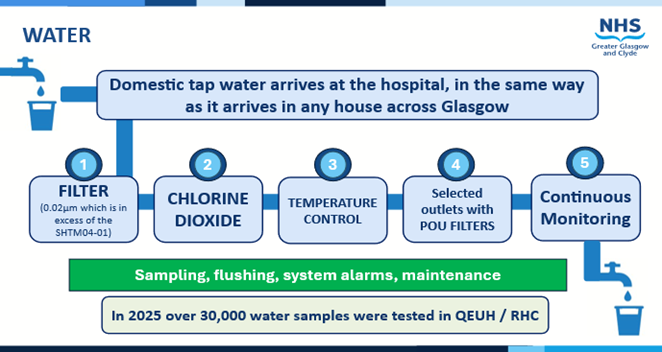
1.5 Water System – Significant work has been undertaken to ensure a high standard of water quality. A comprehensive water treatment system has been in place to ensure the highest quality of tap water is available. The diagram below shows the five additional steps we take:
2 WARD 4B – Ward 4B is our adult Bone Marrow Transplant (BMT) Ward.
The clinical BMT team are highly skilled in providing care and treatment for our patients. During treatment our patients are more vulnerable to infections and our staff are especially diligent at checking for any individual or environmental changes.
Tap water (as set out above) is of the highest standard.
2.1 RECENT ISSUE REPORTED IN MEDIA
Just over two weeks ago, a member of staff noted some dark marks on the ceiling of one room beside a ceiling hatch. There was no patient receiving care in the room at the time of identification.
Potential Causes – At the time of identification there were a number of potential causes considered including that it may simply be a dirty mark or that it could be mould from potential water ingress (for example if there was a leak from a pipe or area above).
Actions Taken
- Swabs of the area were taken – there has been no growth from the swab (no mould detected).
- The room was sealed out of use and the area was not disturbed.
- The adjacent room (which shares a ceiling space) was also isolated until confirmation.
- Once the negative result was received physical examination took place through the hatch above which confirmed that there were no signs of recent or historical water in the ceiling space above either room.
Summary
Following full investigation we are confident that there was NO water (clean or dirty) ingress in the area assessed.
2.2 OTHER PREVIOUS/ONGOING ESTATES ISSUES
Our estates and facilities teams work every day to maintain our hospitals and to manage issues proactively. There is an ongoing programme of maintenance and repairs. As with other areas in the hospital a small number of rooms on 4B have been closed at different times over the past year to carry out maintenance and repairs. These are not related to the investigations of last week.
- On the afternoon of Wednesday 4th March a small drip was noted in a different room. Following investigation, it was found that a rubber washer on the flexible connection had perished (in a heating pipe) above the room. It was replaced and the issue resolved within one hour. As a matter of precaution, the room was sealed and moisture levels checked for 48 hours. The room awaits final testing before being returned to use. No HIIAT was required as there was no clinical incident.
- In August 2025 two (back to back) rooms were closed to have planned repairs to vinyl flooring and walls. This was done as a proactive measure and was not linked to any clinical issue. Following initial work there was evidence of a leak at the basin and it was agreed that a more comprehensive en-suite refit was required. No HIIAT was required as there was no clinical incident.
- In Feb 2026 an external window seal was found to be damaged and subsequently replaced, the room tested and brought back into use. No HIIAT was required as there was no clinical incident.
These issues are rectified using an HAI Scribe (Healthcare Associated Infection System for Controlling Risk in the Built Environment). This is an NHS Scotland risk management tool used to assess and mitigate infection risks during the design, construction and maintenance of healthcare facilities.
This is best practice in safely managing small issues and the issues are not required to be escalated to the Scottish Government.
2.3 CLINICAL CASE REVIEW – Incident Management Team (IMT)
An IMT was established following the identification of an infection in a very small number* of patients. Investigation to date has already been able to exclude one patient from the investigation. Appropriate infection prevention measures have been followed to minimise any risk and we continue to work to understand if there are any links between the cases, and to identify the source of the infections. While the ceiling marks were discussed at the IMT, there has been no confirmed link with any of the patients to date.
The patients are all now discharged and show no cause for concern.
All other patients on the ward have been informed and are being kept updated by clinical teams.
*As with all health boards we operate to Caldicott Principles – this is absolutely crucial to ensure patient information is kept confidential. This is why we do not provide specific information on cases – including numbers of cases when these are less than five. This is standard recognised practice and should not be confused with concealing information as has been reported by the media.
2.4 How HIIATS work and why the HIIAT was rated ‘Red’
Guidance over how Health Boards should evaluate incidents using a Hospital Infection Incident Assessment Tool (HIIAT) is set out in Chapter 3 of the National Infection Prevention and Control Manual: Home.
HIIATs are used by IMTs and assess the impact of the incident on patients, services and public health. These are assessed by Health Boards who are responsible for internal reporting and external reporting to the Antimicrobial Resistance and Healthcare Associated Infection (ARHAI) Scotland.
Incidents can be assessed as red for a range of reasons, including severity of illness and impact on service delivery, and it is not necessarily an indication of a wider problem.
Following the IMT for Ward 4B, the HIIAT was first assessed. This was reassessed on Wednesday 4th March as red, purely in relation to significant media interest and the risk of public anxiety.