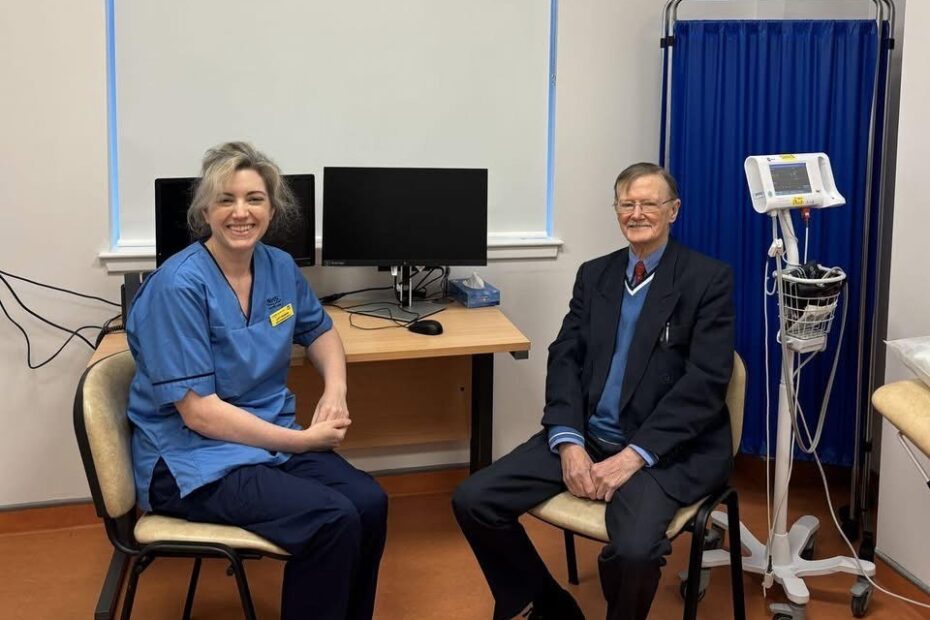
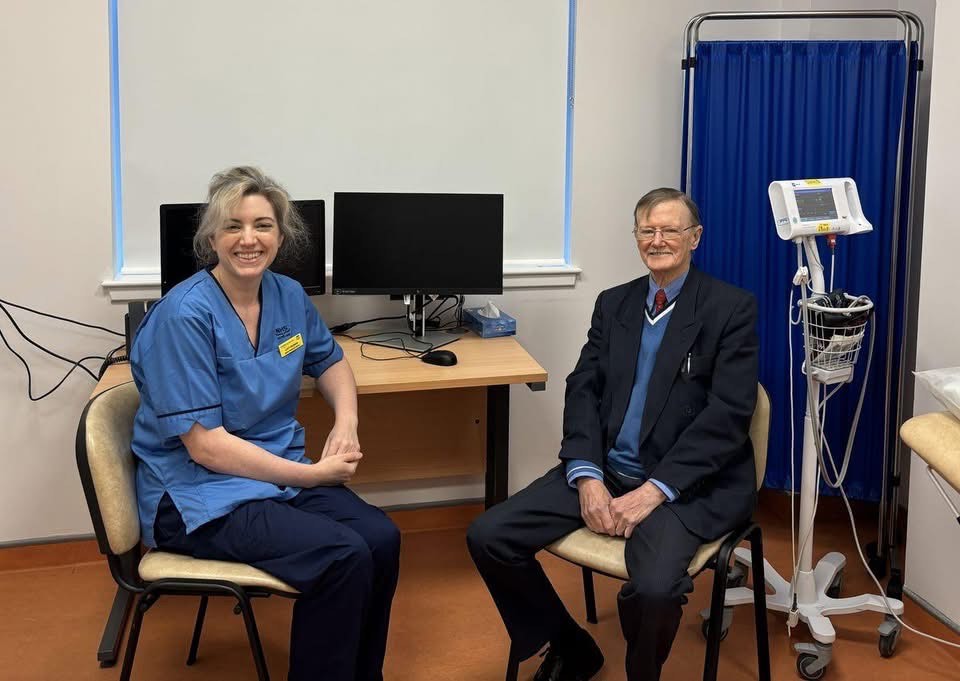
The first patient in Scotland recruited to a major research study has described it as “the light at the end of the tunnel” after he was diagnosed with late-stage lung cancer last year.
The TOURIST PRINCE trial is part of the world’s largest clinical trial using radiotherapy in the treatment of metastatic lung cancer, funded by a £3.4m grant from the National Institute for Health and Care Research (NIHR).
The trial is looking at whether modern radiotherapy treatments can improve outcomes for patients with stage IV disease, who often have a poor prognosis and typically have about a year to live.
PRINCE is part of the wider TOURIST trial platform which is sponsored by The Christie NHS Foundation Trust in Manchester and managed by Southampton Clinical Trials Unit.
81-year-old great-grandfather Robert Brown, a retired managing director from Glasgow, was diagnosed with non-small cell lung cancer (NSCLC) in the summer of 2025.
He said: “At the beginning of July, I had a cough which lasted for six weeks before I went to see the GP. He jumped on it right away and sent me for an x-ray at the New Victoria Hospital and it was then that I was diagnosed with lung cancer.
“I’ve had a decent life and lived pretty healthily for 81 for years, so I suppose it’s just life, isn’t it? But when the team at the hospital told me about the trial and asked if I’d consider taking part, I went straight on to it. It’s the light at the end of the tunnel.”
Lung cancer is the 3rd most common cancer in the UK, but is the biggest cancer killer, accounting for 21% of cancer deaths annually.
Between 85 and 90 per cent of cases diagnosed are non-small cell lung cancer (NSCLC) and nearly half of these cancers are diagnosed at a late stage when the disease has spread and is incurable, meaning treatment focuses on controlling symptoms and extending life, rather than curing patients.
TOURIST is the first trial in 20 years to look at how radiotherapy could benefit late-stage metastatic lung cancer patients.
It uses a technique called ‘VMAT’ (volumetric modulated arc therapy) which is a form of radiotherapy that uses multiple beams of varying strengths to treat cancer. A device called a linear accelerator (LINAC) delivers high-energy beams while rotating around the patient to treat the tumours.
Professor Matthew Hatton, Honorary Professor of Clinical Oncology at The University of Sheffield, who is the chief investigator for the TOURIST PRINCE trial, said: “Giving the radiotherapy in this way makes it very accurate, shortens the treatment time, and uses a lower overall dose of radiation.
“It means more cancer cells can be killed while also sparing healthy tissue around the organ. Previously this machine has only been used to treat patients with early-stage cancer that has not spread, but we are hoping to show that it could also have benefits for those with late-stage disease. If successful, this trial could change global clinical practice for treating advanced lung cancer.”
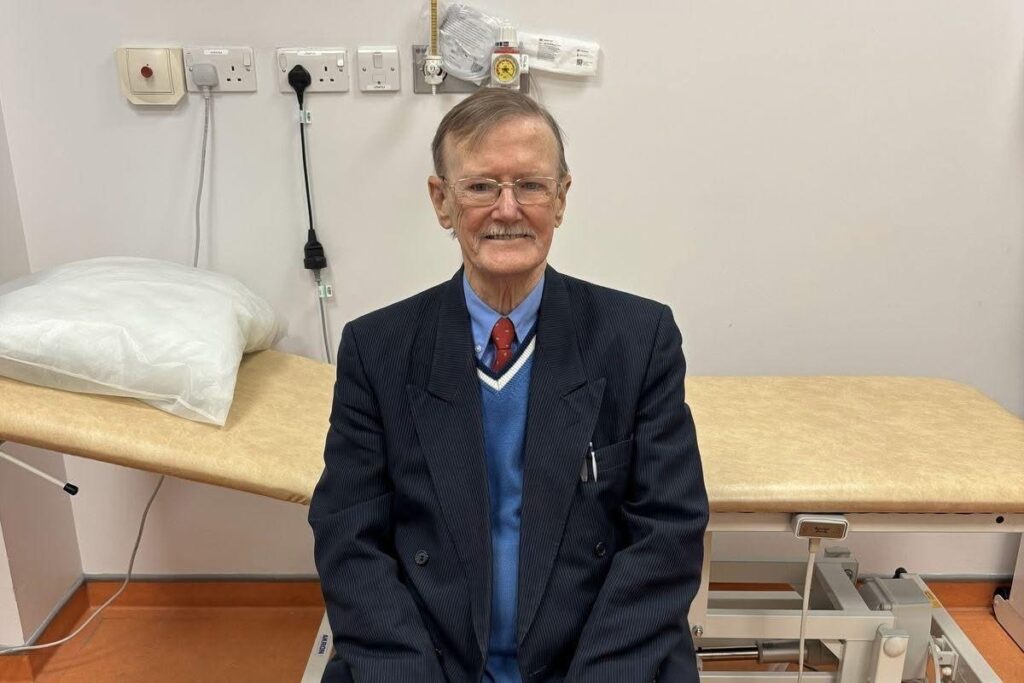
Robert, who has been married to his wife Caroline for 56 years and has two children, two grandchildren and two great grandchildren, said: “Being on the trial has been okay for me, I’ve had no issues so far.
“I am still keeping myself fit and strong, and despite my treatment I’m even continuing to go jogging. It feels good to be part of the trial and part of research. Research has got to help.”
The PRINCE trial is aiming to recruit 472 patients with newly diagnosed with stage IV non-small cell lung cancer at hospitals across the UK. It first opened to recruitment in autumn 2024, but Robert is the first patient in Scotland to take part.
Lucy Badesha is a Senior Research Nurse at the New Victoria Hospital in Glasgow.
She said: “As a satellite site of the Beatson West of Scotland Cancer Centre, part of our mission at the New Victoria Hospital is to offer clinical trials to patients who may not be able to access them otherwise.
“We were delighted to hear that we had recruited the first TOURIST PRINCE participant in Scotland, and we hope to be able to continue to offer participation in this and other life-changing cancer clinical trials to patients living on the south side of Glasgow.”
PRINCE is one of two trials currently recruiting patients in the TOURIST platform, which has been set up to see if radiotherapy, alongside other treatments, improves outcomes and quality of life for lung cancer patients.
Nicky Downs, Senior Trial Manager for the TOURIST trial platform at the Southampton Clinical Trials Unit, said: “It is wonderful to see the first patient recruited to the PRINCE trial in Scotland, and we are so grateful to Robert, and to all the other patients who have agreed to take part in TOURIST, for helping further our research into this awful disease.
“We hope to be able to expand the platform in the coming months with new trials, allowing us to include even more patients, understand the disease better, and learn how we can control patient’s symptoms and improve survival.”
Dr David Woolf, consultant oncologist at The Christie and is the joint chief investigator for the TOURIST platform, said “The TOURIST trials represent a huge shift in the way we potentially treat lung cancer patients and could bring additional benefit to patients undergoing their standard treatments in the future.
“This is the first time we have delivered a trial in radiotherapy for stage IV NSCLC patients for two decades and techniques have advanced massively in that time. We therefore hope to provide enough evidence to change clinical practice globally, which could help up to a million people a year worldwide.”
Professor Anthony Gordon, Director of NIHR’s Health Technology Assessment Programme, said: “Living with late-stage lung cancer is difficult and challenging for patients and their families. This important trial demonstrates innovation by harnessing the latest radiotherapy treatments aiming to improve care for people with this disease to help ease their symptoms and improve outcomes and life expectancy.
“This trial demonstrates NIHR’s mission to drive life-changing research for the health and wealth of our society and ensuring more people can get involved in research. Our aim is to help new treatments reach patients earlier, helping them lead healthier and happier lives, while reducing the burden on the NHS.”