Frequently Asked Questions
How will Interface benefit patients?
Interface will make healthcare more responsive, and patient focused. FNC+, the Virtual Hospital, and Rapid Assessment and Care (RAaC) units will reduce wait times and unnecessary hospital admissions, giving patients the right care they need, where they need it, and when they need it.
This also means that care is more personalised to individual patients’ needs, with more effective triaging allowing for improved pathways and more localised treatment.
How will Interface benefit staff?
For staff, Interface services improve collaboration and streamline processes, aiming to make work more manageable and improve our working lives. We all know the pressures and challenges that come with working in a healthcare environment. These new initiatives and technologies will give you the tools you need to make informed decisions quickly and to relieve pressure on services, effectively shifting the balance of care.
This also fosters a more cohesive working environment, enabling teams across primary, secondary, and community care to support one another, ultimately benefiting both patients and staff by reducing pressure on the system.
How important are staff in this agenda?
Staff are at the heart of all aspects of the Transforming Together programme – and this includes Interface. It has been co-designed with our colleagues across the Board, HSCPs, and the local community to ensure that it will benefit all staff and services.
It is not about technology taking over, it is about using technology to make our lives easier and enhance patient care. Technology will support care, but the driving force is the collective experience and compassion of our fantastic staff.
Take the FNC+ as an example. While it may seem like a high-tech control room, it’s powered by the expertise of its clinical staff. The team includes nurses, consultants, and Scottish Ambulance Service staff, who use their shared experience and dedication to direct patients to the care they need, in the right place, and at the right time.
What does this mean for me and my job?
The purpose of Interface is to make our lives easier and enhance patient care. Technology will support care, not replace us.
New departments as part of the Interface Division
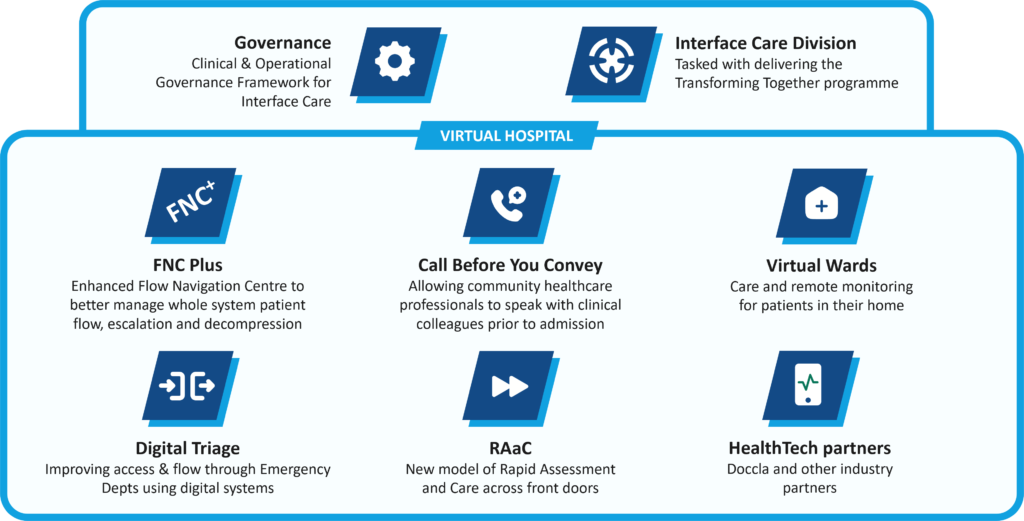
How will the Virtual Hospital work?
The new NHSGGC Virtual Hospital will provide safe, high-quality care to patients at home, reducing hospital stays and allowing patients to be cared for from the comfort of their own homes.
The Interface Division aims to reach 1,000 beds in the Virtual Hospital, relieving pressure on existing healthcare sites and supporting long-term condition management.
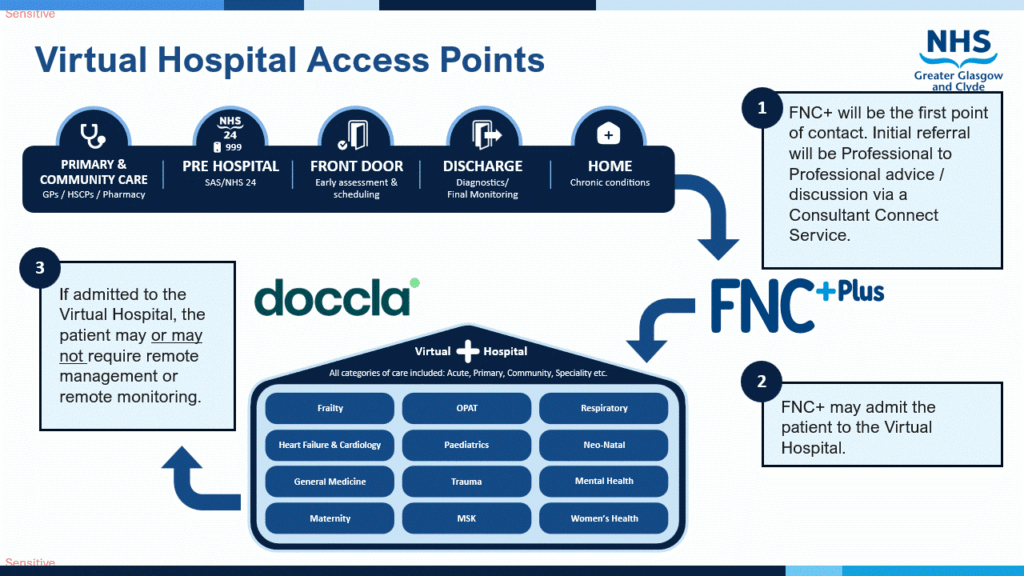
This Virtual Hospital is powered by remote monitoring – where patients will receive equipment from our technology partner Doccla that can keep tabs on health metrics like blood pressure, heart rate, and oxygen saturation. Doccla will also provide clinical support capacity, working closely with NHSGGC clinical specialists and the FNC+ (Flow Navigation Centre Plus) to support realistic medicine, giving patients the choice to be treated in their own homes.
Suitable patients will be admitted to the Virtual Hospital through pathways such as the FNC+ and digital triage.
What is the Flow Navigation Centre Plus (FNC+)?
The FNC+ is an enhanced version of the Flow Navigation Centre, offering additional clinical capabilities and support for managing our patient through our health and care system, all powered by technology and innovation.
It is effectively the ‘central spine’ to manage a sustainable, consistent health and care through our whole system.
You can expect clinical, professional and administration specialists working within the dedicated FNC+ contact centre to act as a true command and control, supporting services by directly providing virtual care and ensuring patients move more easily and quickly to the best point of care.
Although the FNC+ is based at QEUH, it will act as the central hub to manage patient flow throughout our whole NHSGGC system. It will develop more proactive pathways and better use of our resources, reducing strain on acute sites.
What are Rapid Assessment and Care (RAac) Units?
Rapid Assessment and Care (RAaC) units will manage selected urgent presentations through rapid clinical pathways. This means safe and effective assessment of patients presenting with specific urgent conditions and providing timely diagnostics, clinical review, and short-term management.
These units will be implemented in addition to ED and MIU departments, with the aim of:
- supporting early senior decision-making
- increasing access to same day urgent care through expansion of ambulatory care pathways and access to dedicated diagnostics
- improving patient experience and outcomes (especially for COPD and Cardiology patients)
- improving flow and waiting times for ED
- reducing length of stay for patients who do not require admission
- avoiding unnecessary ED attendances and admissions, and reducing readmissions
What is Digital Triage?
Digital triage, often branded as eTriage, is a digital check-in and triage system where patients go to a kiosk on arrival at ED and answer a series of questions on a tablet about their condition. The information is immediately available to staff working in ED and is automatically categorised for risk.
This gives staff more information on patient cases, faster, enabling staff to identify critical conditions within minutes of patient arrival and support decision making in prioritising patients.
This tool will support staff working in emergency departments to deliver the right care, in the right place, at the right time.
Glossary Of Terms
Call Before You Convey (CBYC)
Call Before You Convey or CBYC allows ambulance services to contact urgent care providers and community care teams prior to admitting a patient. This initiative enables clinicians to work together to find the optimum pathway for their patient.
This can help to prevent unnecessary hospital admissions, improve patient outcomes, and reduce pressure on acute sites.
Care Home Navigation Pathways
Care Home Pathways enables care home staff/community health care staff in the out of hours period to access professional triage, clinical advice, and support. There are pathways for residents who have fallen, deteriorating or require care when dying. Interface will build on these pathways.
Consultant Connect
Consultant Connect is a telemedicine provider that connects professionals digitally to ensure efficient collaboration.
Digital Triage / eTriage
Digital triage, often branded as eTriage, is a digital check-in and triage system where patients go to a kiosk on arrival at ED and answer a series of questions on a tablet about their condition. The information is immediately available to staff working in ED and is automatically categorised for risk.
This gives staff more information on patient cases, faster, enabling staff to identify critical conditions within minutes of patient arrival and support decision making in prioritising patients.
This tool will support staff working in emergency departments to deliver the right care, in the right place, at the right time.
Doccla (Virtual Ward HealthTech Partner)
Doccla is a technology company that partners with NHSGGC for remote monitoring services. Doccla supplies the remote monitoring devices, software platform, and technical support needed to operate the Virtual Hospital.
Doccla also provides clinical support, with their own clinicians monitoring patients in real time to ease the workload of NHSGGC colleagues, only escalating as and when necessary.
Flow Navigation Centre Plus (FNC+)
The FNC+ is an enhanced version of the Flow Navigation Centre, offering additional clinical capabilities and support for managing our patient through our health and care system, all powered by technology and innovation.
It is effectively the ‘central spine’ to manage a sustainable, consistent health and care through our whole system.
You can expect clinical, professional and administration specialists working within the dedicated FNC+ contact centre to act as a true command and control, supporting services by directly providing virtual care and ensuring patients move more easily and quickly to the best point of care.
Hospital @ Home
Hospital at Home provides acute urgent short-term hospital level care at home. This may range from 1 day to several weeks which would otherwise be spent in hospital. With Hospital at Home, care is provided by specialist doctors, nurses, and other healthcare professionals in a patient’s home or place of residence.
Interface Division
The Interface Division is tasked with developing and implementing new services such as the Virtual Hospital, Flow Navigation Centre Plus (FNC+), and remote monitoring.
The team’s aim is to drive transformation, innovation, and improvement across the Board from acute sites to primary and community care. Through collaboration, communication, and new technologies, the team will be key in improving care for patients and experience for staff.
Professional to Professional Pathways
Professional to Professional pathways enable clinicians to contact one another directly for advice, triage, or shared decision making. The Interface Division will build on those existing pathways to support rapid digitally enabled conversations between professionals across the health and care system, supporting people with urgent and unscheduled care needs to get the right care in the right place.
Rapid Assessment and Care (RAaC) units
Rapid Assessment and Care (RAaC) units will manage selected urgent presentations through rapid clinical pathways. This means safe and effective assessment of patients presenting with specific urgent conditions and providing timely diagnostics, clinical review, and short-term management.
These units will be implemented in addition to ED and MIU departments, with the aim of:
- increasing access to same day urgent care through expansion of ambulatory care pathways and access to dedicated diagnostics
- improving patient experience and outcomes (especially for COPD and Cardiology patients)
- improving flow and waiting times for ED
- reducing length of stay for patients who do not require admission
- avoiding unnecessary ED attendances and admissions, and reducing readmissions
- supporting early senior decision-making.
Remote Monitoring
Remote Monitoring refers to the use of digital technologies to track a patient’s vital signs outside of traditional health and care settings.
When staff decide that a patient can be safely monitored remotely, our healthcare technology
partner Doccla sends a box to the patient containing wearable sensors and home-use medical devices to collect patient data and monitor them from home.
These devices can monitor vital signs like blood pressure, heart rate, oxygen levels, and glucose levels. The collected data is then transmitted to healthcare providers for continuous monitoring.
This kit links up to a mobile phone, also provided in the box, where patients can easily track their vitals and be contacted by a clinician if their readings go outside of safe levels.
Doccla also provides clinical support, with their own clinicians monitoring patients in real time to ease the workload of NHSGGC colleagues, only escalating cases as and when necessary.
This enables us to detect deterioration early, support self-management, and intervene before problems escalate.
Virtual Hospital
The new NHSGGC Virtual Hospital will provide safe, high-quality care to patients at home, reducing hospital stays and allowing patients to be cared for from the comfort of their own homes.
The Virtual Hospital will contain many specialist virtual wards ranging from patients being remotely monitored while waiting on diagnostic tests to patients receiving specialist care and treatment within their own home.
The Interface Division aims to reach 1,000 beds in the Virtual Hospital by July 2026, relieving pressure on existing healthcare sites and supporting long-term condition management.
Ask the Interface Division anything
Still unsure? Send your question to the Interface Division using the online form below.